
New Egypt life insurance regulations require insurers to obtain credit checks for applicants seeking individual life insurance policies worth EGP 10 million or more. Introduced by the Financial Regulatory Authority (FRA), the measures strengthen life insurance underwriting, improve fraud detection and enhance policyholder protection across the Egyptian insurance sector.
Key Overview
- FRA introduced new underwriting rules.
- Credit checks become mandatory.
- Rules apply to EGP 10 million policies.
- Insurers receive a three-month transition period.
- Fraud reporting requirements strengthened.
- Policyholder verification expanded.
- Risk management standards updated.
- Insurance compliance enhanced.
Egypt Life Insurance Rules Mandate Credit Checks for High-Value Policies
Egypt’s life insurance industry is set to operate under stricter underwriting requirements after the Financial Regulatory Authority (FRA) introduced mandatory credit checks for applicants seeking high-value individual life insurance policies. The new regulations require insurers to obtain credit reports for customers applying for policies worth EGP 10 million or more, or the equivalent value in foreign currency, as part of broader efforts to strengthen risk management, reduce fraud and improve policyholder protection.
The reforms form part of the FRA’s ongoing implementation of Egypt’s Unified Insurance Law and represent another significant step towards modernising the country’s insurance industry. By strengthening underwriting procedures and enhancing applicant verification, the regulator aims to improve the long-term stability of the Egyptian insurance sector while promoting greater confidence among insurers and policyholders.
FRA Introduces New Risk Management Standards
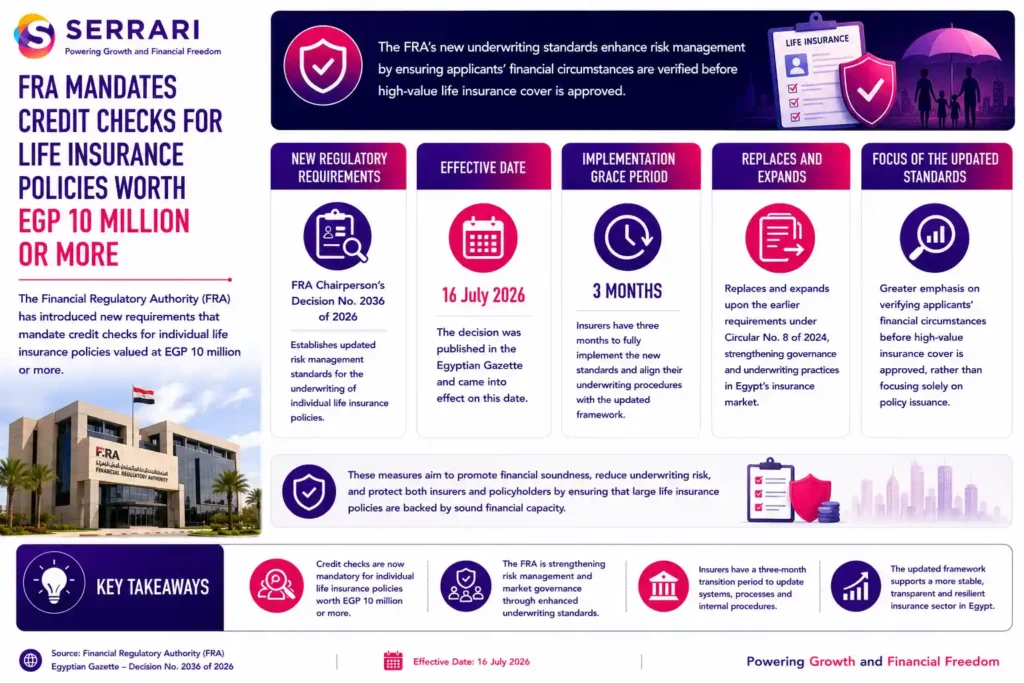
The new requirements are contained in FRA Chairperson’s Decision No. 2036 of 2026, which establishes updated risk management standards governing the underwriting of individual life insurance policies.
Published in the Egyptian Gazette, the decision officially came into effect on 16 July 2026, although insurers have been granted a three-month grace period to fully implement the new standards and align their internal underwriting procedures with the updated regulatory framework.
The decision replaces and expands upon the earlier requirements introduced under Circular No. 8 of 2024, reflecting the regulator’s continuing efforts to strengthen governance and improve underwriting practices across Egypt’s insurance market.
Rather than focusing solely on policy issuance, the updated standards place greater emphasis on verifying applicants’ financial circumstances before high-value insurance cover is approved.
Context is everything. Stay ahead of shifting trends with today’s market updates, and uncover emerging opportunities using the Serrari Group Market Index and Marketplace. Then, take control of your own financial future by exploring our Money & Life Reset Transformation Blueprint ™ to build stronger habits, create better systems, and design a path toward lasting wealth.
Credit Checks Become Mandatory for High-Value Policies
One of the most significant changes introduced by the new regulations is the mandatory use of credit reports during the underwriting process for high-value life insurance applications.
Under the new rules, every applicant seeking an individual life insurance policy valued at EGP 10 million or more must undergo a credit assessment conducted through a licensed credit information provider.
The requirement is intended to help insurers better evaluate financial risk while ensuring that the size of the requested insurance cover aligns with an applicant’s financial profile.
Beyond the mandatory threshold, insurers must also obtain credit reports whenever an applicant’s declared income, profession, occupation or premium payments appear inconsistent with the value of the requested policy. Credit checks are also required whenever insurers have concerns regarding the legitimacy of an application or suspect unusual activity during the underwriting process.
The expanded use of financial verification is expected to strengthen policyholder verification while improving the overall quality of underwriting decisions.
Strengthening Life Insurance Underwriting
Effective life insurance underwriting relies on accurately assessing both the financial and insurance risks associated with each applicant.
The FRA believes that incorporating credit reports into the underwriting process provides insurers with additional information that can help identify inconsistencies, assess financial capacity and detect potentially fraudulent applications before policies are issued.
By requiring insurers to verify applicants’ financial profiles against the level of insurance requested, the regulator aims to reduce situations where coverage amounts significantly exceed an individual’s apparent financial circumstances.
The enhanced standards are expected to improve underwriting accuracy while supporting more sustainable pricing and risk management across the industry.
New Rules Target Insurance Fraud
Reducing insurance fraud forms another major objective of the updated regulations.
According to FRA Chairman Islam Azzam, stronger verification procedures will enable insurers to identify suspicious applications more effectively while reducing fraudulent claims and financial crime within the sector.
The new framework also requires insurance companies to report suspected fraud cases to the Financial Regulatory Authority immediately whenever irregularities are identified during underwriting or policy administration.
The regulator believes that earlier detection and mandatory reporting will strengthen cooperation between insurers and regulators while protecting legitimate policyholders from the financial impact of fraudulent activity.
Improved fraud detection also contributes to maintaining confidence in Egypt’s growing insurance market by ensuring policies are issued based on accurate and verified information.
Supporting Egypt’s Insurance Sector Development
The updated standards are closely aligned with the objectives of Unified Insurance Law No. 155 of 2024, which seeks to modernise Egypt’s insurance industry and improve its contribution to national economic development.
The FRA has emphasised that stronger underwriting standards should not only reduce risk but also encourage insurers to develop more innovative insurance products while maintaining sound risk management practices.
Improved governance and more consistent underwriting standards are expected to increase confidence among both domestic and international market participants, supporting the long-term growth of the Egyptian insurance sector.
By strengthening regulatory oversight, the FRA also hopes to create a more competitive market where insurers compete through better products, improved customer service and stronger financial management rather than aggressive underwriting practices.
Compliance Period Gives Insurers Time to Adapt
Recognising that insurers will need to adjust their operational processes, the FRA has provided a three-month transition period before full compliance becomes mandatory.
During this period, insurance companies are expected to update their underwriting procedures, integrate licensed credit information providers into their application processes and train underwriting teams on the new regulatory requirements.
Many insurers may also need to revise internal risk assessment models, documentation procedures and compliance systems to ensure all applications falling within the new requirements are processed appropriately.
The transition period aims to ensure implementation occurs smoothly without disrupting policy issuance or customer service.
Outlook for Egypt Life Insurance
The introduction of mandatory credit checks represents one of the most significant recent developments in Egypt life insurance regulation. By strengthening applicant verification, improving insurance compliance and enhancing underwriting standards, the FRA is seeking to build a more resilient and transparent insurance market.
While insurers may initially face additional administrative requirements, the reforms are expected to improve underwriting quality, reduce fraud and increase confidence across the sector over the long term. As Egypt continues implementing the Unified Insurance Law, further regulatory developments are likely to focus on promoting innovation, strengthening governance and supporting sustainable growth within the country’s insurance industry.
FAQs
Why has Egypt introduced mandatory credit checks for life insurance?
The Financial Regulatory Authority introduced mandatory credit checks to improve underwriting decisions, reduce insurance fraud and strengthen policyholder protection. Credit reports help insurers verify whether an applicant’s financial profile is consistent with the level of insurance coverage being requested, reducing the likelihood of fraudulent or high-risk policies being issued.
Which life insurance policies require credit checks?
The new regulations apply to individual life insurance policies worth EGP 10 million or more, including equivalent values in foreign currencies. Insurers must also obtain credit reports for lower-value policies whenever an applicant’s income, occupation, premiums or requested coverage appears inconsistent or raises concerns about the legitimacy of the application.
When do the new Egypt life insurance regulations take effect?
The regulations became effective on 16 July 2026 following publication in the Egyptian Gazette. However, the FRA has granted insurance companies a three-month grace period to implement the new underwriting standards and ensure full compliance with the updated requirements.
How will the new rules affect Egypt’s insurance industry?
The regulations are expected to improve underwriting quality, strengthen fraud prevention and increase confidence in Egypt’s insurance market. By requiring more thorough applicant verification and enhancing compliance standards, the FRA aims to support a more transparent, competitive and sustainable insurance sector while encouraging innovation under the Unified Insurance Law.
Sources: Daily News Egypt, State Information Service Egypt, Enterprise AM
Your financial future isn’t something you wait for—it’s something you build.
The real question is: when do you begin?
Move beyond simply staying informed.
Navigate the markets with clarity—track trends through the Serrari Group Market Index, uncover opportunities in the Serrari Marketplace, and build practical knowledge with our Curated Wealth Builder Platform.
Stay connected to what truly matters.
Get daily insights on macro trends and financial movements across Kenya, Africa, and global markets—delivered through the Serrari Newsletter.
Growth opens doors.
Advance your career through professional programs including ACCA, HESI A2, ATI TEAS 7 , HESI EXIT , NCLEX – RN and NCLEX – PN, Financial Literacy!🌟—designed to move you forward with confidence.
See where money is flowing—clearly and in real time.
Track Money Market Funds, Treasury Bills, Treasury Bonds, Green Bonds, and Fixed Deposits, alongside global and African indexes, key economic indicators, and the evolving Crypto and stablecoin landscape—all within Serrari’s Market Index.