





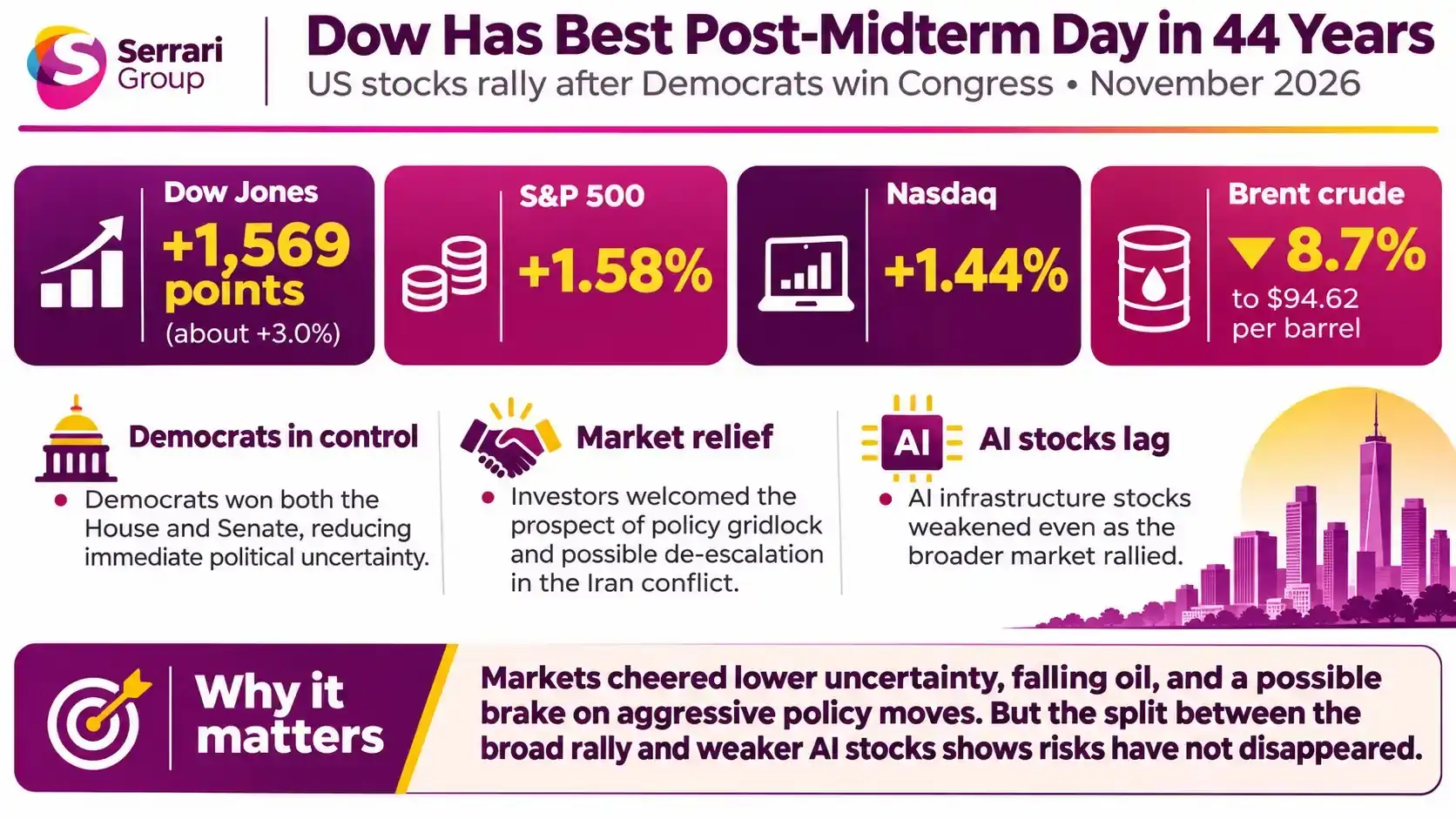
Wall Street rallied sharply on November 4, 2026, after Democrats captured both chambers of Congress in the US midterm elections, ending Republican control of the legislature and confronting President Donald Trump with a divided government. The Dow Jones Industrial Average gained 1,569.40 points, or 3.03%, to close at 53,356.12, its strongest session since April 2025 and its biggest single-day gain immediately following a midterm election in 44 years. The S&P 500 rose 1.58%, while the Nasdaq Composite gained 1.44%.
The rally was not simply an endorsement of one political party. Investors saw a decisive electoral outcome that reduced uncertainty, a potential legislative brake on abrupt policy changes, and a sharp drop in oil prices as markets reassessed the prospects for the US war with Iran. Yet the gains masked a significant divide: energy and AI data-center businesses came under pressure even as consumer-facing companies and other rate-sensitive shares benefited. That split reveals why the election’s lasting market impact will depend less on the immediate vote count than on what Washington does next.
Key Overview
- Historic Dow advance: The index climbed 1,569.40 points, or 3.03%, to 53,356.12 on November 4, the largest post-midterm single-session increase since 1982.
- Congress changes hands: Democrats secured control of both the House and Senate, increasing scrutiny of Trump’s policies while leaving the president’s veto and executive powers intact.
- Oil provides a second catalyst: Brent crude fell roughly 8.7% to $94.62 a barrel as traders priced in a possible reduction in the Iran conflict, although escalation remains a risk.
- Borrowing expectations shift: Treasury yields declined as investors considered whether divided government could restrain fresh fiscal stimulus and federal borrowing.
- AI stocks diverge: Nvidia declined about 3%, while CoreWeave and other data-center-linked companies fell more sharply amid fears of construction restrictions and regulatory scrutiny.
- The bigger question: Whether the rally lasts will depend on energy prices, fiscal negotiations, corporate earnings, interest rates and the direction of AI investment.
Why a Democratic Sweep Sent Stocks Higher
The immediate driver of Wednesday’s rally was the removal of a major political unknown. Democrats secured majorities in both chambers of Congress, meaning investors no longer had to price an array of plausible election outcomes. The result was decisive enough to reduce the risk of prolonged uncertainty over which party would control the legislative agenda.
That certainty matters because financial markets price expected future conditions, not merely the political preferences of investors. Businesses planning investments, investors buying government bonds and companies assessing future tax rules all need some sense of how policy may evolve. A clear result can reduce the premium investors demand for bearing political risk, even when the winning party intends to challenge the president.
The Dow’s 3.03% rise was exceptional by post-election standards. The broader S&P 500 closed at 7,688.62 and the Nasdaq Composite at 25,736.51. These moves were too broad to be explained solely by one industry or one company. They instead reflected a reassessment of risks across stocks, bonds and commodities.
There was also an important element of relief. Markets had spent months weighing a combination of geopolitical uncertainty, expensive energy, rising government debt and stretched expectations for artificial intelligence. An election that appeared to limit some future policy extremes offered investors a reason to reduce defensive positions. The volatility index, or VIX, fell sharply, underscoring the decline in anticipated short-term market turbulence.
But the rally should not be read as a forecast that divided government automatically produces economic growth. Investors were responding to a change in the balance of risks. Whether the new balance proves beneficial will only become clear as legislative negotiations, budget decisions and international developments unfold.
The Iran War and Oil Collapse: Why Energy Mattered So Much
A second, and arguably more immediate, catalyst was the sharp decline in crude oil. Brent settled at $94.62 a barrel after an approximately 8.7% fall, its lowest settlement in about two months. The move followed speculation that the electoral backlash against the war with Iran could increase pressure on the Trump administration to pursue de-escalation.
The political connection is straightforward. High energy prices affect household fuel bills, transport costs, manufacturers’ margins and inflation expectations. A war that threatens oil supply can therefore influence voter sentiment as well as corporate profitability. Following the election, Vice President JD Vance linked the Republican defeat to the conflict, encouraging traders to consider whether domestic political costs might alter Washington’s approach.
Lower oil prices can support equities in several ways. Airlines, logistics operators and retailers may face reduced costs. Households may have more disposable income after paying for transport and energy. If the decline persists, inflationary pressure could ease, potentially giving the Federal Reserve more flexibility on interest rates. Investors consequently viewed the oil selloff as a potential improvement in both the growth and inflation outlook.
However, falling oil prices do not prove that the war is ending. The market response represents an expectation, not a confirmed diplomatic outcome. Energy analysts have warned that military escalation remains possible, and renewed supply disruptions could reverse the decline rapidly. That distinction is central to understanding Wednesday’s gains: part of the rally rests on a geopolitical scenario that has not yet materialized.
The benefits were also uneven. Lower crude prices can hurt energy producers’ expected revenues while improving margins in fuel-consuming sectors. For oil-importing economies, including Kenya, a sustained reduction in global prices could eventually ease imported inflation and external financing pressure, although domestic pump prices depend on exchange rates, taxes, regulated pricing cycles and distribution costs. The global market reaction therefore matters well beyond US stock portfolios.
Divided Government: A Brake on Spending, but Not on Every Policy
With Democrats gaining control of Congress, Trump’s administration faces a more difficult path for passing legislation on taxation, spending and other major domestic priorities. Investors interpreted the new balance of power as a possible restraint on additional fiscal expansion, which in turn could reduce concerns about the future path of federal borrowing.
The decline in Treasury yields reflected this thinking. Bond prices and yields generally move in opposite directions; when investors buy Treasuries, yields tend to fall. Lower government yields may improve the relative attractiveness of equities and ease borrowing conditions across parts of the economy. That offers a plausible explanation for why a political outcome widely viewed as a setback for the president nevertheless supported the stock market.
Yet divided government is not the same as fiscal discipline. A Congress controlled by the opposition may block some new tax cuts or spending proposals, but it can also struggle to agree on appropriations and debt-related measures. Deadlock can heighten the risk of budget standoffs, delayed decisions and government shutdowns. It may constrain fresh stimulus without quickly resolving the existing deficit or accumulated debt.
Nor does Congress control every decision that moves markets. The president retains veto powers and substantial influence over executive actions and foreign policy. The shift toward congressional resistance makes oversight and legislative bargaining more consequential, but it does not guarantee a reversal of the administration’s agenda. Investors will therefore need to distinguish measures that require new laws from actions the executive branch can still pursue independently.
The immediate reduction in political risk may be real, but the longer-term trajectory could include more confrontation. Businesses will watch whether cooperation emerges on essential spending bills and whether the new Congress seeks to change tax incentives, healthcare arrangements or industrial policy. The critical issue is whether divided government produces predictable compromise or repeated fiscal brinkmanship.
Context is everything. Stay ahead of shifting trends with today’s market updates, and uncover emerging opportunities using the Serrari Group Market Index and Marketplace. Then, take control of your own financial future by exploring our Money & Life Reset Transformation Blueprint ™ to build stronger habits, create better systems, and design a path toward lasting wealth.
Why AI Infrastructure Stocks Fell During a Broad Rally
The most striking contradiction of the session was the weakness in stocks tied to building and operating artificial intelligence infrastructure. Nvidia slipped about 3%, while CoreWeave lost roughly 10%, and Nebius fell around 6.7%. Those moves showed that investors separated the broader economic implications of the election from the risks facing one of the market’s most heavily funded growth themes.
AI data centers require large amounts of electricity, land, water, capital and grid capacity. As construction accelerated, communities raised concerns about utility bills, environmental effects, local infrastructure and the incentives offered to developers. The election amplified those issues because Democratic victories included states important to the industry’s expansion, such as Texas and Georgia.
The prospect of tighter scrutiny of data-center development matters directly to valuations. Many companies in the sector are priced on expectations of rapid capacity growth. If permitting takes longer, projects are delayed or tax advantages change, projected revenue can move further into the future while borrowing and construction expenses continue. Even without a nationwide ban, uncertainty over state and local approvals can make ambitious investment schedules less credible.
The selloff also highlights differences within the AI industry. Established technology companies with diversified operations and existing data-center networks may be better positioned to absorb regulatory delays. More specialized infrastructure providers, including firms that rent computing capacity, can be more exposed to debt-financed expansion, new site approvals and assumptions about future utilization.
The weakness in data-center operators is therefore about more than partisan politics. It reflects a growing question over whether the pace of AI infrastructure spending is economically and politically sustainable. Demand for AI computing may remain strong, but rising public opposition, energy constraints and expensive capital could alter which companies capture the benefits.
For investors, this distinction is essential. A broad rally in US equities does not mean every major growth theme is strengthening. Wednesday’s sector divergence suggested a rotation toward businesses perceived as benefiting from cheaper energy and a more predictable macroeconomic environment, and away from those facing greater construction or policy risk.
Winners, Losers and the Implications for Households
Consumer-oriented and interest-rate-sensitive businesses were among the potential beneficiaries of the market’s repricing. Cheaper oil can improve the outlook for transport-dependent companies, while falling Treasury yields may support housing and other borrowing-sensitive activities. Reports of broad gains outside energy and selected industrial shares illustrated how markets favored companies likely to benefit from lower input costs and diminished policy uncertainty.
Clean-energy companies also attracted interest as investors considered whether the new political environment might offer more support for renewable development. At the same time, oil producers and some defense-related businesses faced pressure as traders contemplated a different path for energy prices and the Iran conflict. These are market expectations rather than established changes to government policy.
For ordinary households, the impact depends on whether financial-market changes persist and reach the real economy. A sustained reduction in oil prices could influence fuel and goods prices. Lower bond yields could eventually feed into borrowing conditions, although consumer loan rates do not mechanically match Treasury yields. Retirement accounts and diversified equity portfolios may benefit from rising share prices, but people with concentrated technology holdings could experience a very different outcome.
The election could also affect healthcare, public benefits and federal spending priorities through future legislation. However, no immediate market rally can determine how those policies will ultimately be written or funded. The outcome of negotiations matters more than campaign expectations.
Internationally, shifts in US yields, the dollar and oil prices can transmit quickly to emerging markets. Lower US yields may ease some pressure on countries that borrow in dollars, while declining crude prices can reduce import costs for energy-dependent economies. Those benefits may be offset if renewed geopolitical instability drives investors back toward safe assets or raises global risk premiums.
What Investors Should Watch After the Historic Gain
The crucial test is whether the repricing triggered by the election is supported by subsequent events. Three developments will be particularly important: whether the Iran conflict genuinely de-escalates, whether Congress and the White House can reach workable fiscal agreements, and whether AI infrastructure investment remains viable under greater political scrutiny.
The first will influence energy markets and inflation expectations. The second will shape fiscal uncertainty and government borrowing costs. The third will determine whether the companies that powered much of the AI investment cycle can continue expanding at a pace that supports their valuations.
Corporate earnings and Federal Reserve policy remain important independent forces. A single powerful trading session can reset sentiment, but it cannot eliminate the effects of profitability, financing costs or economic growth. Historical comparisons with previous midterm rallies offer context, not a dependable prediction of future returns.
The larger significance of November 4 is that Wall Street rewarded reduced uncertainty while simultaneously repricing risks that the election may intensify. The Dow’s extraordinary gain showed investors’ willingness to embrace a new political balance, but the selloff in AI infrastructure and the sharp fall in oil revealed a market still highly sensitive to policy and geopolitical outcomes. The election may prove a turning point in the direction of US fiscal debate and AI development. Whether it marks the beginning of a durable market advance will depend on decisions made after the ballots were counted, not on the celebration that followed them.
Sources: Associated Press / Reuters / CNN / Ballotpedia / NPR / MT Newswires / Quartz / Dow Jones Newswires
Your financial future isn’t something you wait for—it’s something you build.
The real question is: when do you begin?
Move beyond simply staying informed.
Navigate the markets with clarity—track trends through the Serrari Group Market Index, uncover opportunities in the Serrari Marketplace, and build practical knowledge with our Curated Wealth Builder Platform.
Stay connected to what truly matters.
Get daily insights on macro trends and financial movements across Kenya, Africa, and global markets—delivered through the Serrari Newsletter.
Growth opens doors.
Advance your career through professional programs including ACCA, HESI A2, ATI TEAS 7 , HESI EXIT , NCLEX – RN and NCLEX – PN, Financial Literacy!🌟—designed to move you forward with confidence.
See where money is flowing—clearly and in real time.
Track Money Market Funds, Treasury Bills, Treasury Bonds, Green Bonds, and Fixed Deposits, alongside global and African indexes, key economic indicators, and the evolving Crypto and stablecoin landscape—all within Serrari’s Market Index.