Circle Q2 USDC results show that growing stablecoin adoption does not always produce equally strong revenue growth. USDC circulation ended the second quarter of 2026 at $73.3 billion, while on-chain transaction volume increased by 151% to $14.8 trillion.
However, Circle’s reserve-return rate declined by 66 basis points to approximately 3.5%. This limited reserve-income growth to 5%, even though average USDC circulation increased by 25%.
Circle returned to profitability with $48 million in net income. However, the improvement was also supported by lower stock-based compensation following its 2025 initial public offering. The results show that Circle remains highly sensitive to short-term interest rates because most of its income comes from the reserves supporting USDC.
Key Overview
- Circle reported $701 million in total revenue and reserve income.
- Net income reached $48 million, compared with a $482 million loss in Q2 2025.
- USDC circulation ended the quarter at $73.3 billion.
- USDC on-chain transaction volume increased by 151% to $14.8 trillion.
- Average USDC circulation increased by approximately 25%.
- Circle’s reserve-return rate fell by 66 basis points to 3.5%.
- Reserve income increased by only 5% to $668 million.
- Circle Payments Network reached $14.7 billion in annualised transaction volume.
- The network had enrolled 175 financial institutions by the end of the quarter.
Circle Q2 USDC Results Expose Reserve-Rate Pressure
Circle Internet Group returned to quarterly profitability during the second quarter of 2026 as USDC circulation, transaction activity and institutional adoption continued to grow.
According to Circle’s official second-quarter earnings release, the stablecoin company generated $701 million in total revenue and reserve income during the quarter, representing growth of 7% from the same period in 2025.
Circle also recorded $48 million in net income and $143 million in adjusted earnings before interest, taxes, depreciation and amortisation.
However, the results exposed one of the most important features of Circle’s business model: its earnings remain strongly influenced by short-term interest rates.
USDC Circulation Continues to Grow
USDC circulation ended the quarter at $73.3 billion, representing growth of 19% from the previous year.
Average USDC circulation during the quarter reached approximately $76.5 billion, increasing by 25% year over year, according to Business Wire’s full financial announcement.
Activity across the USDC network expanded even faster.
On-chain transaction volume reached $14.8 trillion during the quarter, increasing by 151% from the previous year. The number of wallets holding more than $10 in USDC increased by 24% to approximately seven million.
These figures show that USDC is being used more widely for payments, trading, settlement and transfers across blockchain networks.
However, Circle’s revenue did not grow at the same rate as USDC transaction activity.
How Circle Makes Money From USDC
When users exchange dollars for USDC, Circle places corresponding reserve assets in cash, short-term US Treasury securities and overnight Treasury repurchase agreements.
USDC remains redeemable at a one-to-one rate for US dollars. The majority of its reserves are held in the Circle Reserve Fund, an SEC-registered government money market fund managed by BlackRock.
According to Circle’s official reserve transparency disclosures, the fund can hold cash, short-dated US Treasury securities and overnight Treasury repurchase agreements with leading global banks.
The remainder of the reserves is mainly held as cash with large financial institutions.
These reserve assets earn interest, which Circle records as reserve income.
Ordinary USDC holders generally receive the digital dollar rather than the interest generated by the underlying reserves. That income accrues to Circle and its distribution partners.
Lower Reserve Yields Limit Growth
Circle generated $668 million in reserve income during the quarter, representing growth of only 5% from the previous year.
This occurred even though average USDC circulation increased by approximately 25%.
The difference was largely explained by a 66-basis-point decline in the company’s reserve-return rate, which fell to around 3.5%.
The official Circle financial-results summary shows why circulation growth alone does not determine the company’s earnings.
When Circle holds more USDC reserves, it has more interest-generating assets. However, when short-term Treasury yields decline, Circle earns less income from each dollar held in reserve.
Circle can therefore grow USDC circulation and transaction volumes while still experiencing slower revenue growth if interest rates continue falling.
Circle Remains Exposed to Interest Rates
Circle’s earnings model differs from that of a traditional payment-processing company that mainly earns fees each time a customer completes a transaction.
Most of Circle’s revenue comes from the interest earned on USDC reserves.
This means the company benefits when USDC circulation increases or when short-term interest rates rise.
However, lower Treasury yields can reduce Circle’s reserve income even when more people and institutions are using USDC.
The second-quarter results demonstrate this clearly:
- Average USDC circulation increased by 25%.
- The reserve-return rate declined by 66 basis points.
- Reserve income increased by only 5%.
- Total revenue and reserve income increased by 7%.
The central investor question is whether Circle can grow circulation, payments and service revenue quickly enough to offset lower short-term rates.
Context is everything. Stay ahead of shifting trends with today’s market updates, and uncover emerging opportunities using the Serrari Group Market Index and Marketplace. Then, take control of your own financial future by exploring our Money & Life Reset Transformation Blueprint ™ to build stronger habits, create better systems, and design a path toward lasting wealth.
Distribution Costs Remain Significant
Circle incurred $412 million in distribution, transaction and other costs during the quarter.
These costs increased by 1% and mainly reflected payments made to exchanges, platforms and other partners that help distribute USDC.
After deducting these expenses, Circle generated $289 million in revenue less distribution costs, representing growth of 15%. Its revenue-less-distribution-cost margin increased to 41%.
The company’s detailed operating-results tables show that USDC circulation is only one part of the earnings equation.
Investors must also consider how much reserve income Circle shares with distribution partners.
Greater USDC adoption can increase reserve income, but it can also increase payments to the companies that provide users with access to the stablecoin.
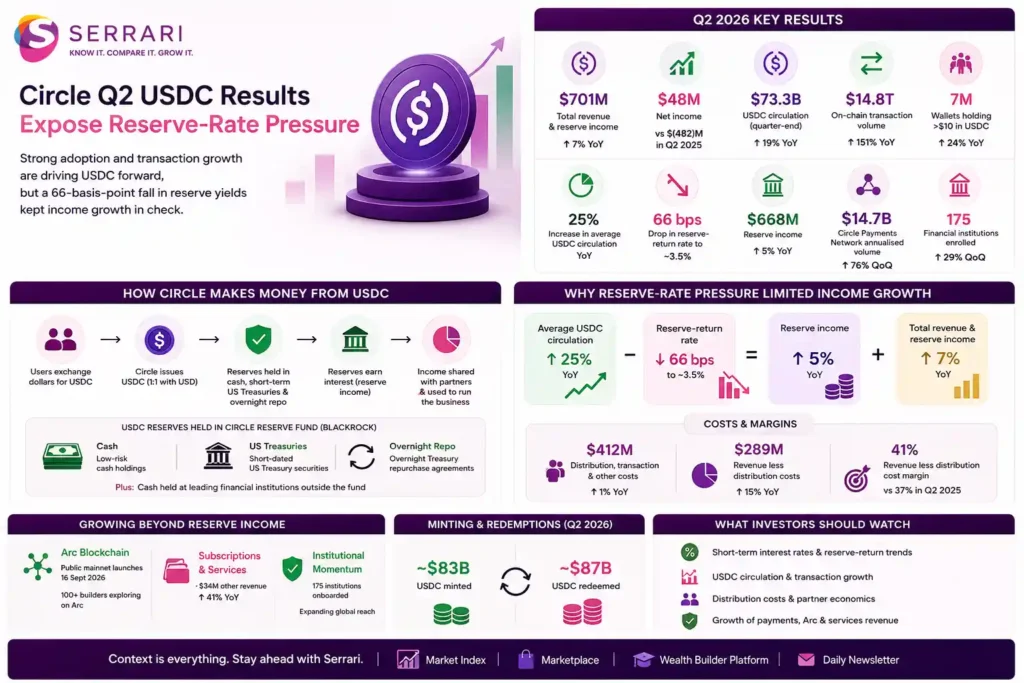
Circle’s second-quarter 2026 results explain how the company earns money from USDC. Users exchange dollars for USDC, while Circle places the supporting reserves in cash and short-term government securities. These assets generate reserve income, part of which is paid to distribution partners before operating and development costs are deducted.
The infographic highlights 19% growth in quarter-end USDC circulation, 25% growth in average circulation, a 66-basis-point decline in reserve yields, 5% growth in reserve income and 7% growth in total revenue. It shows that rising USDC adoption helped offset lower short-term interest rates but did not remove Circle’s exposure to changes in Treasury yields.
Return to Profit Needs Context
Circle’s $48 million quarterly profit represented a significant improvement from the $482 million loss recorded during the second quarter of 2025.
However, the comparison does not reflect only stronger underlying operations.
According to Circle’s official second-quarter 2025 results, the previous year’s loss included $424 million in stock-based compensation following the company’s initial public offering.
The earlier quarter also included a $167 million increase in the value of Circle’s convertible debt caused by an increase in its share price.
Together, these two non-cash items affected the 2025 results by approximately $591 million.
Circle’s return to profitability is therefore positive, but it should not be attributed entirely to stronger stablecoin economics.
Payments Could Reduce Rate Dependence
Circle generated $34 million in other revenue during the quarter, an increase of 41%, supported by growth in subscription and service revenue.
Although this remains small compared with reserve income, Circle is expanding products that could gradually make the company less dependent on interest rates.
Circle Payments Network reached $14.7 billion in annualised transaction volume at the end of the quarter, increasing by 76% from the previous quarter.
The network had enrolled 175 financial institutions, representing quarterly growth of 29%.
Circle also plans to launch the public mainnet of its Arc blockchain network on 16 September 2026.
More than 100 institutional and ecosystem developers were already building or exploring services on Arc, according to Circle’s latest business highlights.
Arc, Circle Payments Network and subscription services could become important sources of revenue. However, their ability to produce sustainable and recurring profits has not yet been fully demonstrated.
Minting and Redemptions Require Context
Approximately $83 billion of USDC was minted during the quarter, while around $87 billion was redeemed.
The higher redemption figure should not automatically be interpreted as declining confidence in USDC.
Minting and redemption figures represent gross movements throughout the quarter. Institutions regularly create and redeem stablecoins as they transfer money between banks, exchanges and blockchain networks.
The reported USDC platform activity figures show that Circle still ended the quarter with $73.3 billion in circulation, 19% more than a year earlier.
Circle estimated that USDC represented approximately 27% of the eligible fiat-backed stablecoin market at the end of the quarter.
What Investors Should Monitor
The main issue for investors is whether Circle can continue expanding USDC circulation quickly enough to compensate for declining reserve yields.
A further reduction in short-term interest rates could reduce the return generated by USDC reserves.
At the same time, stronger circulation, payment activity and service revenue could help offset that pressure.
Investors should also monitor distribution costs. Greater adoption can increase reserve income, but it can also increase the amount Circle pays to exchanges and other partners.
Circle’s SEC filings and corporate disclosures identify interest-rate movements, distribution arrangements, regulation, competition and stablecoin redemption risks as important factors affecting the business.
Arc, Circle Payments Network and other services could make Circle less dependent on reserve income over time. Until those businesses achieve greater scale, reserve income is likely to remain the main driver of the company’s financial performance.
Conclusion
Circle’s second-quarter results show a company benefiting from continued USDC adoption while remaining heavily exposed to the direction of short-term interest rates.
USDC circulation increased, transaction volume expanded and Circle returned to profitability.
However, reserve income increased by only 5% because the reserve-return rate declined by 66 basis points.
The central question is no longer simply whether USDC can grow. It is whether Circle can convert that growth into diversified revenue that remains strong when Treasury yields decline.
Its expanding payments network, institutional partnerships and Arc blockchain could provide additional income. Until those businesses reach greater scale, reserve income will likely remain the most important driver of Circle’s earnings.
FAQs
1. How does Circle earn money from USDC?
Circle earns most of its income from the assets held to support USDC. When USDC is issued, corresponding reserves are placed in cash, short-term US Treasury securities and overnight Treasury repurchase agreements. These assets earn interest, which Circle records as reserve income. Circle pays part of this income to distribution partners and uses the remainder to fund its operations, products and investments.
2. Why do falling interest rates affect Circle?
Falling interest rates reduce the return Circle earns from the cash and short-term government securities supporting USDC. In the second quarter of 2026, average USDC circulation increased by 25%, but Circle’s reserve-return rate declined by 66 basis points. As a result, reserve income increased by only 5%.
3. Why did Circle return to profit?
Circle reported $48 million in net income compared with a $482 million loss in the same quarter of 2025. Part of the improvement came from higher revenue and growing USDC circulation. However, the previous year’s loss also included large IPO-related stock-compensation expenses and changes in the value of convertible debt.
4. Is USDC protected like a bank deposit?
USDC is not an ordinary bank fixed deposit and does not generally receive the same deposit-insurance protection available to eligible bank deposits. Circle states that USDC is backed by highly liquid reserves and redeemable one-to-one for US dollars. However, digital assets remain exposed to operational, regulatory and market risks that differ from traditional insured bank accounts. Circle’s disclosures state that digital assets are not typically covered by deposit-protection insurance.
Sources: Circle, Circle Investor Relations, Business Wire, Circle Transparency and the US Securities and Exchange Commission.
Your financial future isn’t something you wait for—it’s something you build.
The real question is: when do you begin?
Move beyond simply staying informed.
Navigate the markets with clarity—track trends through the Serrari Group Market Index, uncover opportunities in the Serrari Marketplace, and build practical knowledge with our Curated Wealth Builder Platform.
Stay connected to what truly matters.
Get daily insights on macro trends and financial movements across Kenya, Africa, and global markets—delivered through the Serrari Newsletter.
Growth opens doors.
Advance your career through professional programs including ACCA, HESI A2, ATI TEAS 7 , HESI EXIT , NCLEX – RN and NCLEX – PN, Financial Literacy!🌟—designed to move you forward with confidence.
See where money is flowing—clearly and in real time.
Track Money Market Funds, Treasury Bills, Treasury Bonds, Green Bonds, and Fixed Deposits, alongside global and African indexes, key economic indicators, and the evolving Crypto and stablecoin landscape—all within Serrari’s Market Index.