













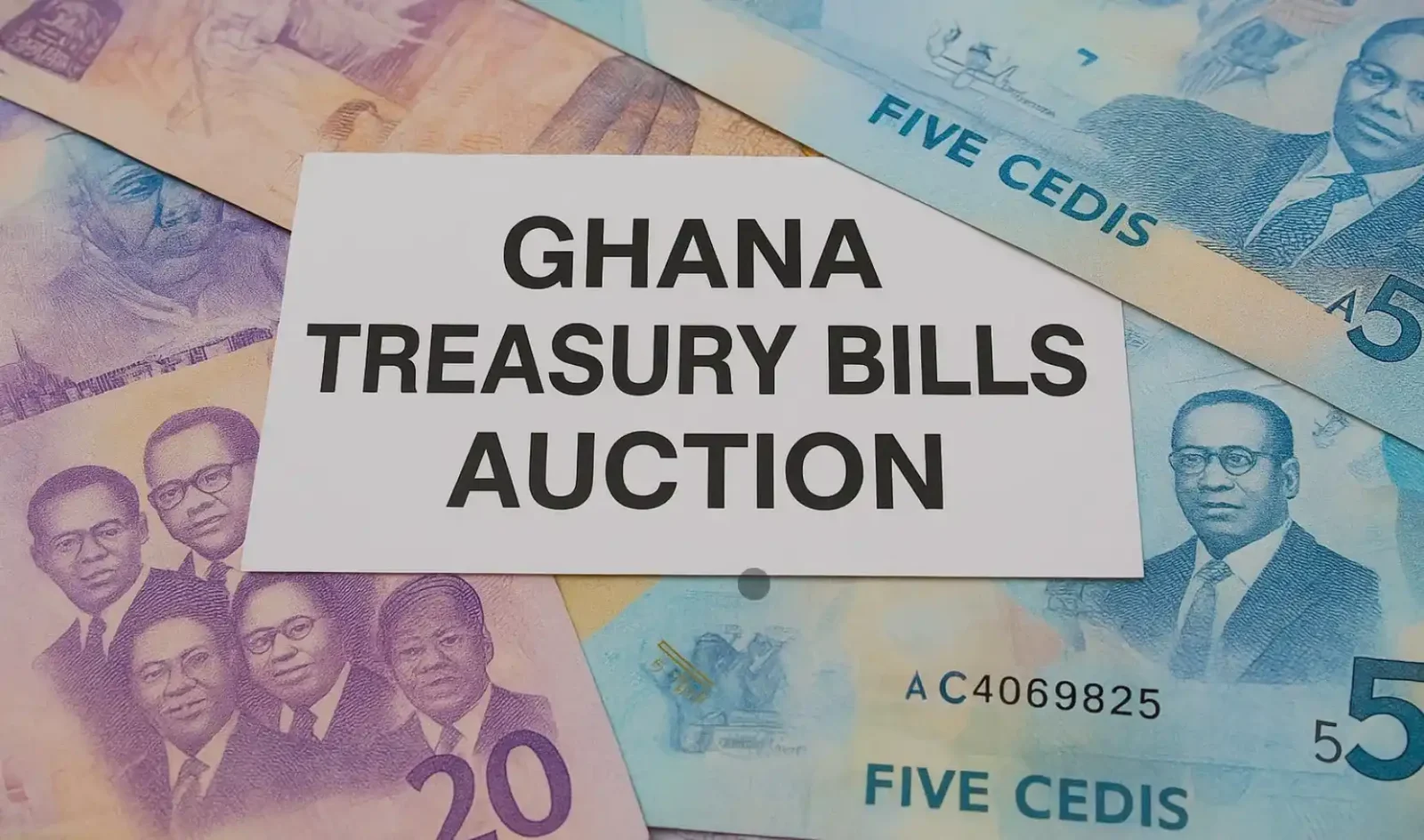
The latest Ghana Treasury bill auction attracted approximately GH¢10.5 billion in investor bids against a government target of GH¢5.866 billion. Demand was concentrated in the 364-day Treasury bill, which attracted approximately GH¢7.47 billion, or 71% of all bids submitted. The one-year bill offered a rate of 12.9821%, compared with 7.6409% for the 182-day bill and 5.7618% for the 91-day instrument.This created a 7.22-percentage-point difference between the longest and shortest available maturities. The steep maturity premium suggests that investors require considerably more compensation to lock their money away for one year. It also creates a practical choice between short-term liquidity and the opportunity to secure the current 364-day rate before market conditions change.
Key Overview
- Investors submitted approximately GH¢10.5 billion in bids.
- The government had targeted GH¢5.866 billion.
- Submitted bids were approximately 79% above the target.
- The government accepted approximately GH¢8.65 billion.
- The 364-day bill attracted around 71% of total bids.
- More than four-fifths of accepted funds went into the 364-day bill.
- The 91-day bill rate was 5.7618%.
- The 182-day bill rate was 7.6409%.
- The 364-day bill rate was 12.9821%.
- The maturity premium between the 364-day and 91-day bills was approximately 7.22 percentage points.
Ghana Treasury Bill Auction Draws GH¢10.5 Billion in Bids
Investors submitted approximately GH¢10.5 billion in bids during Ghana’s latest Treasury bill auction, nearly twice the government’s stated target of GH¢5.866 billion.
The government accepted approximately GH¢8.65 billion, which was around 47.5% more than the original target.
According to the latest Ghana Treasury bill report, the auction was approximately 79% oversubscribed when submitted bids were compared with the government’s target.
However, oversubscription does not mean that every bid was accepted.
The government accepted around 82% of all funds offered by investors, rejecting or reducing some bids based on the rates and amounts submitted.
Investors Preferred the 364-Day Bill
The 364-day Treasury bill attracted approximately GH¢7.47 billion in bids, representing around 71% of the total amount submitted.
The government accepted approximately GH¢7.17 billion to GH¢7.18 billion from this maturity.
This means the one-year bill accounted for more than four-fifths of the total funds accepted during the auction.
Demand for the shorter instruments was significantly lower.
The 91-day bill attracted approximately GH¢2.27 billion in bids, with around GH¢0.97 billion accepted.
The 182-day instrument received approximately GH¢757.9 million in bids, of which roughly GH¢501.4 million was accepted.
The current Ghana auction demand report described this as the government’s sixth consecutive oversubscribed Treasury bill auction, indicating continued institutional and retail demand for short-term government securities.
One-Year Rate Carries a Large Premium
The official Bank of Ghana tender results reported the following interest rates:
- 91-day Treasury bill: 5.7618%;
- 182-day Treasury bill: 7.6409%; and
- 364-day Treasury bill: 12.9821%.
The difference between the 364-day and 91-day rates was 7.2203 percentage points.
An investor was therefore offered substantially more annualised return for committing funds for one year rather than approximately three months.
The 364-day bill also offered 5.3412 percentage points more than the 182-day instrument.
This steep maturity structure shows that investment duration mattered almost as much as the decision to invest in Ghanaian Treasury bills.
Why the Yield Curve Is Steep
A steep Treasury bill yield curve means investors receive considerably higher rates for choosing longer maturities.
Several factors may explain the difference.
Investors may require additional compensation for locking their funds away for a longer period. Money placed in a 364-day bill cannot be freely used during that period unless the investor can sell or otherwise exit the position through an available secondary-market arrangement.
Inflation and fiscal conditions may also change over the coming year.
A 91-day investor has greater flexibility because the money becomes available sooner. The investor can decide whether to spend it, move it to another product or reinvest it at the prevailing market rate.
However, this flexibility creates reinvestment risk.
An investor who chooses the 91-day bill would need to reinvest approximately four times to maintain exposure for a full year. The rates available during the second, third and fourth investment periods are not known today.
If short-term rates fall, the investor may earn less than expected.
A 364-day investor avoids this immediate reinvestment risk by locking in the current rate for one year.
Treasury Bills Are Not Treasury Bonds
Treasury bills are short-term government money-market instruments rather than long-term bonds.
Ghana’s Ministry of Finance debt-management framework classifies 91-day, 182-day and 364-day Treasury bills as short-term government securities. Instruments with maturities of two years or more are treated as medium- or long-term government bonds.
Treasury bills are normally sold at a discount and redeemed at their full face value when they mature.
For example, an investor may pay less than GH¢1,000 today and receive GH¢1,000 at maturity.
The difference between the discounted purchase price and the maturity value represents the investor’s return.
The quoted 12.9821% rate should therefore not be interpreted as a coupon paid every month or quarter.
It is an annualised Treasury bill rate associated with the discounted security.
Liquidity Comes With a Lower Rate
The 91-day bill offered the lowest return but provided the earliest access to maturing funds.
This may suit investors who:
- Expect to need their money within a few months;
- Want to review market conditions regularly;
- Prefer to limit the period of government exposure;
- Anticipate that short-term interest rates could rise; or
- Need greater portfolio liquidity.
The 364-day instrument offered a much higher rate but required investors to remain committed for approximately one year.
This may suit investors who do not expect to need the funds during the holding period and prefer to secure the current rate rather than repeatedly reinvest in shorter bills.
Neither maturity is automatically better.
The appropriate choice depends on the investor’s cash-flow needs, expectations for future rates and ability to remain invested until maturity.
Inflation Comparison Looks Attractive but Is Not Guaranteed
Ghana’s annual inflation rate stood at 5.3% in June 2026, according to the Ghana Statistical Service inflation update.
The 364-day Treasury bill rate of 12.9821% was approximately 7.68 percentage points above that latest inflation figure.
This creates the appearance of a positive inflation-adjusted return.
However, the comparison is backward-looking.
June’s inflation rate measures the change in consumer prices over the previous year. It does not determine how prices will change during the 364-day bill’s actual holding period.
Inflation may rise, fall or remain stable before the bill matures.
Investors should therefore avoid treating the 7.68-percentage-point difference as a guaranteed real return.
The actual purchasing-power gain will depend on future inflation.
Policy Rate Remains Above T-Bill Yields
The Bank of Ghana retained its monetary policy rate at 14% following its July 2026 meeting.
The Bank of Ghana July policy decision came as inflation continued to moderate and the central bank assessed the sustainability of Ghana’s economic recovery.
The 364-day Treasury bill rate of 12.9821% remained approximately one percentage point below the policy rate.
The shorter Treasury bill rates were considerably lower.
The central bank’s published indicators showed a 14% policy rate and June inflation of 5.3%.
Treasury bill rates do not have to match the policy rate directly.
They reflect the interaction between government borrowing needs, investor demand, liquidity conditions, inflation expectations and the rates investors submit during the auction.
Context is everything. Stay ahead of shifting trends with today’s market updates, and uncover emerging opportunities using the Serrari Group Market Index and Marketplace. Then, take control of your own financial future by exploring our Money & Life Reset Transformation Blueprint ™ to build stronger habits, create better systems, and design a path toward lasting wealth.
Heavy Demand Helps Government Funding
Strong demand allowed the government to raise more than its original GH¢5.866 billion target.
Accepting approximately GH¢8.65 billion gives the government additional domestic funding but also creates a future repayment obligation.
Treasury bill proceeds are part of the government’s broader borrowing programme.
The government securities issuance-calendar page provides investors with planned auction periods and indicative borrowing amounts for the July-to-September 2026 quarter.
The strong preference for the 364-day maturity may also help the government reduce the frequency with which part of its short-term debt must be refinanced.
Borrowing for one year gives the government more time before repayment than relying mainly on 91-day instruments.
However, the higher 364-day rate also increases the cost of raising those funds.
Ghana’s latest Treasury bill auction attracted GH¢10.5 billion in bids against a target of GH¢5.866 billion, with approximately GH¢8.65 billion accepted. The 364-day bill attracted GH¢7.47 billion in bids and accounted for more than four-fifths of accepted funds. Its 12.9821% rate exceeded the 91-day rate of 5.7618% by 7.2203 percentage points. The infographic compares auction demand, accepted amounts, rates across the three maturities, June inflation of 5.3% and the Bank of Ghana policy rate of 14%. It also explains the choice between repeatedly reinvesting in 91-day bills and locking in the current 364-day rate.
Rolling Short-Term Bills Creates Uncertainty
An investor comparing the 91-day and 364-day bills may consider two possible approaches.
The first is to invest in a 91-day bill and reinvest the proceeds three more times over the following year.
The second is to invest once in the 364-day bill and hold it to maturity.
The 91-day strategy provides greater flexibility, but its final return cannot be calculated using the current 5.7618% rate alone.
Future auction rates may be higher or lower.
The investor may also face delays, transaction requirements or periods during which funds are not fully invested.
The 364-day strategy provides greater certainty over the agreed rate but offers less flexibility.
The steep maturity premium suggests the market is currently placing meaningful value on that flexibility.
Strong Demand Does Not Remove Risk
Treasury bills are government obligations, but they are not risk-free in every practical sense.
Investors must consider:
- Ghana’s fiscal position;
- The government’s refinancing requirements;
- Future inflation;
- Interest-rate changes;
- Access to funds before maturity;
- Intermediary charges;
- Auction allocation; and
- The effective return received after costs.
The Bank of Ghana weekly auction directory allows investors to review official results and track how rates and demand change across successive auctions.
Rates offered through a bank, broker, fund or other financial intermediary may differ from the headline auction rates after fees and product structures are considered.
Investors should confirm the actual purchase price, maturity value, charges and settlement process before investing.
What Investors Should Monitor
The first issue to monitor is whether the 364-day rate continues to rise while the shorter rates remain low.
A widening maturity premium would suggest that investors are demanding more compensation for longer exposure.
A narrowing premium could occur if short-term rates increase or one-year rates decline.
Investors should also monitor inflation.
The current one-year rate appears attractive relative to June inflation, but the true real return will depend on the inflation rate over the coming 12 months.
Government borrowing targets and acceptance decisions also matter.
Repeated acceptance of amounts significantly above auction targets could indicate strong funding demand from government, abundant liquidity among investors or a combination of both.
Finally, investors should monitor future 91-day rates before assuming that repeatedly rolling short-term bills will produce a return comparable with the current 364-day rate.
Conclusion
Ghana’s latest Treasury bill auction showed strong demand for government money-market instruments, with GH¢10.5 billion submitted against a target of GH¢5.866 billion.
The main story was not only the oversubscription.
It was the concentration of demand in the 364-day bill and the unusually large return difference across maturities.
The 364-day rate of 12.9821% exceeded the 91-day rate by 7.2203 percentage points, giving investors a substantial incentive to commit funds for one year.
Shorter bills still provide greater liquidity and allow investors to respond more quickly to changing market conditions.
However, they also expose investors to reinvestment risk because future rates are unknown.
The auction therefore presents a clear choice between flexibility and rate certainty.
FAQs
1. Why did investors favour Ghana’s 364-day Treasury bill?
The 364-day bill offered a rate of 12.9821%, considerably higher than the 5.7618% rate available on the 91-day bill and the 7.6409% rate offered on the 182-day bill. Investors may have preferred to secure the higher one-year rate rather than risk reinvesting shorter bills at lower rates later. Banks, funds and institutional investors may also have had sufficient liquidity to commit money for the longer period.
2. What does 79% oversubscription mean?
The government targeted GH¢5.866 billion but received approximately GH¢10.5 billion in bids. The difference was around 79% of the target, meaning submitted demand was approximately 179% of the amount the government initially planned to raise. The government did not accept all submitted bids. It accepted approximately GH¢8.65 billion, which was around 47.5% above the original target.
3. Does the 364-day bill pay a 12.9821% coupon?
No. Ghanaian Treasury bills are generally issued at a discount and redeemed at their face value when they mature. The difference between the price paid and the amount received at maturity represents the return. The quoted 12.9821% is an annualised Treasury bill rate and should not be interpreted as a monthly, quarterly or semi-annual coupon payment.
4. Is the 364-day rate guaranteed to beat inflation?
No. The 12.9821% rate was approximately 7.68 percentage points above Ghana’s June 2026 inflation rate of 5.3%. However, June inflation is a historical figure. The investor’s actual real return will depend on how inflation changes during the 364-day holding period. Future inflation could be higher or lower than the latest published rate.
Sources: Bank of Ghana tender results, Bank of Ghana auction directory, Ghana Ministry of Finance, Ghana Statistical Service, MyJoyOnline auction coverage and 3News auction coverage.
Your financial future isn’t something you wait for—it’s something you build.
The real question is: when do you begin?
Move beyond simply staying informed.
Navigate the markets with clarity—track trends through the Serrari Group Market Index, uncover opportunities in the Serrari Marketplace, and build practical knowledge with our Curated Wealth Builder Platform.
Stay connected to what truly matters.
Get daily insights on macro trends and financial movements across Kenya, Africa, and global markets—delivered through the Serrari Newsletter.
Growth opens doors.
Advance your career through professional programs including ACCA, HESI A2, ATI TEAS 7 , HESI EXIT , NCLEX – RN and NCLEX – PN, Financial Literacy!🌟—designed to move you forward with confidence.
See where money is flowing—clearly and in real time.
Track Money Market Funds, Treasury Bills, Treasury Bonds, Green Bonds, and Fixed Deposits, alongside global and African indexes, key economic indicators, and the evolving Crypto and stablecoin landscape—all within Serrari’s Market Index.