China’s automotive market experienced another difficult month in May, with passenger vehicle sales falling 22.1% year-on-year as high oil prices continued to dampen consumer demand. The slowdown has prompted the China Passenger Car Association (PCA) to sharply cut its annual sales forecast. Despite the downturn, the China EV Market remains a critical focus for global automakers, including Volkswagen, which is pursuing a faster and more localized electric vehicle strategy to strengthen its position in the world’s largest automotive market.
Key Overview
- China car sales fell 22.1% in May
- PCA cut its full-year sales outlook to an 11% decline
- Internal combustion vehicle sales dropped 39%
- New energy vehicle sales fell 7.5%
- EV and plug-in hybrid sales declined for a fifth straight month
- Vehicle exports rose 75.1%
- Overseas EV sales surged more than 112%
China Car Sales Continue Downward Trend
China’s automotive industry faced another challenging month in May as passenger vehicle sales declined sharply, extending a downturn that has persisted throughout much of the year.
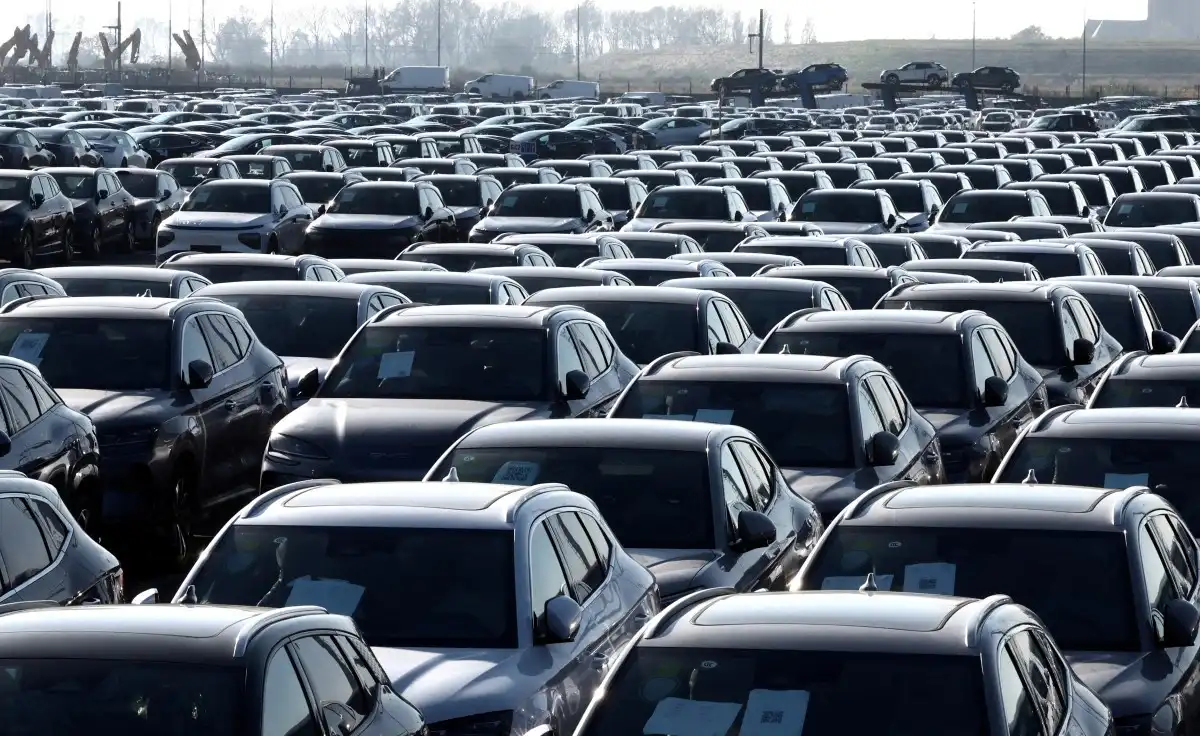
According to data released by the China Passenger Car Association (PCA), passenger vehicle sales fell 22.1 per cent year-on-year to approximately 1.5 million units. The disappointing performance prompted the industry body to significantly downgrade its expectations for the remainder of 2026.
The association now forecasts that full-year passenger vehicle sales will drop by 11 per cent, a substantial revision from its earlier projection of a 1% decline.
The downgrade reflects weaker-than-expected consumer demand and ongoing pressures affecting both vehicle manufacturers and supply chains.
High Oil Prices Weigh on Demand
PCA Secretary General Cui Dongshu attributed much of the weakness to elevated oil prices, which have reduced consumer spending power and negatively impacted purchasing decisions.
China’s traditional internal combustion engine vehicle segment was particularly affected, with sales falling 39 per cent year on year.
The sharp decline in fuel-powered vehicle sales played a major role in dragging down overall market performance.
“China’s auto market downturn is mainly driven by the sharp drop in fuel-powered vehicle sales under the pressure of high oil prices, which has weighed heavily on the industry’s performance,” Cui said.
Industry participants had anticipated a recovery beginning in April, but market conditions have remained weaker than expected.
During the first five months of the year, total vehicle sales contracted 19.5%, highlighting the challenges facing automakers as government support measures are reduced and overcapacity concerns persist.
Electric Vehicle Sales Also Face Pressure
While electric vehicles have continued gaining market share in recent years, recent data suggests the sector is not entirely immune to broader economic pressures.
Sales of new energy vehicles, including battery electric vehicles and plug-in hybrids, fell 7.5% year-on-year in May.
The decline marked the fifth consecutive month of falling demand for electrified vehicles, raising concerns about short-term growth prospects for the sector.
The slowdown in Electric Vehicle Sales China reflects softer domestic demand even as automakers continue investing heavily in electrification and new product launches.
For global manufacturers, maintaining momentum in the Chinese EV sector remains crucial given the market’s size and strategic importance.
Volkswagen Faces Critical Market Test
The downturn comes at a particularly important moment for Volkswagen, which is working to defend its long-standing position in China through a revamped electric vehicle strategy.
The German automaker has increasingly focused on localizing vehicle development and accelerating product launches to compete with rapidly growing domestic Chinese brands.
China remains Volkswagen’s largest market, making the success of its EV transformation especially important as consumer preferences continue shifting toward electric mobility.
The broader weakness in the China Auto Market creates additional challenges for global automakers attempting to regain growth while navigating intense competition and changing customer expectations.
Manufacturers are under pressure to deliver more advanced technologies, competitive pricing and localized offerings that appeal to Chinese consumers.
Context is everything. Stay ahead of shifting trends with today’s market updates, and uncover emerging opportunities using the Serrari Group Market Index and Marketplace. Then, take control of your own financial future by exploring our Money & Life Reset Transformation Blueprint ™ to build stronger habits, create better systems, and design a path toward lasting wealth.
Exports Provide a Bright Spot
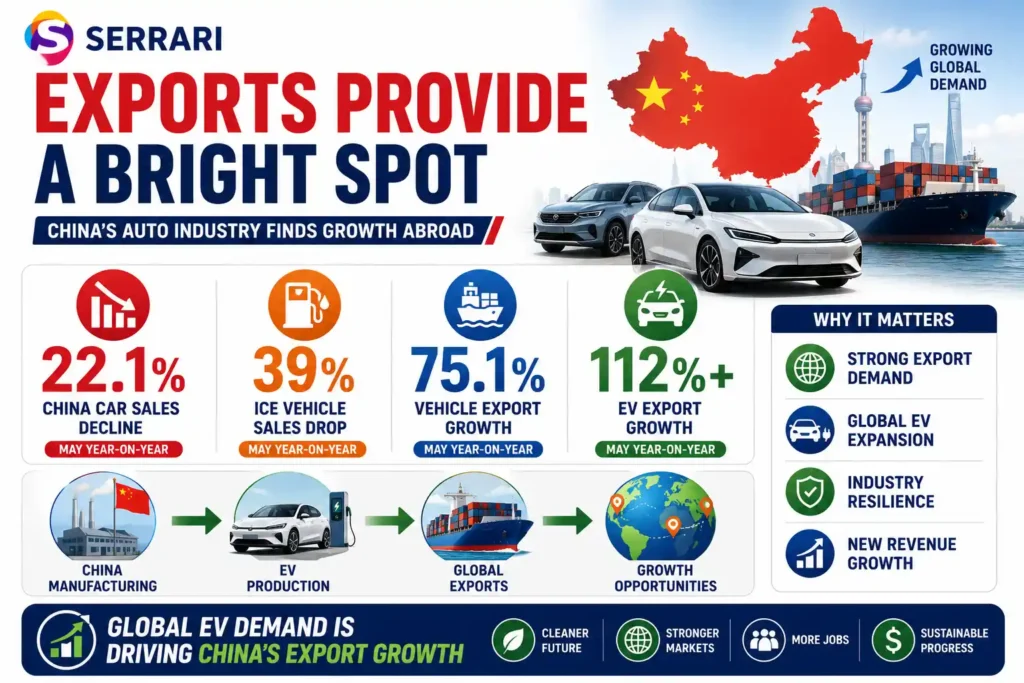
While domestic demand remains weak, exports continue to provide positive momentum for the industry.
Overall vehicle exports increased 75.1% year-on-year during May, helping offset some of the losses experienced in the domestic market.
Even more impressive was the performance of China EV Exports, which surged more than 112% compared with the previous year.
The strong export growth highlights the increasing competitiveness of Chinese electric vehicle manufacturers in international markets.
Chinese automakers continue expanding their presence across Europe, Latin America, Southeast Asia and other regions, benefiting from strong demand for affordable electric vehicles.
The export boom has become an increasingly important growth driver as domestic market conditions remain challenging.
BYD, Tesla and Nio Show Mixed Results
Despite broader market weakness, some major manufacturers reported encouraging results.
BYD recorded its first increase in total vehicle sales in nine months, delivering 383,453 vehicles during May. The company reported a modest 0.3% increase compared with a year earlier, supported largely by strong overseas demand.
Nio also posted strong results, reporting a 62% year-on-year increase in vehicle sales.
Tesla shipped 85,982 electric vehicles from its Shanghai Gigafactory during the month, with 47,281 of those vehicles sold within China. The performance represented an increase from the same period last year.
These results suggest that while the overall market remains under pressure, leading manufacturers continue finding growth opportunities through exports and targeted product strategies.
Outlook
Although China’s automotive market remains under pressure, industry officials believe conditions could gradually improve during the second half of the year. The PCA expects market performance to stabilize during the third quarter before returning to growth in the final months of 2026.
For now, however, weak domestic demand, falling fuel-powered vehicle sales and softer EV demand continue to weigh on the market. Strong exports remain the industry’s brightest spot, helping manufacturers offset domestic challenges while reinforcing China’s growing influence in global automotive markets.
FAQS
Q1: Why did China car sales fall in May 2026?
China car sales fell 22.1% year-on-year in May due to weaker consumer demand, rising oil prices, and broader economic pressures affecting the automotive sector. The decline was particularly pronounced among fuel-powered vehicles, which saw sales drop 39%.
Q2: How did electric vehicle sales perform in China during May?
Sales of new energy vehicles, including electric vehicles and plug-in hybrids, fell 7.5% compared to May 2025. The decline marked the fifth consecutive month of weaker EV demand in the domestic market.
Q3: Why are vehicle exports important to China’s auto industry?
Vehicle exports have become a major growth driver as domestic demand weakens. In May, overall vehicle exports rose 75.1%, while China EV exports surged more than 112%, helping automakers offset declining sales at home.
Q4: How is Volkswagen responding to challenges in the China auto market?
Volkswagen is accelerating its electric vehicle transformation in China through a more localized strategy focused on developing EVs tailored to Chinese consumers. The company is seeking to strengthen its position in the highly competitive China auto market as domestic brands continue gaining market share.
Sources: The Business Times, Market Screener, Salem Radio Network News
Your financial future isn’t something you wait for—it’s something you build.
The real question is: when do you begin?
Move beyond simply staying informed.
Navigate the markets with clarity—track trends through the Serrari Group Market Index, uncover opportunities in the Serrari Marketplace, and build practical knowledge with our Curated Wealth Builder Platform.
Stay connected to what truly matters.
Get daily insights on macro trends and financial movements across Kenya, Africa, and global markets—delivered through the Serrari Newsletter.
Growth opens doors.
Advance your career through professional programs including ACCA, HESI A2, ATI TEAS 7 , HESI EXIT , NCLEX – RN and NCLEX – PN, Financial Literacy!🌟—designed to move you forward with confidence.
See where money is flowing—clearly and in real time.
Track Money Market Funds, Treasury Bills, Treasury Bonds, Green Bonds, and Fixed Deposits, alongside global and African indexes, key economic indicators, and the evolving Crypto and stablecoin landscape—all within Serrari’s Market Index.