The Government of Canada plans to issue its seventh Canadian-dollar-denominated green bond, with a new 10-year maturity, subject to market conditions. The offering will expand a programme that has raised $17.5 billion through six previous transactions since March 2022, financing eligible environmental expenditures and supporting Canada’s ambition to achieve net-zero emissions by 2050.
Key Overview
- Canada is preparing its seventh green bond issuance.
- The new bond will have a 10-year maturity.
- Six previous transactions have raised $17.5 billion since March 2022.
- The February 2026 issuance was a $2 billion 10-year green bond.
- Eligible projects include clean energy, clean transportation, energy efficiency and nature conservation.
- Certain nuclear expenditures are eligible under Canada’s updated Green Bond Framework.
- Canada publishes annual allocation and impact reports for investors.
Canada Prepares Seventh Green Bond Offering
The Government of Canada is preparing to launch its seventh Canadian-dollar-denominated green bond issuance, extending its efforts to mobilise capital for environmental projects and climate-related investments.
The planned offering is a new 10-year green bond, with its launch dependent on market conditions. It follows Canada’s February 2026 issuance of a $2 billion 10-year bond.
The latest offering adds to the $17.5 billion raised through six previous transactions since the programme began in March 2022. Earlier bonds had maturities ranging from seven to 30 years, giving investors different options for exposure to Canada’s sovereign green debt.
The government intends to maintain regular issuance as part of its broader sustainable finance strategy.
Financing Clean Energy and Environmental Projects
Canada’s green bond programme is designed to direct an amount equivalent to the net proceeds of its bonds towards eligible environmental expenditures. These can include government spending on renewable energy, clean transportation, energy efficiency, climate adaptation and conservation.
Eligible activities can cover grants, loans, subsidies, tax measures, research and development, and capital and operating expenditure. This broad framework allows the government to finance or refinance a range of environmental programmes rather than relying on a single project or technology.
The programme also supports clean growth, renewable energy, climate action and, environmental protection, linking government borrowing to investments intended to deliver environmental benefits and economic opportunities.
Projects may include green infrastructure, lower-emission transport systems, improvements in energy efficiency and the protection of natural environments.
Nuclear Energy Included in the Green Bond Framework
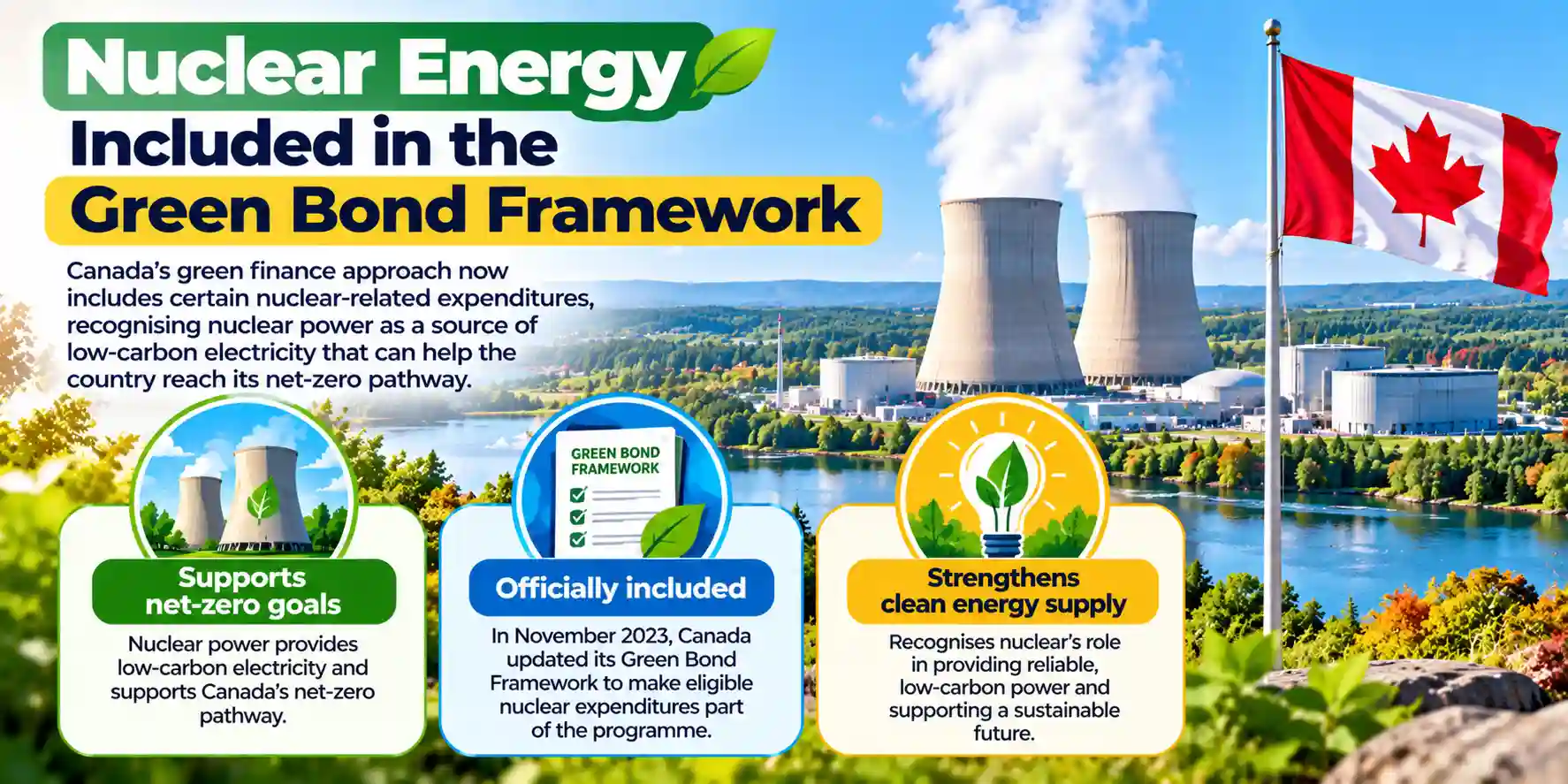
Canada’s green finance approach also includes certain nuclear-related expenditures. In November 2023, the government updated its Green Bond Framework to make eligible nuclear expenditures part of the programme.
The change reflects Canada’s position that nuclear power can contribute to its net-zero pathway by providing low-carbon electricity. It also brings the framework into line with evolving sustainable finance practices and investor preferences.
The inclusion of nuclear expenditure distinguishes Canada’s approach from frameworks that restrict green bond proceeds to renewable energy alone. Eligibility remains governed by the criteria set out in the framework, rather than extending automatically to all nuclear-related spending.
Context is everything. Stay ahead of shifting trends with today’s market updates, and uncover emerging opportunities using the Serrari Group Market Index and Marketplace. Then, take control of your own financial future by exploring our Money & Life Reset Transformation Blueprint ™ to build stronger habits, create better systems, and design a path toward lasting wealth.
Reporting on Environmental Impact
Transparency is a central feature of Canada’s green bond programme. The government publishes annual allocation reports detailing how proceeds are assigned to eligible expenditure categories, alongside impact reports describing environmental benefits and related social outcomes where data is available.
The reporting process continues until the net proceeds have been fully allocated. If a previously identified expenditure is cancelled, postponed or becomes ineligible, the government can replace it with another eligible expenditure under the applicable framework.
This structure is intended to give investors greater visibility into how the funds are used and the environmental outcomes associated with the financed activities.
Supporting Canada’s Net-Zero Ambition
Green bonds form part of Canada’s broader strategy to mobilise private capital for climate and environmental investment. By issuing sovereign green debt, the government can attract investors seeking environmental investment opportunities while financing eligible public expenditure.
The programme also aims to strengthen Canada’s sustainable finance market and support investment in infrastructure and technologies needed for a lower-carbon economy.
Canada’s green bonds are backed by the country’s AAA credit rating, although investors remain exposed to market risks, including changes in interest rates and bond prices.
Outlook
Canada’s seventh green bond issuance will extend a programme that has become an established part of the government’s sustainable finance strategy. The planned 10-year bond offers another route for investors seeking Canadian-dollar-denominated sovereign debt linked to eligible environmental expenditure.
The scale of the programme will ultimately depend on market conditions and investor demand, while its environmental contribution will be assessed through the government’s allocation and impact reporting.
As Canada works towards net-zero emissions by 2050, green bonds are expected to remain one of the tools used to mobilise capital for clean energy, infrastructure, conservation and other eligible environmental priorities.
FAQs
1. What is Canada planning to issue?
Canada plans to issue its seventh Canadian-dollar-denominated green bond, with a maturity of 10 years, subject to market conditions.
2. How much has Canada raised through previous green bond transactions?
The six previous transactions have raised $17.5 billion since the programme began in March 2022.
3. What types of projects can green bond proceeds finance?
Eligible expenditures include clean energy, clean transportation, energy efficiency, climate adaptation, conservation, sustainable water management and certain nuclear-related activities.
4. How does Canada report on the use of green bond proceeds?
The government publishes annual allocation and impact reports detailing how proceeds are assigned to eligible expenditures and describing their environmental benefits.
Sources: Government of Canada | Morningstar | Eawaz
Your financial future isn’t something you wait for—it’s something you build.
The real question is: when do you begin?
Move beyond simply staying informed.
Navigate the markets with clarity—track trends through the Serrari Group Market Index, uncover opportunities in the Serrari Marketplace, and build practical knowledge with our Curated Wealth Builder Platform.
Stay connected to what truly matters.
Get daily insights on macro trends and financial movements across Kenya, Africa, and global markets—delivered through the Serrari Newsletter.
Growth opens doors.
Advance your career through professional programs including ACCA, HESI A2, ATI TEAS 7 , HESI EXIT , NCLEX – RN and NCLEX – PN, Financial Literacy!🌟—designed to move you forward with confidence.
See where money is flowing—clearly and in real time.
Track Money Market Funds, Treasury Bills, Treasury Bonds, Green Bonds, and Fixed Deposits, alongside global and African indexes, key economic indicators, and the evolving Crypto and stablecoin landscape—all within Serrari’s Market Index.