


















The Bank of England has intensified its call for structural reform of the UK government bond repo market, warning that inaction could leave gilt trading vulnerable to severe liquidity breakdowns during future financial shocks. Deputy Governor for Financial Stability Sarah Breeden said further engagement was essential because “doing nothing is not an option,” while stressing that any changes must be carefully calibrated.
The regulatory focus is on wider central clearing and minimum haircuts for repo trades that continue to be settled bilaterally. The central bank argues these measures could reduce excessive leverage, improve dealers’ balance-sheet capacity and limit disorderly selling when market conditions deteriorate.
Key Overview
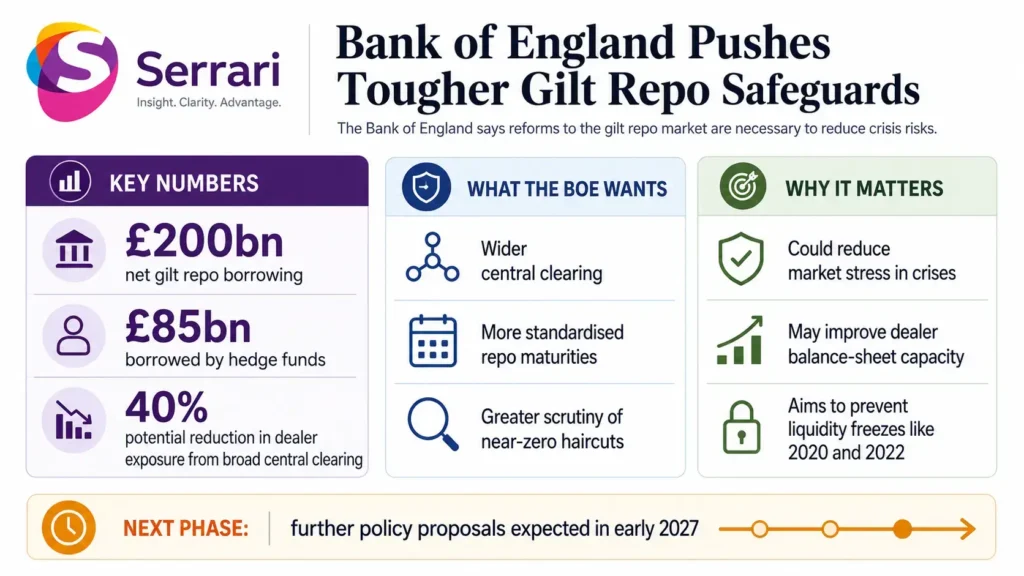
- Net borrowing in the gilt repo market is approximately £200 billion, with hedge funds accounting for about £85 billion.
- Hedge funds are estimated to represent as much as 60% of secondary gilt trading volumes, increasing their influence over market liquidity.
- Comprehensive central clearing could have reduced UK dealers’ gilt repo exposures by 40% during the March 2020 “dash for cash.”
- Standardising repo maturity dates could have delivered a further 20-percentage-point reduction in dealer exposures.
- The Bank is also concerned that around half of bilateral gilt repo haircuts are routinely set at zero.
- Detailed policy proposals are expected in early 2027, while implementation could take several years.
Why the Gilt Repo Market Matters
A repurchase agreement allows one party to obtain short-term cash by temporarily exchanging securities, such as gilts, with an agreement to repurchase them later. This market supports cash and collateral flows, improves gilt-market liquidity and helps transmit monetary policy through the financial system.
The Bank’s concern is that repo funding can disappear precisely when it is most needed. During the March 2020 market shock and the September 2022 liability-driven investment crisis, rising demand for cash collided with limited dealer capacity, contributing to market dysfunction and prompting central bank intervention. The Bank’s latest assessment of repo resilience argues that similar pressures could re-emerge in a more severe future shock.
The market has also changed significantly. Globally active hedge funds have shifted from being net cash lenders to major borrowers, with their latest net borrowing position estimated at £85 billion. The Bank estimates that rerunning its system-wide stress scenario under the current market structure could generate an additional £5 billion of gilt sales, more than doubling sales recorded in the original exercise and potentially exhausting banks’ market-making capacity.
Central Clearing Could Free Dealer Capacity
Central clearing replaces a web of bilateral exposures with a central counterparty that stands between buyers and sellers. This can allow offsetting trades to be netted, reducing the gross positions dealers must carry on their balance sheets.
Research on the potential impact of broader clearing found that comprehensive clearing before the 2020 crisis could have reduced gilt repo exposures on UK dealers’ balance sheets by 40% and improved their aggregate leverage ratio by three basis points. Aligning maturity dates could have increased the exposure reduction to 60%.
Breeden rejected the argument that central clearing would necessarily offer limited savings under the market’s current structure. She said market structures can evolve once clearing expands, as participants adopt new access models, standardised contracts and cross-margining arrangements.
Context is everything. Stay ahead of shifting trends with today’s market updates, and uncover emerging opportunities using the Serrari Group Market Index and Marketplace. Then, take control of your own financial future by exploring our Money & Life Reset Transformation Blueprint ™ to build stronger habits, create better systems, and design a path toward lasting wealth.
Near-Zero Haircuts Face Regulatory Scrutiny
A repo haircut requires the borrower to provide collateral worth more than the cash received, creating a buffer against price changes and counterparty risk. Yet the Bank says half of bilateral-market haircuts are routinely set at zero, including many hedge fund transactions.
Breeden acknowledged that portfolio-level margining can create legitimate efficiencies, but argued it must be supported by robust legal documentation, governance and stress testing. She also warned that commercial competition between dealers may be contributing to the widespread use of near-zero haircuts.
The Bank’s September 2025 reform options proposed minimum margins for non-centrally cleared trades alongside expanded central clearing. Regulators believe properly designed haircuts could constrain the most highly leveraged positions and reduce the risk of forced selling during periods of volatility.
Industry Pushback Shapes the Next Phase
Market participants broadly support the goal of improving resilience but have questioned whether mandatory central clearing and standardised minimum haircuts would be proportionate. Industry responses cited access barriers, operational complexity, higher funding costs and the possibility that tougher requirements could reduce normal-market liquidity.
Respondents also argued that central clearing could create liquidity pressure when margin requirements rise rapidly in stressed markets. However, the Bank’s April 2026 feedback statement said firms provided limited quantitative evidence on the scale of some potential negative effects.
The Bank plans to continue assessing clearing access, cross-margining, risk-sensitive haircut design and safeguards against procyclical margin calls. A comprehensive update, including possible policy proposals, is scheduled for early 2027. Breeden said the transition would probably take “years, not months,” but argued that work must begin now to create a stronger and more efficient market.
Sources
Bank of England / Reuters
Your financial future isn’t something you wait for—it’s something you build.
The real question is: when do you begin?
Move beyond simply staying informed.
Navigate the markets with clarity—track trends through the Serrari Group Market Index, uncover opportunities in the Serrari Marketplace, and build practical knowledge with our Curated Wealth Builder Platform.
Stay connected to what truly matters.
Get daily insights on macro trends and financial movements across Kenya, Africa, and global markets—delivered through the Serrari Newsletter.
Growth opens doors.
Advance your career through professional programs including ACCA, HESI A2, ATI TEAS 7 , HESI EXIT , NCLEX – RN and NCLEX – PN, Financial Literacy!🌟—designed to move you forward with confidence.
See where money is flowing—clearly and in real time.
Track Money Market Funds, Treasury Bills, Treasury Bonds, Green Bonds, and Fixed Deposits, alongside global and African indexes, key economic indicators, and the evolving Crypto and stablecoin landscape—all within Serrari’s Market Index.