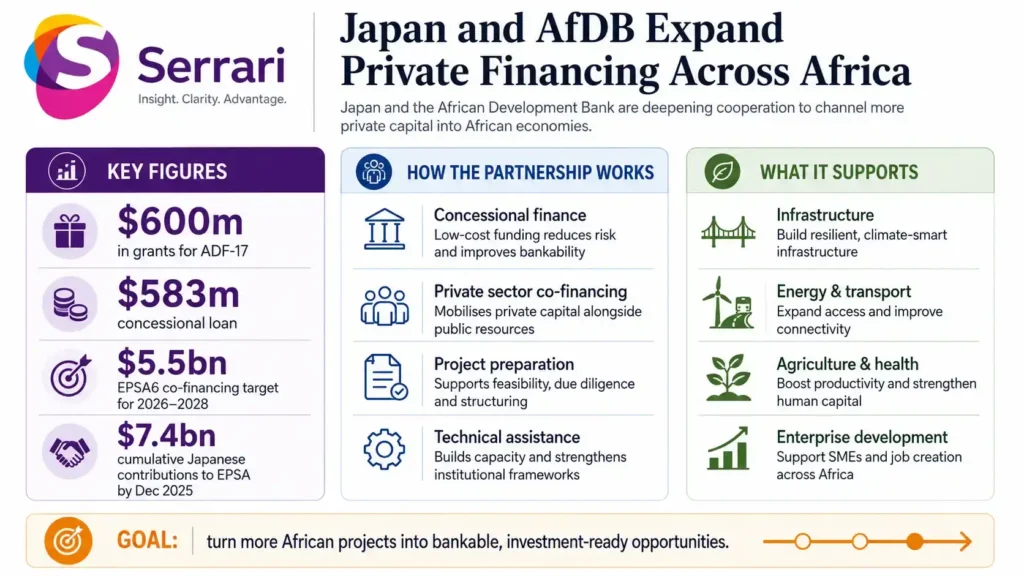
Japan and the African Development Bank Group are expanding a partnership designed to move more African projects from development plans to investable transactions. Their approach combines concessional funding, private-sector co-financing, project preparation, technical assistance and knowledge exchange to reduce risk and attract commercial capital.
The collaboration is increasingly focused on implementation. Through dedicated financing platforms and trust funds, Japan and the Bank Group are supporting infrastructure, energy, transport, agriculture, health, digital connectivity and enterprise development while helping Japanese companies enter African markets.
Key Overview
- Japan has participated in the African Development Fund since 1973 and the African Development Bank since 1982.
- Japan pledged about $600 million in grant resources and debt-relief compensation to ADF-17, alongside a yen-denominated concessional loan of approximately $583 million.
- The sixth Enhanced Private Sector Assistance for Africa phase targets $5.5 billion in joint financing between 2026 and 2028.
- Japanese contributions to the initiative had reached a cumulative $7.4 billion by December 2025.
- Japan has contributed $128 million to the Fund for African Private Sector Assistance since 2005.
- The next stage will emphasise bankable projects, stronger institutions and measurable delivery.
A Partnership Built Around Multiple Financing Channels
The relationship extends beyond direct lending. Japan supports the Bank Group through capital subscriptions, concessional finance, grants, co-financing arrangements and bilateral trust funds. This structure allows the two partners to address different stages of a project’s development, from early feasibility work to large-scale financing and implementation.
Japan’s contribution to the seventeenth replenishment of the African Development Fund included roughly $600 million in grants and Multilateral Debt Relief Initiative compensation. It also committed a yen-denominated concessional loan equivalent to about $583 million.
The African Development Fund is the Bank Group’s concessional window for low-income and structurally vulnerable countries. Japan has encouraged the fund to concentrate on quality infrastructure, governance, debt management, health systems, procurement reform, critical-mineral supply chains and private-capital mobilisation.
EPSA6 Targets $5.5 Billion in Joint Financing
The main vehicle for scaling private investment is the Enhanced Private Sector Assistance for Africa initiative, created by Japan and the Bank Group in 2005. Its sixth phase was signed during the Ninth Tokyo International Conference on African Development and sets a joint financing target of $5.5 billion for 2026–2028.
Priority sectors include energy, transport, healthcare, digital connectivity, agriculture and nutrition. By December 2025, Japan had provided cumulative contributions of $7.4 billion across the initiative’s phases.
TICAD 9, held in Yokohama from 20 to 22 August 2025, reinforced the shift from traditional development assistance towards investment, business partnerships and technology cooperation. The conference produced 324 business-related cooperation documents between Japanese and African public and private-sector organisations.
Context is everything. Stay ahead of shifting trends with today’s market updates, and uncover emerging opportunities using the Serrari Group Market Index and Marketplace. Then, take control of your own financial future by exploring our Money & Life Reset Transformation Blueprint ™ to build stronger habits, create better systems, and design a path toward lasting wealth.
Project Preparation Helps Convert Plans Into Investments
Large financing commitments cannot deliver results without projects that meet commercial, technical and regulatory requirements. The Fund for African Private Sector Assistance addresses this gap by financing feasibility studies, enterprise development, quality standards, clean technologies, startups, incubators and smaller businesses.
Since 2005, Japan has contributed about $128 million to the fund. It has financed 111 projects valued at $86.8 million, giving governments and businesses access to the upstream support needed before larger lenders and investors can participate.
The Policy and Human Resource Development Grant adds another layer of support. Established in 1994, it has received more than $44 million from Japan for technical assistance in agriculture, nutrition, climate resilience, debt management, health, policy development and institutional capacity.
The grant also supports the Africa–Asia Platform, launched in November 2025 to connect researchers, policymakers and entrepreneurs through knowledge exchange, technology transfer and innovation.
Japanese Expertise Is Reaching African Projects
The partnership is already visible in individual African projects. Examples highlighted by the Bank Group include Kenya’s 35-megawatt Menengai geothermal plant, developed with Toyota Tsusho and Fuji Electric, and Côte d’Ivoire’s Agricultural Growth Program, implemented by NEC Corporation.
These projects demonstrate how Japanese technology and business capabilities can be paired with the Bank Group’s financing, government relationships and project-development expertise. At the Africa Investment Forum 2025 Market Days in Rabat, Japanese companies, financial institutions, startups and development partners discussed additional opportunities to connect African economies with regional and global value chains.
Implementation Will Determine the Partnership’s Impact
The next test is whether the partnership can turn financing commitments into completed projects at scale. For African countries, the arrangement offers long-term capital, technical expertise and access to Japanese private-sector networks. For Japan, it creates a multilateral route into high-growth markets while supporting quality infrastructure and more resilient supply chains.
The collaboration also supports the Bank Group’s Ten-Year Strategy for 2024–2033, which calls for public and private operations to be expanded in complementary ways. Its success will depend on stronger project pipelines, effective risk-sharing and disciplined execution after financing agreements are signed.
Sources
African Development Bank Group / Ministry of Foreign Affairs of Japan
Your financial future isn’t something you wait for—it’s something you build.
The real question is: when do you begin?
Move beyond simply staying informed.
Navigate the markets with clarity—track trends through the Serrari Group Market Index, uncover opportunities in the Serrari Marketplace, and build practical knowledge with our Curated Wealth Builder Platform.
Stay connected to what truly matters.
Get daily insights on macro trends and financial movements across Kenya, Africa, and global markets—delivered through the Serrari Newsletter.
Growth opens doors.
Advance your career through professional programs including ACCA, HESI A2, ATI TEAS 7 , HESI EXIT , NCLEX – RN and NCLEX – PN, Financial Literacy!🌟—designed to move you forward with confidence.
See where money is flowing—clearly and in real time.
Track Money Market Funds, Treasury Bills, Treasury Bonds, Green Bonds, and Fixed Deposits, alongside global and African indexes, key economic indicators, and the evolving Crypto and stablecoin landscape—all within Serrari’s Market Index.