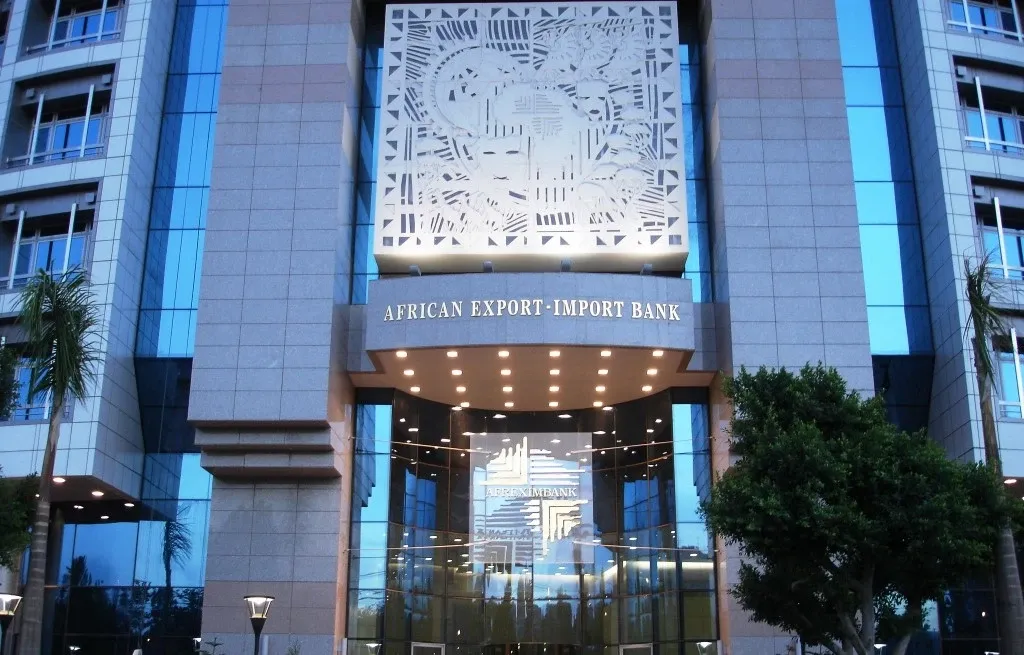
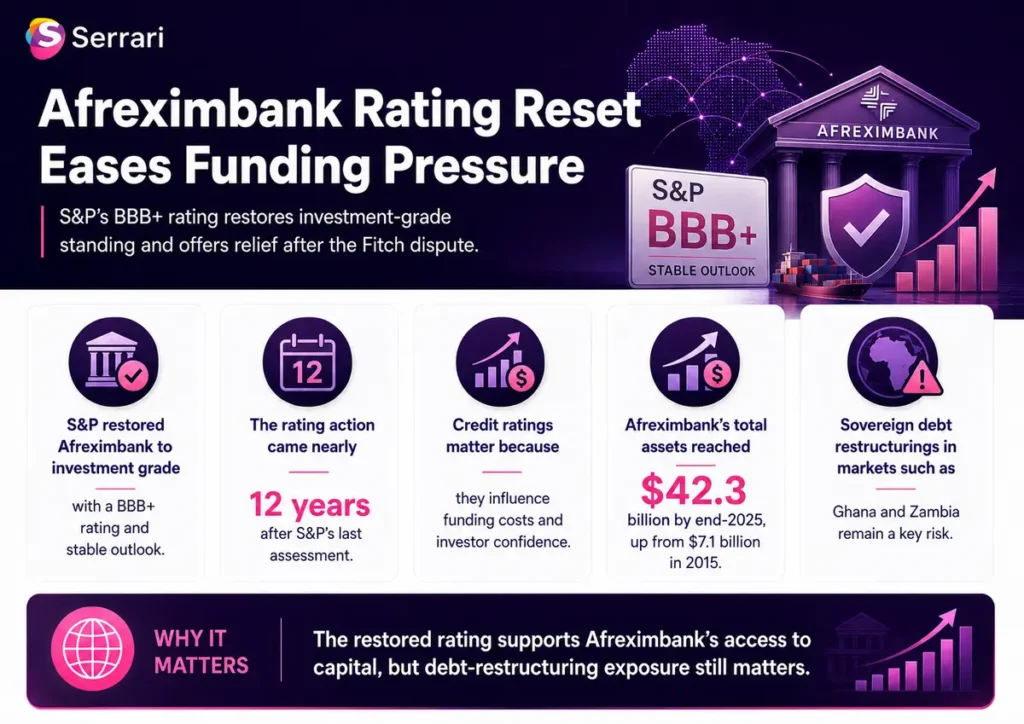
S&P Global Ratings has restored the African Export-Import Bank to investment-grade status, assigning the pan-African lender a BBB+ long-term issuer credit rating and a stable outlook. The decision, announced in a June 11 rating action, marks S&P’s first assessment of Afreximbank in almost 12 years and places the bank one notch above Moody’s Baa2 rating.
The upgrade is significant because credit ratings influence how cheaply borrowers can raise capital. For Afreximbank, a stronger rating could help protect funding access at a time when African sovereign debt restructurings, questions over preferred creditor status and disputes with Fitch Ratings have placed the lender under closer market scrutiny.
Key Overview
- S&P assigned Afreximbank a BBB+ long-term rating and A-2 short-term rating with a stable outlook.
- The rating restores the bank to investment-grade territory under S&P’s assessment.
- S&P cited Afreximbank’s countercyclical lending role, capital position and shareholder support.
- The decision comes after Afreximbank ended its relationship with Fitch following a downgrade dispute.
- The bank’s exposure to sovereign debt restructurings in countries such as Ghana and Zambia remains a key risk.
S&P Backs Afreximbank’s Credit Profile
S&P said Afreximbank’s rating reflects its role as a countercyclical lender supporting African trade and investment during periods of market stress. In its rating action, the agency said the bank had a strong enterprise risk profile, supported by its regional mandate, broad shareholder base and growing balance sheet.
Afreximbank’s total assets have expanded sharply over the past decade. S&P noted that assets reached $42.3 billion by the end of 2025, compared with $7.1 billion in 2015. The bank has grown by financing trade, infrastructure, industrialisation and emergency liquidity needs across African markets.
The BBB+ rating also gives Afreximbank a stronger external signal after a period of market uncertainty. Credit ratings matter because they influence investor confidence, bond pricing and borrowing costs. For a multilateral lender that depends on access to international capital markets, a stronger rating can support cheaper funding and broader investor participation.
Context is everything. Stay ahead of shifting trends with today’s market updates, and uncover emerging opportunities using the Serrari Group Market Index and Marketplace. Then, take control of your own financial future by exploring our Money & Life Reset Transformation Blueprint ™ to build stronger habits, create better systems, and design a path toward lasting wealth.
Fitch Dispute Still Shapes Investor Debate
The S&P decision comes months after Afreximbank severed ties with Fitch Ratings following a downgrade that left the bank one notch above junk status. Fitch had cited higher credit risks and concerns around the treatment of sovereign exposures linked to debt restructurings in Ghana, Zambia and Malawi, according to rating coverage.
Afreximbank rejected Fitch’s approach, arguing that the agency misunderstood its multilateral mandate and its position as a preferred creditor. The African Union’s peer review body also criticised Fitch’s treatment of the bank’s sovereign exposures, saying the assessment did not properly reflect Afreximbank’s treaty-backed role and shareholder relationships, according to regional response reporting.
The dispute matters because preferred creditor status can affect how lenders are treated when countries restructure debt. Institutions such as the International Monetary Fund and World Bank are typically protected from losses in sovereign restructurings. Afreximbank argues that its founding structure and member-state backing support similar treatment, but market participants remain divided because the bank has both public and private shareholders.
Debt Restructuring Risk Remains
S&P did not give Afreximbank a rating uplift for preferred creditor status, noting that almost 80 percent of the bank’s loans are to private-sector entities. However, the agency acknowledged that Afreximbank and other institutions have faced prolonged payment arrears following sovereign defaults and restructurings.
Ghana and Zambia remain important cases for investors. S&P noted that Afreximbank said in December it had reached an agreement with Ghana over a $750 million loan, while no similar resolution had been announced with Zambia. Further restructurings involving African sovereigns could still pressure the bank’s asset quality if more borrowers enter comprehensive debt treatments under frameworks such as the G20 Common Framework.
That risk is why the new rating does not end the debate around Afreximbank’s credit profile. Instead, it gives markets a fresh benchmark from a major rating agency while keeping attention on arrears, sovereign exposure and the legal treatment of multilateral lenders.
Stronger Rating Supports Africa’s Trade Finance Ambition
For Afreximbank, the restored investment-grade rating strengthens its ability to keep playing a countercyclical role in African markets. The bank has become a major source of trade finance, liquidity support and development-linked lending, especially when countries face tighter access to global capital.
The rating also comes as Afreximbank continues expanding its balance sheet and regional footprint. Its own disclosures show it still holds investment-grade ratings from several other agencies, including Moody’s, GCR, CCXI and JCR, according to a ratings update.
The immediate market impact is likely to be positive, especially if the BBB+ rating lowers perceived funding risk. But the bank’s long-term credit strength will depend on whether it can manage sovereign arrears, maintain shareholder support and preserve investor confidence while continuing to fund Africa’s trade and industrialisation agenda.
Sources used: Reuters / S&P Global Ratings / Afreximbank / Fitch Ratings
Your financial future isn’t something you wait for—it’s something you build.
The real question is: when do you begin?
Move beyond simply staying informed.
Navigate the markets with clarity—track trends through the Serrari Group Market Index, uncover opportunities in the Serrari Marketplace, and build practical knowledge with our Curated Wealth Builder Platform.
Stay connected to what truly matters.
Get daily insights on macro trends and financial movements across Kenya, Africa, and global markets—delivered through the Serrari Newsletter.
Growth opens doors.
Advance your career through professional programs including ACCA, HESI A2, ATI TEAS 7 , HESI EXIT , NCLEX – RN and NCLEX – PN, Financial Literacy!🌟—designed to move you forward with confidence.
See where money is flowing—clearly and in real time.
Track Money Market Funds, Treasury Bills, Treasury Bonds, Green Bonds, and Fixed Deposits, alongside global and African indexes, key economic indicators, and the evolving Crypto and stablecoin landscape—all within Serrari’s Market Index.