
The European Commission has proposed adding Kyrgyzstan to a list of jurisdictions subject to crypto-related sanctions, a move that could prohibit European brokers from conducting direct or indirect transactions with cryptocurrency exchanges based in the Central Asian country. The proposal uses a mechanism introduced under the EU’s 21st sanctions package in July 2026. If approved unanimously by all 27 member states, Kyrgyzstan would become the first country listed under Annex LVII. The measure follows concerns that crypto platforms in Kyrgyzstan may have facilitated the movement of Russian cryptocurrency funds after the shutdown of the Garantex exchange in March 2025. The proposal has not yet been adopted.
Key Takeaways
- The European Commission has proposed adding Kyrgyzstan to Annex LVII, a list targeting jurisdictions whose crypto service providers facilitate sanctions evasion.
- If approved, EU brokers could be barred from direct and indirect dealings with crypto exchanges based in Kyrgyzstan.
- The proposal requires unanimous approval from all 27 EU member states.
- The move follows concerns surrounding the transfer of Garantex customer deposits to Grinex, an exchange registered in Kyrgyzstan.
- The restrictions could cover exchanges not individually named on sanctions lists.
- European brokers may need to strengthen counterparty checks and verify where crypto exchanges are registered before executing transactions.
EU Proposes Restrictions on Crypto Exchanges Based in Kyrgyzstan
The European Commission has proposed a sanctions measure that could prohibit European brokers from trading with cryptocurrency exchanges based in Kyrgyzstan, escalating the European Union’s efforts to prevent Russia from using digital asset platforms to evade financial restrictions.
The proposal would add Kyrgyzstan to Annex LVII, a list established under the EU’s 21st sanctions package adopted in July 2026.
If approved, the measure could restrict both direct and indirect transactions with Kyrgyz crypto service providers.
This would make Kyrgyzstan the first jurisdiction considered for inclusion on the list, which has so far remained empty.
The proposal was submitted to the Council of the European Union on November 23 under reference ST 15487/26, together with its accompanying annexes.
However, the measure is not yet in force. All 27 EU member states must agree unanimously before the proposed restrictions can be adopted.
An EU official said the bloc had raised its concerns privately with Kyrgyz authorities before proposing the restrictions.
How Would the Proposed Crypto Sanctions Work?
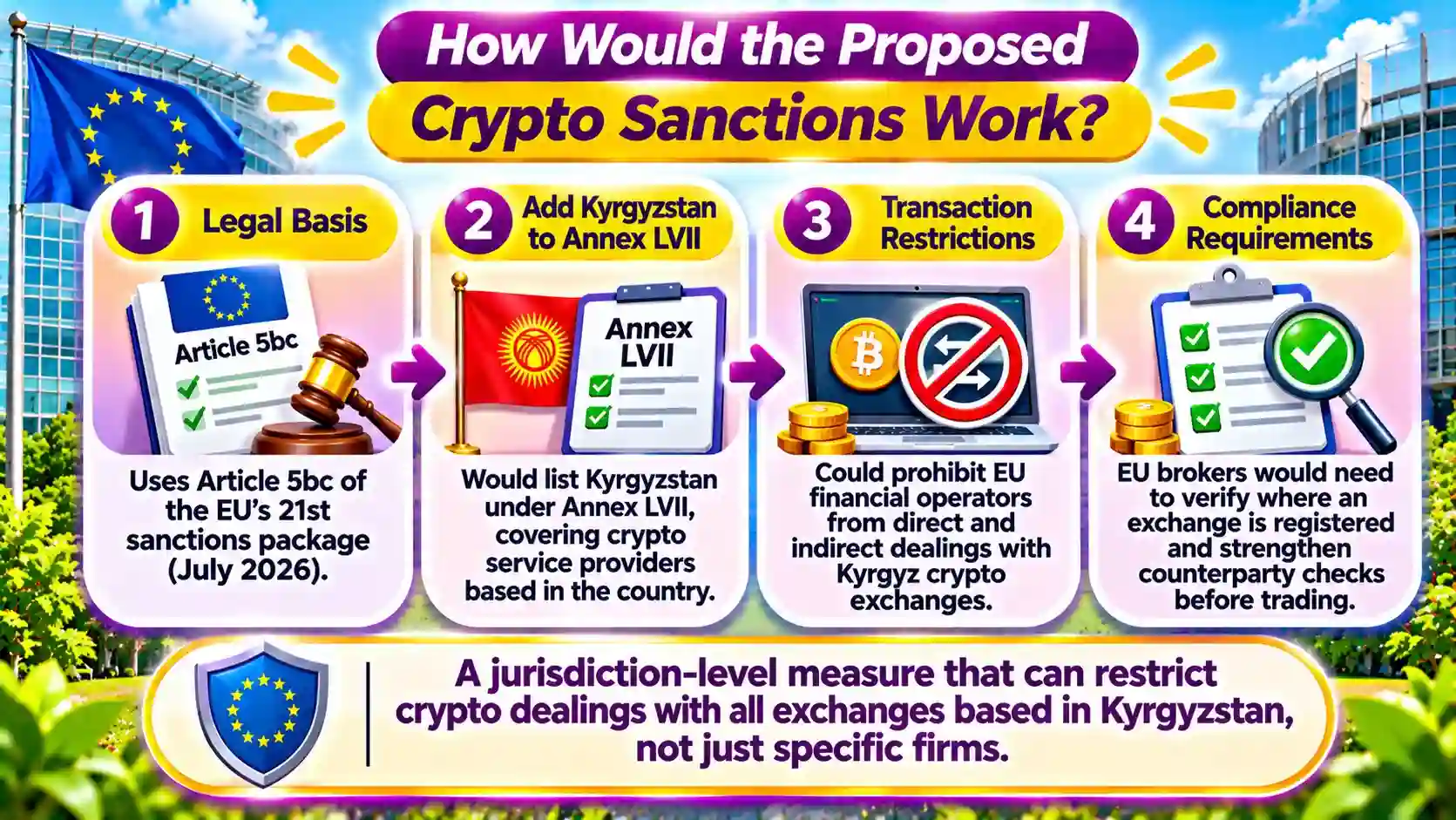
The proposed measure uses a legal mechanism introduced through Article 5bc of the EU’s 21st sanctions package, adopted on July 23, 2026.
The provision allows the EU to prohibit financial operators from engaging, directly or indirectly, with virtual-asset service providers based in jurisdictions identified as systematically failing to prevent sanctions evasion through crypto services.
Under the proposal, adding Kyrgyzstan to Annex LVII would bring crypto service providers based in the country within the restrictions without requiring every exchange to be individually named on a sanctions list.
This is an important distinction because the measure would apply at the jurisdictional level rather than targeting only specific companies.
For European brokers, this could mean that an exchange with no individual sanctions designation may still become off-limits because of where it is registered.
Even without a firm-specific sanctions designation, European brokers would have to confirm where a counterparty exchange is registered before executing a trade.
The practical responsibility would therefore extend to compliance teams, which would need to examine the registration details of their trading and settlement partners.
Why Is the EU Targeting Kyrgyzstan?
The proposal follows concerns about the movement of Russian cryptocurrency funds through exchanges registered in Kyrgyzstan.
The issue traces back to the shutdown of Garantex, a Russian cryptocurrency exchange, in March 2025.
The US Treasury Department said that after Garantex was shut down, staff established another exchange, Grinex, in Kyrgyzstan and transferred customer deposits there.
The movement of funds raised concerns about whether cryptocurrency platforms operating outside Russia were being used to maintain access to digital asset services despite international restrictions.
British sanctions officials later traced substantial transfers between Grinex and licensed international exchanges, adding to concerns about the role of third-country platforms in sanctions evasion.
The European Commission’s proposal seeks to address this potential gap by restricting dealings with providers based in the jurisdiction, rather than relying exclusively on sanctions against individual companies.
Earlier EU Sanctions Targeted Grinex and Other Crypto Networks
The proposed designation follows previous European restrictions involving cryptocurrency businesses and digital assets linked to Russia.
In October 2025, the EU imposed sanctions on Grinex and stablecoin issuer Old Vector. It also introduced restrictions on transactions involving the ruble-backed A7A5 token.
The United Kingdom separately sanctioned Bishkek-based TokenSpot in October 2026.
These measures demonstrate the growing attention regulators are paying to cryptocurrency exchanges, stablecoin issuers and payment networks that may facilitate financial activity connected to Russia.
European Commission President Ursula von der Leyen also said on November 23 that the EU’s 22nd sanctions package would target crypto and payment networks in Russia and countries helping it evade restrictions.
The wider financial measures she outlined would extend transaction bans to approximately 60 Russian banks and remove them from the SWIFT financial messaging system.
The proposed Kyrgyzstan designation forms part of this broader effort to strengthen sanctions enforcement beyond Russia’s borders.
Context is everything. Stay ahead of shifting trends with today’s market updates, and uncover emerging opportunities using the Serrari Group Market Index and Marketplace. Then, take control of your own financial future by exploring our Money & Life Reset Transformation Blueprint ™ to build stronger habits, create better systems, and design a path toward lasting wealth.
What Would the Restrictions Mean for European Crypto Brokers?
If the proposal receives unanimous approval, European brokers could face restrictions on transactions with crypto exchanges registered in Kyrgyzstan, including platforms that have not been individually sanctioned.
The measure would also introduce additional compliance responsibilities for financial operators.
Brokers would need to verify the jurisdiction in which an exchange or counterparty is registered before executing transactions. Checking whether a company appears on an individual sanctions list would no longer be sufficient if the jurisdiction itself becomes subject to the proposed restrictions.
This could affect established settlement relationships and trading arrangements involving Kyrgyzstan-based platforms.
A broker could check a longtime settlement partner, find no sanctions entry for the firm itself, and still be required to route the transaction elsewhere.
Market participants have also raised concerns about possible operational disruption because cryptocurrency trading desks sometimes rely on offshore venues for liquidity and settlement.
A restriction covering an entire jurisdiction could leave less room for case-by-case exemptions than measures targeting individual companies.
However, the precise operational impact will depend on the final scope of the adopted measure and any additional guidance issued by EU authorities.
Kyrgyzstan’s Growing Role in Digital Finance
Kyrgyzstan has spent recent years developing its digital finance infrastructure and expanding its role in regional cryptocurrency activity.
The government has supported several digital finance initiatives, including the issuance of a stablecoin pegged to the national currency, the som.
The country’s growing involvement in crypto-related activity has also brought greater attention to its regulatory and oversight arrangements.
The EU’s proposal reflects concerns that jurisdictions with insufficient controls could become channels through which sanctioned entities continue accessing cryptocurrency services.
For Kyrgyzstan, the proposed designation could therefore affect its relationship with European financial operators and the international crypto market if the restrictions are adopted.
The proposal does not, however, establish that every cryptocurrency business in the country has engaged in sanctions evasion. Its intended effect is to restrict dealings with providers based in the jurisdiction if it is formally added to Annex LVII.
The Bigger Picture: Sanctions Enforcement Is Expanding Beyond Individual Crypto Firms
The proposed restrictions illustrate a shift in how authorities are approaching sanctions enforcement in digital asset markets.
Rather than targeting only individual exchanges, the EU is considering using jurisdiction-level restrictions to address concerns about crypto service providers operating in countries where sanctions evasion is believed to be insufficiently controlled.
This approach could make it harder for sanctioned entities to move between platforms by establishing new businesses or transferring operations to other jurisdictions.
However, it also creates wider compliance implications for financial operators that may have legitimate commercial relationships with businesses in the affected country.
The proposal highlights the challenge regulators face in overseeing cryptocurrency markets that operate across borders and allow funds to move between exchanges, wallets and payment networks.
Why Does This Matter Now?
The proposal matters because cryptocurrency exchanges and payment networks can provide alternative channels for moving funds when traditional financial institutions are subject to sanctions.
By considering restrictions that apply to an entire jurisdiction, the EU is seeking to close potential gaps that could allow sanctioned Russian entities to continue accessing digital asset services through third countries.
For European brokers, the proposed measure could change how they conduct due diligence, verify counterparties and manage settlement relationships.
For Kyrgyzstan-based exchanges, approval could restrict access to European financial operators even if individual platforms have not been named in separate sanctions decisions.
For the wider crypto industry, the proposal highlights the growing importance of jurisdictional compliance, transparent ownership structures and effective sanctions controls.
The central issue is whether the EU can strengthen enforcement without unnecessarily disrupting legitimate cryptocurrency activity and financial relationships.
Outlook: Unanimous Approval Will Determine the Next Step
The proposed designation still requires unanimous approval from all 27 EU member states.
As of November 26, 2026, Kyrgyzstan had not been formally added to Annex LVII, and no new jurisdiction-wide restriction had taken effect.
If approved, the measure could make Kyrgyzstan the first country listed under the framework introduced in July 2026, extending the EU’s ability to restrict crypto-related transactions beyond individually sanctioned businesses.
European brokers would then need to assess their exposure to exchanges and other virtual-asset service providers registered in the country.
The next developments to watch are the Council’s decision, the final wording of the sanctions measure and any guidance on how brokers should apply the restrictions.
For now, the proposal signals a broader approach to crypto sanctions enforcement, but its implementation depends on agreement among all 27 member states.
Frequently Asked Questions
1. Why is the EU proposing crypto sanctions against Kyrgyzstan?
The proposal follows concerns that cryptocurrency platforms in Kyrgyzstan may have been used to facilitate the movement of Russian funds following the shutdown of the Garantex exchange and the transfer of customer deposits to Grinex.
2. What would the proposed sanctions mean for Kyrgyzstan-based crypto exchanges?
If adopted, the restrictions could prohibit EU brokers from conducting direct or indirect transactions with virtual-asset service providers based in Kyrgyzstan, including exchanges not individually named on sanctions lists.
3. Have the proposed EU sanctions against Kyrgyzstan been approved?
No. As of November 26, 2026, the proposal still required unanimous approval from all 27 EU member states.
4. What is Annex LVII?
Annex LVII is a list established under the EU’s 21st sanctions package in July 2026. It provides a framework for restricting transactions with crypto service providers based in jurisdictions identified as enabling sanctions evasion.
Your financial future isn’t something you wait for—it’s something you build.
The real question is: when do you begin?
Move beyond simply staying informed.
Navigate the markets with clarity—track trends through the Serrari Group Market Index, uncover opportunities in the Serrari Marketplace, and build practical knowledge with our Curated Wealth Builder Platform.
Stay connected to what truly matters.
Get daily insights on macro trends and financial movements across Kenya, Africa, and global markets—delivered through the Serrari Newsletter.
Growth opens doors.
Advance your career through professional programs including ACCA, HESI A2, ATI TEAS 7 , HESI EXIT , NCLEX – RN and NCLEX – PN, Financial Literacy!🌟—designed to move you forward with confidence.
See where money is flowing—clearly and in real time.
Track Money Market Funds, Treasury Bills, Treasury Bonds, Green Bonds, and Fixed Deposits, alongside global and African indexes, key economic indicators, and the evolving Crypto and stablecoin landscape—all within Serrari’s Market Index.