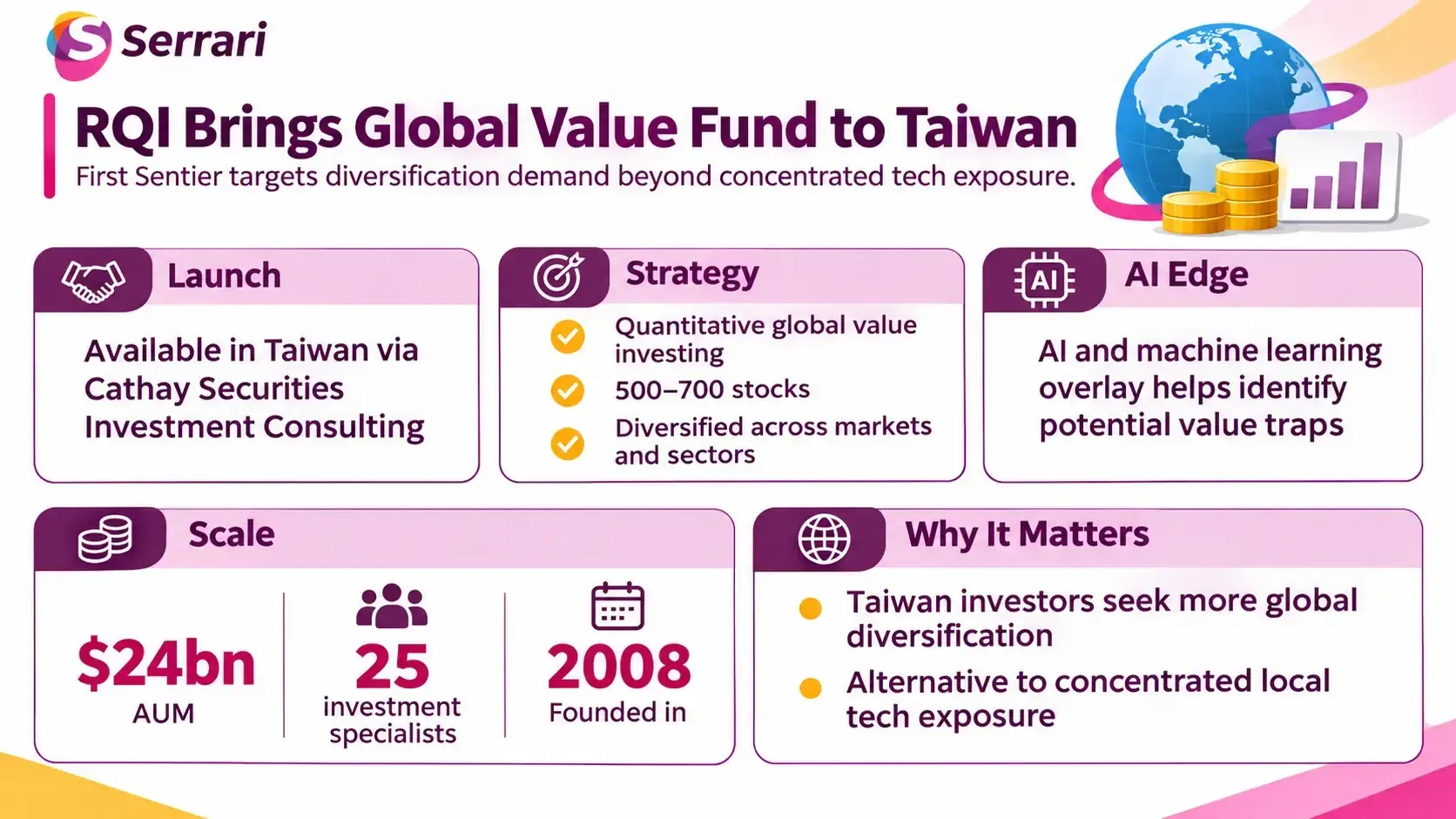
First Sentier Group’s quantitative investment affiliate RQI Investors has introduced its Global Value Fund to Taiwan through Cathay Securities Investment Consulting, extending a strategy already offered in other international markets. Announced on November 18, 2026, the launch targets a growing problem for Taiwanese investors: strong returns from semiconductor and artificial intelligence-related companies have also left many portfolios heavily exposed to the same economic forces. RQI proposes a diversified portfolio of approximately 500–700 global equities selected through systematic valuation analysis and machine-learning signals. The attraction is not simply artificial intelligence in portfolio management, but the possibility of finding reasonably priced businesses outside Taiwan’s dominant technology trade. Whether the fund succeeds will depend on investment results, fees, currency exposure and its ability to distinguish genuinely undervalued companies from businesses whose cheap valuations reflect deteriorating prospects.
Key Overview
- Taiwan launch: RQI Investors introduced its Global Value Fund through Cathay Securities Investment Consulting on November 18, 2026.
- Investment strategy: The manager targets approximately 500–700 global shares using quantitative valuation research, machine learning and additional signals intended to identify potential value traps.
- Management scale: RQI reported US$24 billion under management as of September 30, 2026, supported by a 25-member investment team.
- Concentration problem: Taiwan Semiconductor Manufacturing Company represented 44% of the S&P Taiwan BMI in June 2026, illustrating the potential exposure from relying heavily on domestic benchmarks.
- Rising global interest: A 2026 investor survey found that the share of affluent Taiwanese respondents preferring investments outside their home market climbed from 28% in 2025 to 44% in 2026.
- Investor consideration: Global exposure can diversify sectors and geographies, but value stocks, quantitative models and foreign-currency holdings can still lose money.
Why Taiwan Has Become an Attractive Market for Global Value Funds
The launch comes at a time when Taiwan’s extraordinary strength in semiconductor manufacturing has created an investment dilemma. The same businesses that drive its export earnings and stock-market performance can dominate investors’ portfolios. Investors who already receive income from the technology supply chain, own local shares and hold domestic funds may have more exposure to a single industry cycle than they realize.
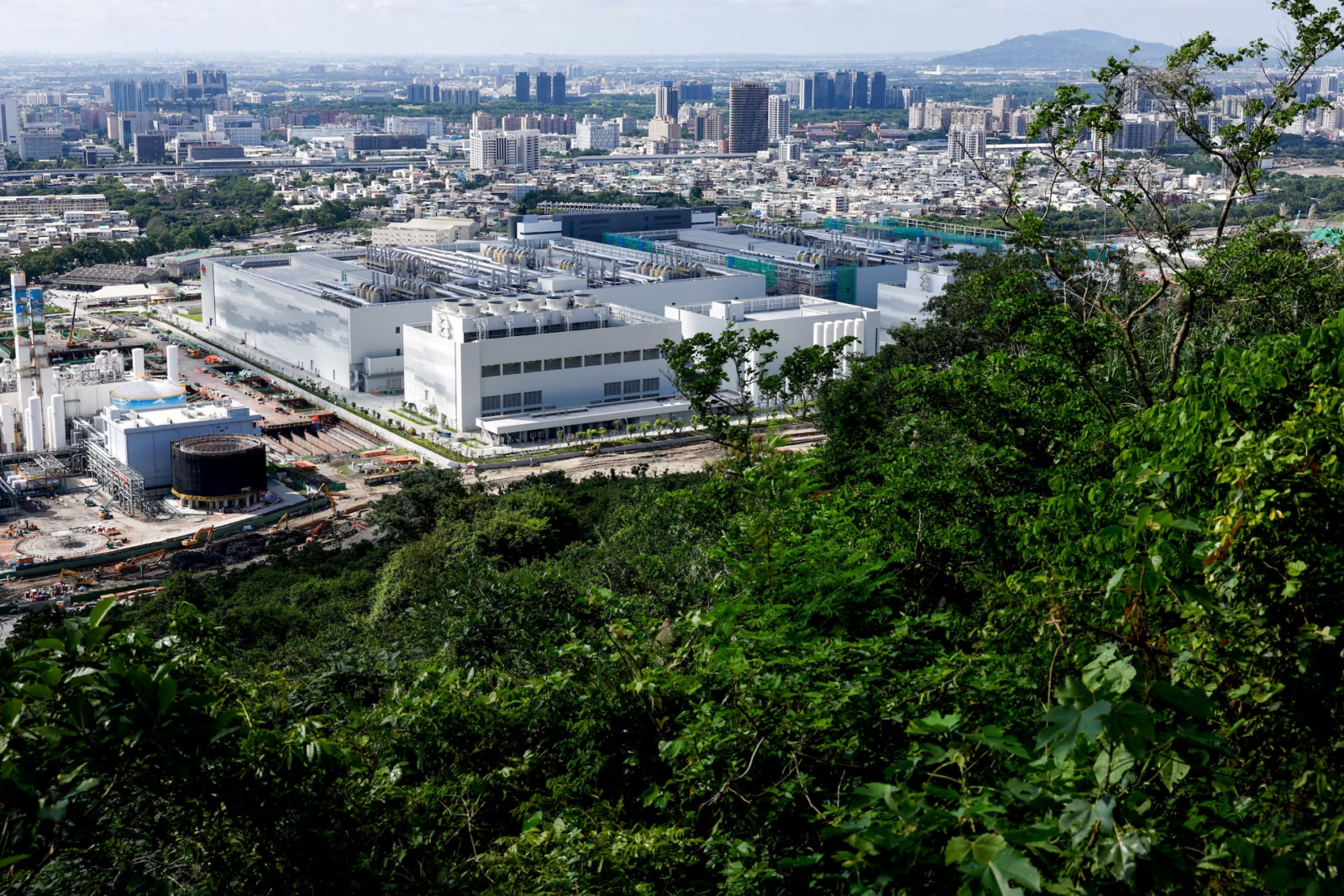
That concentration is measurable. A July 2026 examination of Taiwan’s stock market found that Taiwan Semiconductor Manufacturing Company alone accounted for 44% of the S&P Taiwan BMI as of June 15. Information technology represented approximately 83% of the benchmark, while its forward price-to-earnings ratio reached 23.67 in May, above the comparisons cited for global and US equities. These figures describe a particular index and measurement dates, not every Taiwanese portfolio, but demonstrate how diversification can weaken when one sector becomes dominant.
A concentrated market is not necessarily a bad investment. Taiwan’s position in advanced chips means investors have benefited from global spending on AI infrastructure and high-performance computing. The problem arises when a portfolio’s future returns depend excessively on continued semiconductor demand, favorable valuations and uninterrupted supply chains. A change in any of those conditions could affect many holdings simultaneously.
The demand for alternatives is therefore not merely theoretical. A 2026 survey of affluent investors found that 44% of respondents in Taiwan preferred exposure beyond their home market, up from 28% the previous year. This 16-percentage-point change provides a commercial explanation for why a global equities manager would expand distribution in Taiwan now. It measures stated investor preferences, however, not confirmed subscriptions into RQI’s product.
How RQI Combines Value Investing With Artificial Intelligence
RQI’s approach begins with a familiar value-investing question: is a company’s market price attractive relative to its financial fundamentals? Traditional approaches examine indicators such as earnings, balance-sheet strength, profitability and valuation multiples. Quantitative managers seek to apply comparable rules across large sets of securities, rather than relying exclusively on a portfolio manager’s individual judgments about each company.
Under the Taiwan distribution announcement, RQI describes an investment process that uses more than a decade of experience with artificial intelligence and machine learning. Its additional alpha-signal analysis incorporates forward-looking information, including changes in analysts’ expectations and AI-assisted analysis of text, to help flag businesses whose inexpensive prices may be justified by weakening prospects. The fund seeks to hold between 500 and 700 stocks across countries, sectors and individual issuers.
That last distinction matters because a stock trading at a low price-to-earnings multiple is not automatically a bargain. A business facing falling demand, high debt, obsolete products or declining margins might deserve a lower valuation. Investors call these situations value traps: companies that appear inexpensive but continue to disappoint because their underlying economic value is weakening.
Machine learning may help screen enormous datasets for patterns a human team would struggle to monitor consistently. It may also reduce dependence on emotional judgments during volatile markets. But the models are only as reliable as their inputs, design and continued relevance. Signals that worked in one market regime can fail when interest rates, corporate behavior or investor preferences change. AI-assisted analysis therefore does not remove the need for fundamental oversight and risk management.
Context is everything. Stay ahead of shifting trends with today’s market updates, and uncover emerging opportunities using the Serrari Group Market Index and Marketplace. Then, take control of your own financial future by exploring our Money & Life Reset Transformation Blueprint ™ to build stronger habits, create better systems, and design a path toward lasting wealth.
Why the Cathay Partnership Matters
RQI’s Taiwan entry is also a distribution strategy. A capable international manager may have a credible investment process, yet still face substantial obstacles reaching local investors: regulatory requirements, investor disclosures, sales channels and the need for locally familiar customer support. Working with Cathay Securities Investment Consulting gives the fund a local route to market rather than requiring the Australian-based manager to establish its own retail distribution network immediately.
The fund is new to Taiwan, but the underlying investment operation is not newly established. RQI was founded in Australia in 2008 and reported US$24 billion of managed assets as at September 30, 2026, across Australian, global and emerging-market equity value strategies. Its investment team comprises 25 specialists. The Taiwan launch follows earlier expansion into Europe, the Middle East and Africa, Hong Kong and Singapore, reflecting an effort to export an existing investment capability into additional wealth-management markets.
For First Sentier, this approach broadens the audience for its strategies and may create opportunities to gather assets without developing a different investment model for every market. For Cathay, it adds a differentiated global value product to the overseas fund choices available to clients. Neither the announcement nor the reported assets under management establishes how much money Taiwanese investors will commit to the product.
The launch also fits a broader effort to develop Taiwan as a wealth-management centre. The same investor research on cross-border allocations noted expanding access to offshore products and the creation of a financial asset-management zone in Kaohsiung. These developments increase the relevance of overseas managers that can offer strategies different from the local market’s dominant exposures.
What Global Diversification Can—and Cannot—Deliver
An investor holding a concentrated Taiwan equity portfolio could use global value exposure to access sectors such as financial services, healthcare, industrial businesses and consumer companies in other regions. Because the revenue drivers, valuations and economic cycles of these businesses may differ from those of semiconductor manufacturers, adding them could reduce dependence on a single source of returns.
Diversification, however, is not the same as immunity to market declines. Global stocks can fall together during recessions, financial crises or abrupt shifts in risk appetite. Value-oriented strategies may underperform growth-heavy benchmarks for extended periods, particularly when a small number of technology companies continue to lead the market. A diversified fund can therefore trail Taiwan’s market during a sustained semiconductor rally even if its broader risk profile ultimately benefits an investor.
International investing also creates currency exposure. Taiwan-based investors evaluating a foreign-currency share class need to consider how exchange-rate movements affect the value of their investment in New Taiwan dollars. Share-class structure, potential currency hedging, charges and distribution policies can materially change the investor’s realized return. Cathay’s local product communication specifically warns that some fund distributions may come from capital, meaning a cash payout should not automatically be interpreted as investment profit.
Fees deserve equal attention. The public launch information establishes the investment concept and local distributor, but investors should consult the relevant Taiwan share-class prospectus and investor disclosures for the precise ongoing charges, any sales fees, redemption terms and applicable risks. The manager’s US$24 billion in assets across strategies is evidence of organizational scale, not a guarantee of the new distribution offering’s returns.
Why This Launch Matters Beyond One Fund
RQI’s move into Taiwan highlights two developments reshaping the investment industry. First, growth in AI-linked equities has made geographic and sector concentration a more prominent wealth-management concern, even in markets enjoying strong returns. Second, asset managers are increasingly presenting technology not only as an investment theme but as a tool for choosing investments, processing information and managing portfolios.
Those developments can reinforce each other. Investors who have gained wealth from AI-related companies may seek assets less directly tied to the same trend, while managers use machine learning to search for opportunities in the wider market. That is the business case behind the fund: global diversification supported by a repeatable quantitative process, rather than a simple promise that artificial intelligence can outperform human stock pickers.
The real test will come after distribution begins. Investors should examine whether the fund’s holdings materially diversify their existing portfolios, how its returns compare with an appropriate global value benchmark, and whether its extra complexity produces sufficient benefits after costs. A 500–700-stock portfolio is broadly diversified by number of holdings, but its actual exposures still depend on country, sector, factor and currency weights.
For Taiwanese investors, the decision is not whether to abandon a successful domestic technology market. It is whether continuing to rely on that market for an excessive share of wealth creates risks that can be managed through carefully selected global investments. For First Sentier and Cathay, the opportunity is to turn that concern into sustained demand for a credible alternative. The November launch marks the start of that proposition’s test, not proof of its success.
Sources: First Sentier Group / Cathay Securities Investment Consulting / Anue / S&P Dow Jones Indices / HSBC / Hubbis
Your financial future isn’t something you wait for—it’s something you build.
The real question is: when do you begin?
Move beyond simply staying informed.
Navigate the markets with clarity—track trends through the Serrari Group Market Index, uncover opportunities in the Serrari Marketplace, and build practical knowledge with our Curated Wealth Builder Platform.
Stay connected to what truly matters.
Get daily insights on macro trends and financial movements across Kenya, Africa, and global markets—delivered through the Serrari Newsletter.
Growth opens doors.
Advance your career through professional programs including ACCA, HESI A2, ATI TEAS 7 , HESI EXIT , NCLEX – RN and NCLEX – PN, Financial Literacy!🌟—designed to move you forward with confidence.
See where money is flowing—clearly and in real time.
Track Money Market Funds, Treasury Bills, Treasury Bonds, Green Bonds, and Fixed Deposits, alongside global and African indexes, key economic indicators, and the evolving Crypto and stablecoin landscape—all within Serrari’s Market Index.