Kenya and the European Union have completed negotiations toward a mutual data adequacy arrangement, bringing the country closer to a potentially important breakthrough for its digital-services economy. In a joint statement issued in Brussels on November 16, 2026, European Commissioner Michael McGrath and Kenya’s Data Commissioner Immaculate Kassait said talks launched in 2024 had established closer alignment between their data-protection systems. If both sides formally adopt the necessary decisions, qualifying personal information could move between the jurisdictions without the additional transfer mechanisms currently required in many circumstances. That could reduce costs for outsourcing providers, financial and technology firms and research institutions. Yet no adequacy decision is in force, and the commercial benefits depend on continued enforcement, international customer confidence and the ability of Kenyan businesses to compete.
Key Overview
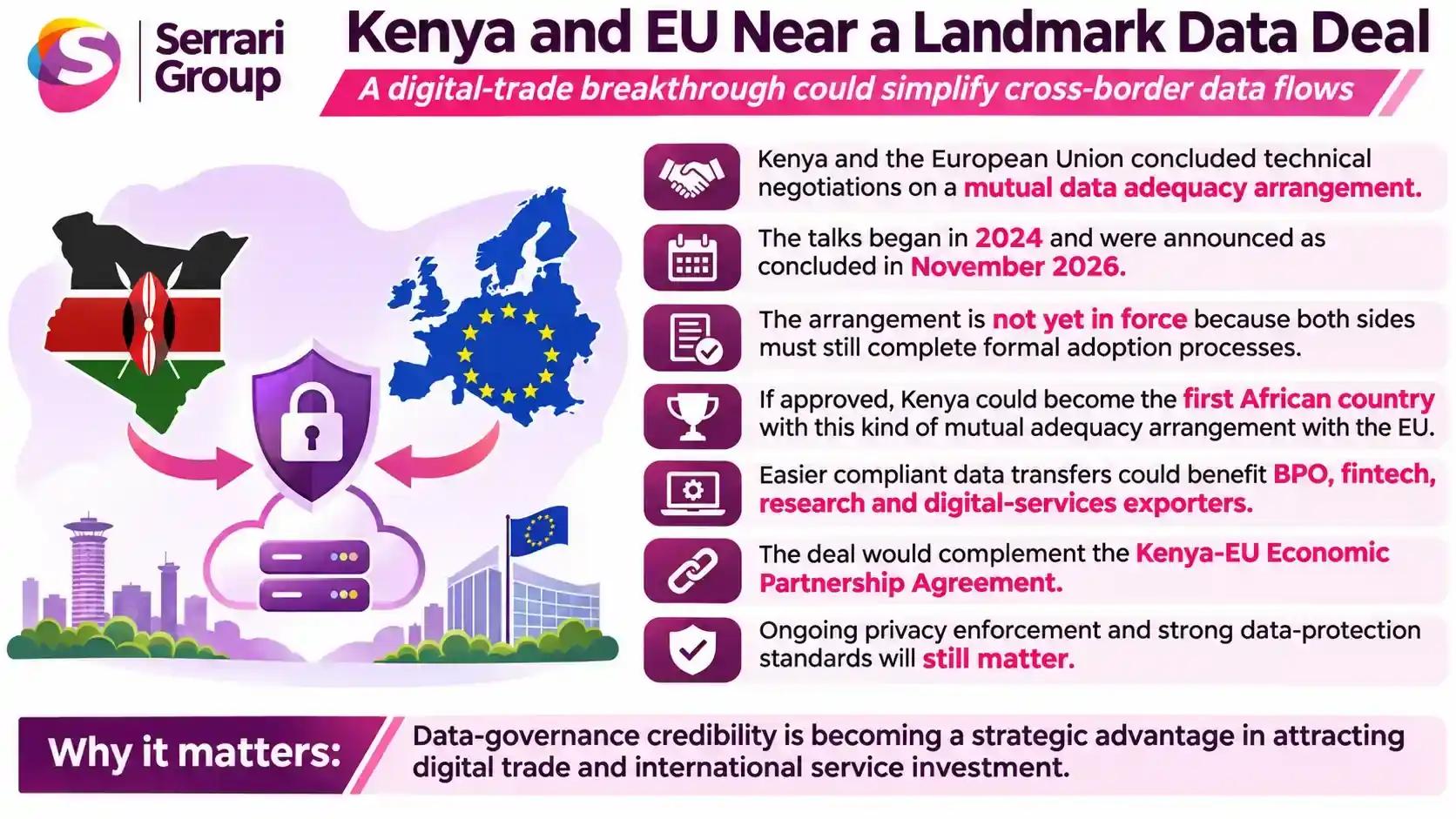
- Negotiations concluded: Kenyan and EU regulators finished technical talks launched in 2024, with the outcome announced on November 16, 2026.
- Not yet effective: The European Commission and Kenya’s Office of the Data Protection Commissioner must still complete formal adoption processes.
- Potential first: Approval would establish the first mutual data adequacy arrangement of this kind between the EU and an African country.
- Business implications: Outsourcing, financial technology, research and digital-service exporters could face fewer legal barriers to qualifying cross-border data transfers.
- Privacy requirements remain: Adequacy would not abolish data-protection duties, cyber safeguards, customer rights or sector-specific restrictions.
- Wider strategy: The move would complement the Kenya-EU trade agreement in force since July 2024, adding a possible digital dimension to closer economic ties.
Why Kenya and the EU Pursued a Data Adequacy Arrangement
A growing share of international trade involves information moving across borders rather than goods passing through ports. When a European company hires a Kenyan team to handle customer support, develop a digital product or process an insurance claim, employees may need to access personal information about people in Europe. That creates a legal issue before the work even starts: European data-protection rules restrict transfers of personal data to countries outside the European Economic Area unless an approved legal basis or transfer safeguard applies.
Kenya’s opportunity has therefore been constrained not only by connectivity, skills and the cost of doing business, but also by the effort that international clients must undertake to authorize data transfers. Firms can already transfer information through lawful mechanisms, including standard contractual clauses where appropriate. Those mechanisms, however, may require legal assessments, contracts and ongoing compliance work, particularly when businesses depend on multiple service providers.
The November 16 joint statement confirms that negotiations between Kenya’s Office of the Data Protection Commissioner and the European Commission’s justice directorate have concluded after beginning in 2024. The two sides acknowledged convergence between their data-protection frameworks and said they would begin their respective decision-making processes.
That is why this development matters now. Kenya wants to convert its digital workforce and telecommunications investment into higher-value exports, while European businesses need service partners they can use without taking on unnecessary regulatory uncertainty. The negotiations are an attempt to address a practical barrier to that commercial relationship by establishing confidence in the rules governing personal information.
What Adequacy Would Change—and What It Would Not
Under Article 45 of the EU’s General Data Protection Regulation, the European Commission may find that another jurisdiction provides an adequate level of protection for personal data. For transfers covered by such a decision, organizations would not need a separate international transfer safeguard solely because the data is being sent to that jurisdiction. This can simplify lawful outsourcing and data-processing arrangements.
The proposed Kenya-EU approach is mutual: both sides intend to adopt decisions recognizing the relevant protections offered by the other. The official description of the planned arrangement says it would create a broad area for safe data flows and would be the first mutual arrangement of its kind between the EU and an African country.
But concluded negotiations are not an adopted adequacy decision. European procedures still involve a draft decision, an opinion from the European Data Protection Board, scrutiny by EU member-state representatives and final adoption by the Commission. Kenya must also complete its own formal process. Until the relevant decisions take effect, firms must continue using the legal transfer bases currently available to them.
Nor would adequacy mean that companies can collect, sell or process personal information without restrictions. Requirements concerning lawful processing, transparency, security, individual rights and accountability would remain applicable. A favorable adequacy decision is a tool for international transfers, not an exemption from privacy law or a guarantee that every proposed use of data is lawful.
Context is everything. Stay ahead of shifting trends with today’s market updates, and uncover emerging opportunities using the Serrari Group Market Index and Marketplace. Then, take control of your own financial future by exploring our Money & Life Reset Transformation Blueprint ™ to build stronger habits, create better systems, and design a path toward lasting wealth.
Why Outsourcing, Fintech and Research Have the Most to Gain
Business process outsourcing is a particularly clear example of the potential benefit. A Kenyan company answering calls, reviewing documents or managing customer accounts for an EU client may need access to names, contact details, transaction histories or service records. Reducing uncertainty around lawful transfers can make supplier onboarding faster and potentially reduce legal and administrative costs, although each contract will still require ordinary due diligence.
For financial technology and other regulated services, easier data movement could support cross-border operations, fraud detection and customer-service functions. However, financial institutions remain subject to separate obligations involving banking secrecy, cybersecurity, outsourcing governance and potentially restrictions on where certain records are stored. Data adequacy alone does not authorize every financial service or override those controls.
Research institutions could also benefit when studies require international collaboration or access to personal data, including sensitive datasets. Such work must still satisfy applicable ethical approvals, security requirements and legal protections. The advantage would be a clearer transfer framework, not unrestricted access to patient, student or other confidential records.
The Commission specifically identified outsourcing, research and digital-services exports as areas where closer data cooperation could create investment opportunities. Yet it did not announce a quantified investment package, a number of new jobs or guaranteed contracts resulting from the proposed agreement. Those benefits remain potential outcomes rather than completed economic gains.
Why Privacy Enforcement Will Determine Investor Confidence
An adequacy determination depends on the substance and effectiveness of privacy protections, not simply the existence of a statute. Kenya has a Data Protection Act and an established regulator, but sustained confidence also requires enforcement capacity, accessible remedies for individuals and safeguards against inappropriate access or misuse of personal information.
The EU’s adequacy assessment framework considers protections for fundamental rights, the independence and powers of supervisory authorities, and rules governing public-authority access to data. Adequacy decisions can be reviewed and, where necessary, amended, suspended or repealed. Approval would therefore create an ongoing responsibility for Kenya to demonstrate that protections remain effective as its technology sector develops.
That carries a direct business implication. An international client may consider formal adequacy a positive regulatory signal, but it will still examine a vendor’s cybersecurity, breach response, staffing, access controls and contract management. Kenya’s firms will have to combine regulatory credibility with reliable delivery and competitive pricing if they are to win more European business.
Kassait’s receipt of the 2026 Giovanni Buttarelli Award during the Brussels engagements highlighted the country’s growing international visibility in privacy regulation. Recognition is significant for professional credibility, but it is not a substitute for formal adoption or evidence of how effectively data rights are protected in practice.
How the Deal Fits Kenya’s Wider Economic Strategy
The agreement would deepen a relationship already strengthened through the Kenya-EU Economic Partnership Agreement, which entered into force on July 1, 2024. That trade agreement primarily addresses trade in goods and wider economic cooperation; the proposed adequacy arrangement would address a different obstacle by simplifying qualifying personal data flows needed for digital commerce.
Together, the two frameworks could make Kenya more attractive to businesses combining physical trade, customer support, software development and back-office operations. They could also give the country a stronger position when competing for internationally mobile service-sector investment. Yet geography, skills, broadband reliability, electricity costs and tax and regulatory predictability will remain decisive factors for investors.
For other African countries, Kenya’s progress may offer a model for regulatory cooperation with major trading partners. It does not mean that African jurisdictions share identical privacy laws or that an arrangement for Kenya would automatically apply across the continent. Each country must address its own legal and institutional circumstances.
What Happens Next, and Why It Matters
The next milestone is legal rather than ceremonial: the publication and adoption of the respective adequacy decisions. Businesses should watch for the final scope of those decisions, their effective dates and any conditions attached. Until then, the current cross-border transfer rules remain in place.
The bigger opportunity is to turn regulatory trust into export earnings, better jobs and a stronger digital-services industry. But that requires more than a signed declaration. Kenya must maintain credible privacy oversight while employers invest in workforce skills, secure technology and reliable service delivery. European clients must also find commercially compelling reasons to place work and investment in Kenya.
The significance of the November 2026 breakthrough is that data protection is becoming part of economic competitiveness. For Kenya, the prize is not simply permission to exchange information more easily; it is the chance to compete for business that depends on trustworthy international data flows. Whether the agreement ultimately delivers that prize will depend on formal approval, implementation and the quality of the services Kenyan firms provide.
Sources: European Commission / EUR-Lex / European Parliament / Capital FM / Citizen Digital / The Standard
Your financial future isn’t something you wait for—it’s something you build.
The real question is: when do you begin?
Move beyond simply staying informed.
Navigate the markets with clarity—track trends through the Serrari Group Market Index, uncover opportunities in the Serrari Marketplace, and build practical knowledge with our Curated Wealth Builder Platform.
Stay connected to what truly matters.
Get daily insights on macro trends and financial movements across Kenya, Africa, and global markets—delivered through the Serrari Newsletter.
Growth opens doors.
Advance your career through professional programs including ACCA, HESI A2, ATI TEAS 7 , HESI EXIT , NCLEX – RN and NCLEX – PN, Financial Literacy!🌟—designed to move you forward with confidence.
See where money is flowing—clearly and in real time.
Track Money Market Funds, Treasury Bills, Treasury Bonds, Green Bonds, and Fixed Deposits, alongside global and African indexes, key economic indicators, and the evolving Crypto and stablecoin landscape—all within Serrari’s Market Index.