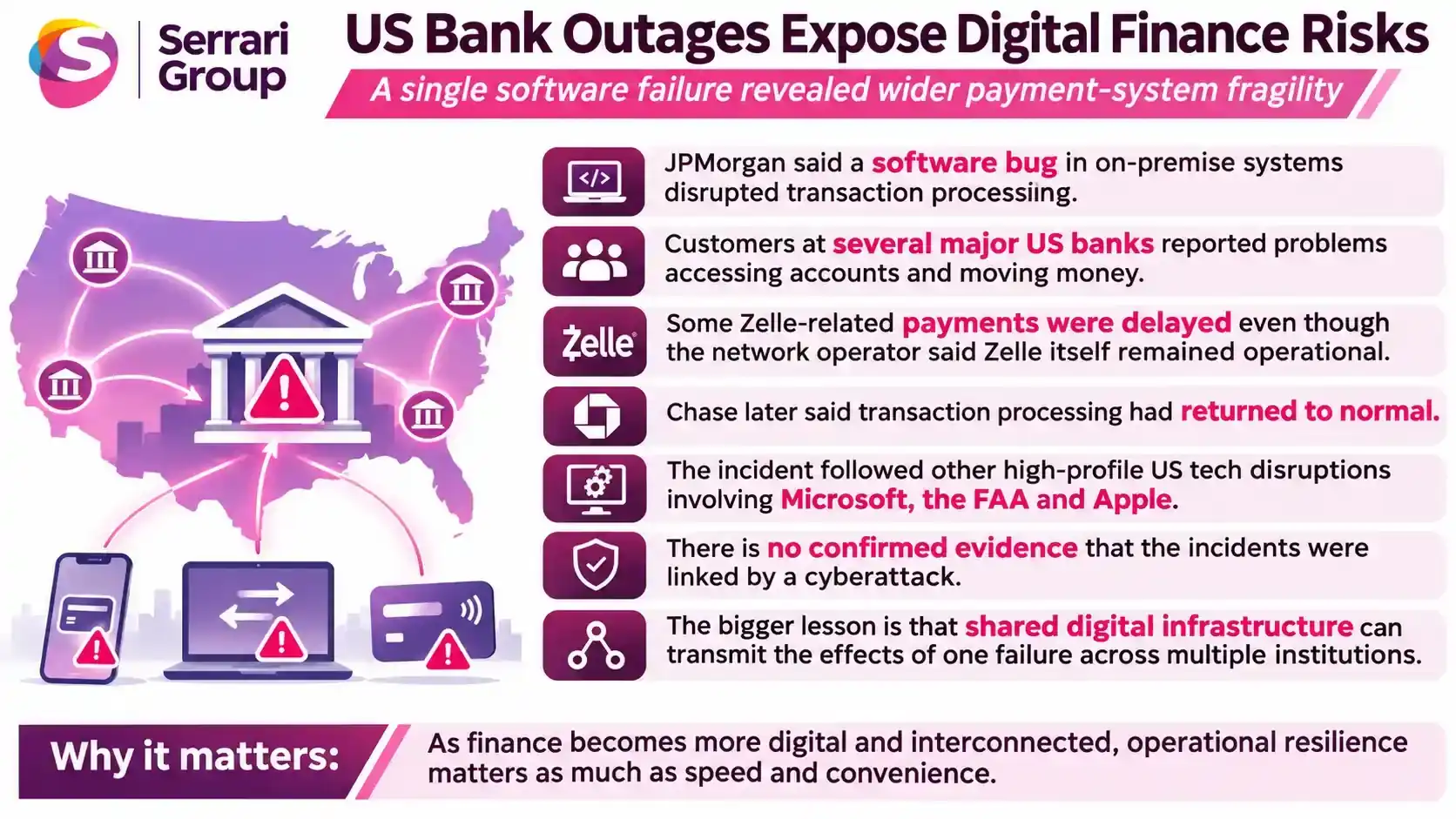
A software failure at JPMorgan Chase disrupted transactions on November 16, 2026, generating complaints from customers of several major US banks and drawing attention to the financial system’s interconnected technology. It followed interruptions at Microsoft and the Federal Aviation Administration and preceded another outage affecting Apple services. Although the incidents have different reported causes and no demonstrated common attack, their concentration within days has sharpened questions about operational resilience, reliance on shared infrastructure, customer protection and the financial consequences of systems that cannot reliably remain online.
Key Overview
- Banking trigger: JPMorgan attributed transaction delays to a software bug affecting its on-premises hardware systems, not a confirmed cyberattack.
- Wider disruption: Customers reported difficulties at other banks and with Zelle-related transfers, even though Zelle’s network operator said its platform remained operational.
- Multiple sectors: Microsoft, US aviation systems, United Airlines and Apple suffered separate technology disruptions between November 12 and 17.
- Market implications: Bank stocks declined amid the outages, but a broader equity sell-off prevents a simple one-cause explanation.
- Strategic concern: Shared payment connections and critical software dependencies can transmit the effects of an isolated fault across institutions.
- Regulatory outlook: Policymakers are pressing for clearer customer communication, compensation where warranted and stronger management of technology risk.
Why a JPMorgan Software Bug Affected Customers Beyond One Bank
On Monday, November 16, customers of JPMorgan Chase and several other US financial institutions reported problems accessing online banking, completing transfers and using payment services. The incident was especially unsettling because it involved ordinary financial activities that users increasingly expect to work instantly: checking balances, moving money and paying other people.
JPMorgan identified the immediate problem as a software bug in its on-premises systems. The bank said certain transactions were taking longer than usual, stressed that customers retained access to their accounts and funds, and said there was no evidence of a cyber-related cause. By Monday evening, transaction processing had returned to normal, according to subsequent banking service updates.
The distinction between a customer report and an institution-wide outage matters. Complaints surfaced involving Bank of America, Wells Fargo, Capital One and US Bancorp, but those reports do not prove every institution’s own systems failed. Bank of America said its systems operated normally, while US Bancorp indicated that customers might encounter delays sending Zelle payments to other banks despite its own systems not being directly affected. Zelle’s operator likewise maintained that its network was operating.
That combination helps explain how a fault at one large bank can produce problems that appear far more widespread. Transfers are not independent events within sealed banking applications. They involve sending and receiving banks, processing infrastructure, communications channels, reconciliation and sometimes third-party payment arrangements. A delay in one part of a transaction chain can leave a customer at another institution waiting for money, even if that second bank’s app is functioning.
This is the central financial-stability lesson: a technical incident need not disable the entire payment network to interrupt the movement of money. When a major participant experiences processing delays, the effects can travel through interconnected transactions faster than customers can identify where the fault began.
Why Consecutive Outages Have Raised Bigger Questions
The banking incident was part of an unusually visible sequence of failures, not evidence that all those failures shared a cause. On November 12, Microsoft’s Outlook, Teams and other Microsoft 365 services were disrupted. Subsequent technical findings on the Microsoft incident described an older software defect, traffic pressures and reduced capacity contributing to the disruption.
On November 13, the Federal Aviation Administration implemented a nationwide ground stop following a telecommunications failure. In its official account of the aviation disruption, the agency reported approximately 12,462 flight cancellations that day. United Airlines then experienced a separate system outage on November 16, further focusing attention on the operational vulnerability of air travel.
The following day, Apple customers encountered problems involving iCloud, the App Store and other services, with reports also affecting Apple Pay. Apple attributed its difficulties to an internal update that disrupted services and said the incident was not a cyberattack. Most affected services were being restored as the company worked through the remaining problems.
The confirmed explanations therefore point to different technical faults rather than a single verified conspiracy or coordinated intrusion. Yet their timing matters. Each incident occurred in an essential system used by large numbers of people or businesses. Taken together, they reveal the extent to which routine commercial and public services depend on software upgrades, network gateways, hardware configurations and recovery procedures working exactly as intended.
A change designed to improve capacity or performance can unintentionally trigger failure elsewhere. The potential for disruption is particularly significant when a platform serves millions of users or sits between numerous other organizations. The broader question is not whether complex technology can fail—it inevitably can—but whether safeguards prevent one error from becoming an economic disruption.
What Customers and Businesses Stand to Lose
For a household, a failed payment may mean a missed bill, a delayed rent transfer or uncertainty about whether money has left an account. For a small business, a failed or delayed receipt can disrupt payroll, supplier settlements or working-capital planning. Even short incidents can be costly when payments fall near contractual deadlines.
Customers also face an information problem. An error message rarely explains whether a transaction has been rejected, delayed, queued or completed without confirmation. Sending the payment again could risk duplication, while doing nothing might prolong a missed obligation. Banks therefore need to communicate not only that an outage exists, but also which functions are affected, whether balances and funds remain secure and what users should do while waiting for recovery.
The harm can extend beyond temporary inconvenience. Repeated failures may weaken confidence in mobile and online banking, particularly for consumers who have few alternatives to digital channels. Businesses, meanwhile, must consider whether dependence on one bank, payment route or software service creates an avoidable operational bottleneck.
There is a practical fraud dimension, too. Service disruptions create opportunities for criminals to impersonate bank support teams, send fraudulent restoration notices or request account credentials. Customers should verify updates through their bank’s established channels rather than links in unsolicited messages, and retain evidence of attempted transfers or unexpected charges.
Context is everything. Stay ahead of shifting trends with today’s market updates, and uncover emerging opportunities using the Serrari Group Market Index and Marketplace. Then, take control of your own financial future by exploring our Money & Life Reset Transformation Blueprint ™ to build stronger habits, create better systems, and design a path toward lasting wealth.
Why Falling Bank Stocks Do Not Tell the Whole Story
Financial markets registered the disruption while also reacting to broader selling pressure. JPMorgan, Bank of America, Wells Fargo and Capital One shares declined around the period of the banking complaints. The reported market reaction to bank disruptions reflected immediate concern about the reliability of customer-facing financial services.
However, it would be misleading to attribute every decline to the software failure. US equities were also under pressure from technology-sector weakness and concerns surrounding artificial-intelligence valuations. The broader November 17 market retreat illustrates why company-specific operational headlines must be interpreted alongside the trading environment.
What matters beyond a single session is whether outages lead to higher costs, lost business or regulatory scrutiny. Financial institutions may need to invest more in redundant infrastructure, testing, recovery systems, incident monitoring and customer-service capacity. Those expenses can weigh on margins in the short term but may be necessary to protect trust and avoid more severe operational losses.
Investors should therefore distinguish between a brief, resolved malfunction and evidence of a persistent weakness in a bank’s operational controls. The former may have limited lasting financial impact; the latter could affect reputation, oversight requirements and future profitability.
Why Regulators Are Paying Closer Attention
The outages also arrive as supervisors are reconsidering how financial institutions manage technology and outside providers. On November 13, US banking agencies extended consultation on third-party risk guidance, part of an effort to improve oversight of dependencies that can affect banks’ operations. That regulatory process predates the November 16 banking incident and should not be presented as a direct response to it.
The latest disruption nonetheless reinforces the relevance of that debate. A bank can invest heavily in cybersecurity yet still be vulnerable to faulty updates, overloaded systems, unavailable partners or inadequate failover arrangements. Operational resilience requires identifying critical services, mapping dependencies, testing realistic failures and ensuring recovery plans function under pressure.
Political scrutiny has also increased. Representative Maxine Waters called for transparency about disrupted services and their resolution, arguing that regulators should ensure harmed customers are made whole. Her statement on the banking interruptions reflects the growing expectation that banks explain incidents in terms customers can understand rather than relying solely on technical diagnoses.
That expectation creates a second test for institutions: response quality. Even when a bank cannot prevent every fault, it can provide timely updates, clarify payment status, make support staff accessible and review fees or financial harm caused by the disruption. A technically successful repair is not sufficient if customers remain uncertain about their money.
The Bigger Picture: Digital Efficiency Now Requires Digital Resilience
Banking, commerce, cloud software and aviation have all benefited from interconnected technology that accelerates transactions and expands access. The same connectivity can also magnify operational mistakes. The faster money and information move through shared systems, the greater the importance of knowing where dependencies sit and how failures can be contained.
The November incidents do not establish a systemic collapse, nor do they demonstrate a coordinated cyberattack. They do expose a recurring structural challenge: large institutions increasingly operate as interdependent technology networks, while consumers experience the entire chain as one service that should simply work.
For customers, the immediate response is to monitor payments, preserve transaction records and use verified support channels. For businesses, it is to review continuity plans and alternatives for time-sensitive payments. For banks and regulators, the priority is more demanding: resilience must be engineered into daily operations, tested across organizational boundaries and communicated clearly when things go wrong.
The reason this matters now is that digital dependence is already a fact of economic life. The question is no longer whether critical systems will encounter software faults, but whether institutions can stop those faults from becoming a crisis of confidence.
Sources: Associated Press / Reuters / Banking Dive / BleepingComputer / Federal Aviation Administration / Barron’s / Federal Reserve / U.S. House Committee on Financial Services Democrats
Your financial future isn’t something you wait for—it’s something you build.
The real question is: when do you begin?
Move beyond simply staying informed.
Navigate the markets with clarity—track trends through the Serrari Group Market Index, uncover opportunities in the Serrari Marketplace, and build practical knowledge with our Curated Wealth Builder Platform.
Stay connected to what truly matters.
Get daily insights on macro trends and financial movements across Kenya, Africa, and global markets—delivered through the Serrari Newsletter.
Growth opens doors.
Advance your career through professional programs including ACCA, HESI A2, ATI TEAS 7 , HESI EXIT , NCLEX – RN and NCLEX – PN, Financial Literacy!🌟—designed to move you forward with confidence.
See where money is flowing—clearly and in real time.
Track Money Market Funds, Treasury Bills, Treasury Bonds, Green Bonds, and Fixed Deposits, alongside global and African indexes, key economic indicators, and the evolving Crypto and stablecoin landscape—all within Serrari’s Market Index.