Kenya and Singapore have signed a legally binding agreement to cooperate on carbon credit generation and transfers under Article 6.2 of the Paris Agreement. The agreement creates a framework for Singapore-linked investment in eligible Kenyan climate projects, including initiatives involving forests, wetlands, grasslands, mangroves and renewable energy. It also establishes procedures for approving projects, authorising Internationally Transferred Mitigation Outcomes (ITMOs), monitoring emissions reductions and preventing double counting. Singapore has committed to allocating 5% of proceeds from authorised carbon credits towards climate adaptation measures in Kenya. The agreement builds on a memorandum of understanding signed by the two countries in May 2023.
Key Takeaways
- Kenya and Singapore have signed a legally binding carbon credit cooperation agreement under Article 6.2 of the Paris Agreement.
- The agreement allows eligible Kenyan climate projects to generate and transfer authorised carbon credits to Singapore.
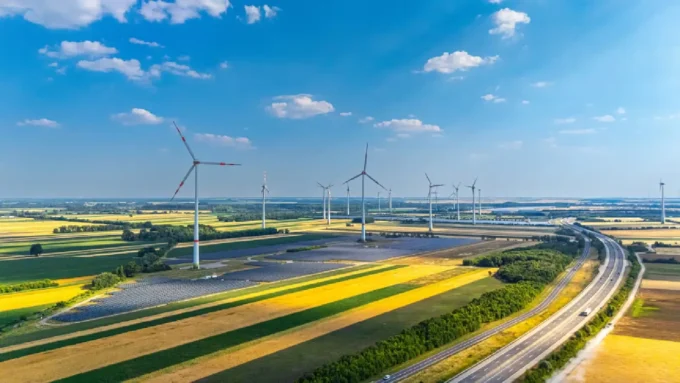
- Kenya’s potential project areas include forests, wetlands, grasslands, mangroves and renewable energy.
- The framework provides for project approval, authorisation of ITMOs, joint oversight and transparent carbon registry arrangements.
- Singapore has committed to allocating 5% of proceeds from authorised carbon credits towards climate adaptation measures in Kenya.
- Kenya must apply corresponding adjustments to transferred emissions reductions to prevent double counting.
- Implementation will require a Joint Committee, common approval procedures and stronger monitoring, reporting and verification systems.
What Is the Kenya–Singapore Carbon Trading Agreement?
Kenya has entered into an agreement with Singapore with a view of exploring opportunities offered by carbon trade.
The agreement with Singapore provides an important platform for mobilising international investment and encouraging greater private-sector participation in eligible mitigation activities.
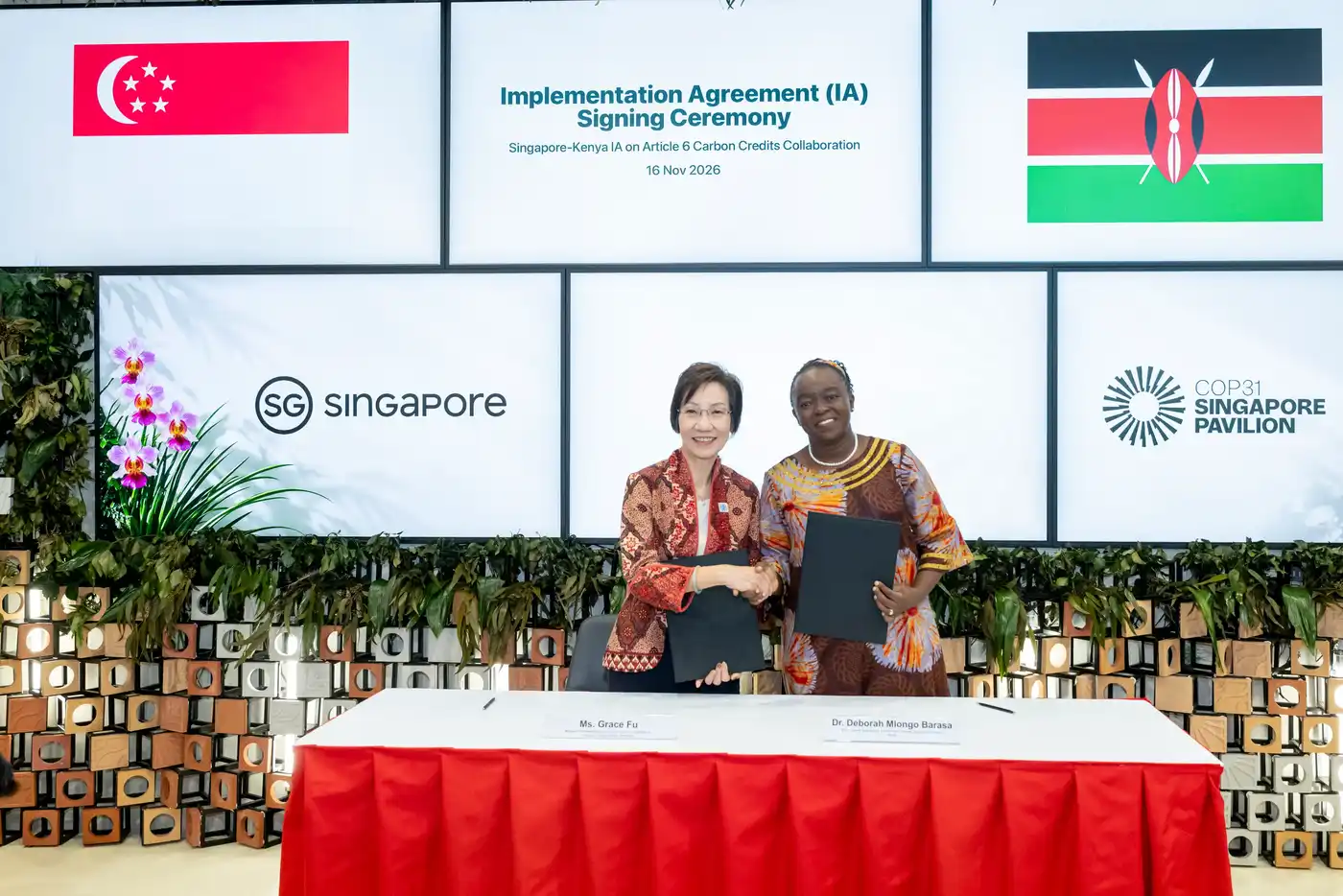
Environment Cabinet Secretary Dr Deborah Barasa and Singapore’s Minister for Sustainability and the Environment and Minister-in-charge of Trade Relations, Grace Fu, presided over the signing ceremony at the Singapore Pavilion.
The agreement establishes an operational framework for cooperation under Article 6.2 of the Paris Agreement, allowing the two countries to work together on carbon credit generation and the transfer of verified greenhouse gas emission reductions.
The latest agreement builds on a Memorandum of Understanding signed by the two countries in Nairobi on May 18, 2023.
The earlier memorandum established the basis for cooperation, while the latest agreement takes the partnership further by setting out procedures for approving mitigation activities and authorising international carbon credit transfers.
Barasa described the signing as an important milestone in strengthening bilateral relations and advancing practical solutions to climate change.
“Climate change is not merely an environmental challenge; it is an economic, social and development challenge that demands innovative financing, strong partnerships and collective action,” she said.
The agreement is expected to create opportunities for Singapore-linked investment in eligible Kenyan climate projects while supporting the country’s efforts to meet its climate commitments.
How Does Article 6.2 of the Paris Agreement Work?
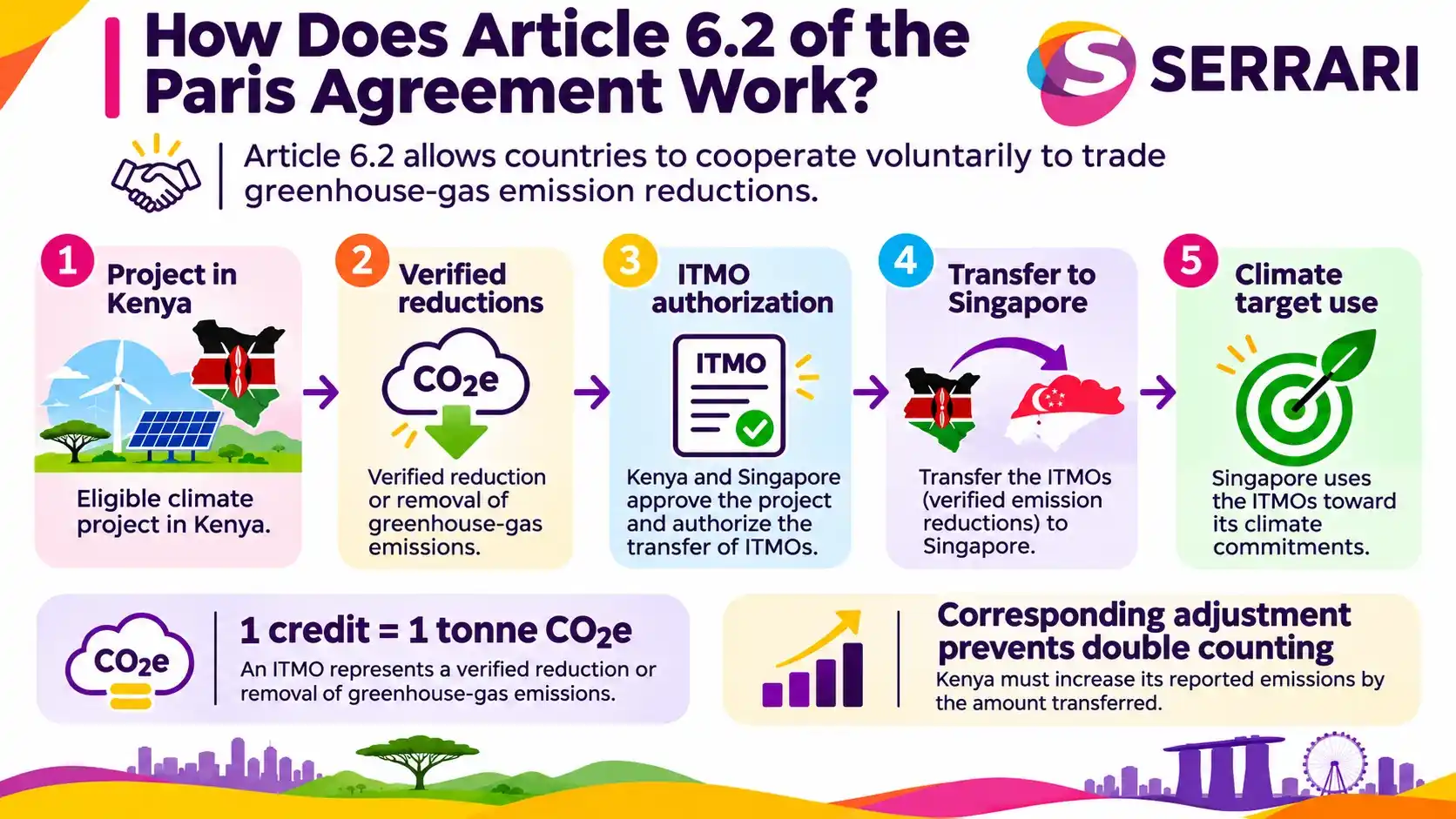
The agreement is based on Article 6.2 of the Paris Agreement, which enables countries to cooperate voluntarily through bilateral or multilateral arrangements to trade greenhouse gas emission reductions.
Under this mechanism, one country can support emissions-reduction activities in another country and acquire authorised emissions-reduction outcomes for use towards its climate commitments.
Under the agreement, Kenya and Singapore will establish procedures for approving climate projects and authorising the transfer of Internationally Transferred Mitigation Outcomes (ITMOs), which represent verified reductions or removals of greenhouse gas emissions.
An ITMO is an authorised emissions-reduction or removal outcome transferred between countries under the Article 6 framework.
For example, an eligible project in Kenya could generate verified emissions reductions. Subject to the required approvals and authorisations, these reductions could be transferred to Singapore for use towards its climate targets.
However, the transfer requires proper accounting by both countries.
Under Article 6, a host country will have to increase its reported emissions by the amount of carbon credits it has transferred to Singapore to avoid double-counting, in a move known as corresponding adjustments.
This accounting process is called a corresponding adjustment. It ensures that the same emissions reduction is not counted towards the climate targets of both countries.
One carbon credit represents a reduction or removal of one tonne of carbon dioxide equivalent.
The agreement therefore provides a framework for ensuring that transferred credits are properly accounted for and supported by credible emissions-reduction information.
Which Kenyan Projects Could Benefit From Carbon Trading?
Kenya’s natural resources and renewable energy potential provide opportunities for developing projects that could participate in international carbon markets.
Kenya is endowed with significant natural capital, including our forests, wetlands, grasslands, mangroves and renewable energy resources.
These resources can support climate mitigation activities, including projects that protect or restore natural ecosystems and initiatives that reduce greenhouse gas emissions through renewable energy.
Barasa said carbon markets provide Kenya with an opportunity to mobilise climate finance, attract investment and accelerate the implementation of its Nationally Determined Contribution (NDC).
The agreement is intended to encourage investment in eligible mitigation activities, although it does not identify specific Kenyan projects that have already received approval for carbon credit transfers.
Kenya is seeking to attract international investment into its forests, wetlands and renewable energy projects through carbon trading after signing a climate cooperation agreement with Singapore.
This creates opportunities for project developers and investors to explore initiatives that can generate verified emissions reductions while supporting local economic and environmental priorities.
However, projects will need to meet the applicable requirements before their carbon credits can be authorised for international transfer.
How Will Kenya Ensure Carbon Credits Are Properly Accounted For?
A key part of the agreement is establishing systems that ensure emissions reductions are properly measured, documented and verified.
The framework provides for joint institutional oversight, transparent reporting and carbon registry systems.
The CS said the agreement also provides for corresponding adjustments, joint institutional oversight, transparent reporting and registry arrangements to ensure that every authorized transfer is properly accounted for and that double counting is avoided.
Monitoring, reporting and verification (MRV) systems will play an important role in this process.
These systems help establish how much greenhouse gas emissions a project has reduced or removed, how the results are documented and whether the reported outcomes can be independently verified.
They are particularly important in carbon markets because buyers and participating countries need confidence that credits represent genuine and properly accounted-for emissions reductions.
Kenya has already established a legal and institutional framework to govern carbon market activities.
Through the Climate Change (Amendment) Act, 2023, and the Climate Change (Carbon Markets) Regulations, 2024, the country has established a legal and institutional framework to ensure that carbon market activities in Kenya are transparent, accountable and anchored in environmental integrity.
The latest agreement builds on these national regulations by establishing procedures for international cooperation with Singapore.
Barasa emphasised that Kenya’s participation in international carbon markets must remain guided by the protection of its national climate ambitions, environmental integrity and the interests of its people.
“We must maintain robust carbon accounting systems, effective monitoring and reporting, strong regulatory oversight and appropriate environmental and social safeguards. Our commitment is clear: Kenya welcomes climate investment, but such investment must operate within our laws, respect our national priorities and deliver credible and measurable outcomes,” she said.
Context is everything. Stay ahead of shifting trends with today’s market updates, and uncover emerging opportunities using the Serrari Group Market Index and Marketplace. Then, take control of your own financial future by exploring our Money & Life Reset Transformation Blueprint ™ to build stronger habits, create better systems, and design a path toward lasting wealth.
How Much of the Carbon Credit Revenue Will Support Climate Adaptation in Kenya?
Beyond facilitating carbon credit transfers, the agreement also provides for a share of proceeds to support climate adaptation.
Singapore has committed to allocating 5% of the proceeds from authorised carbon credits to support climate adaptation measures in Kenya.
This provision creates a potential financial channel through which carbon market activity can contribute to Kenya’s efforts to prepare for and respond to climate impacts.
Climate adaptation involves measures that help communities, infrastructure and economic activities cope with the effects of climate change. These can include improving resilience to droughts and floods, strengthening water management and protecting vulnerable ecosystems.
The allocation is linked to proceeds from authorised carbon credits. The supplied material does not specify the expected revenue, the total volume of credits or the precise projects that will receive adaptation funding.
The actual amount available will therefore depend on the carbon credits generated, authorised and transferred under the agreement.
What Benefits Could the Agreement Bring to Kenyan Communities?
The government has emphasised that carbon market investment should deliver benefits beyond the generation and sale of carbon credits.
“We must ensure that carbon market investments do more than generate carbon credits. They must create jobs, support local communities, protect biodiversity, improve livelihoods and contribute to our broader national development priorities,” Barasa said.
This means that eligible projects are expected to consider their wider environmental and social impacts.
For example, projects involving forests, wetlands and mangroves could support ecosystem protection while creating opportunities for communities involved in their conservation and sustainable management.
Renewable energy projects could also attract investment while contributing to emissions reductions and supporting Kenya’s transition towards cleaner energy.
Barasa said the country could unlock the value of its natural resources through high-integrity carbon markets while ensuring that communities involved in protecting and sustainably managing these resources benefit from climate action.
She also stressed that the opportunity must go hand in hand with accountability.
The agreement therefore places emphasis on environmental and social safeguards, regulatory oversight and credible emissions accounting.
What Does the Agreement Mean for Singapore?
For Singapore, the agreement provides another route to access authorised carbon credits generated through eligible projects in partner countries.
The agreement with Kenya is the 13th that Singapore has entered into, following similar deals inked with Papua New Guinea, Ghana, Bhutan, Peru, Chile, Rwanda, Paraguay, Thailand, Vietnam, Mongolia, the Philippines and Laos.
The collaboration also marks Singapore’s third carbon credit implementation agreement with an African country, following partnerships with Ghana and Rwanda.
The arrangement forms part of Singapore’s broader efforts to develop international carbon credit partnerships under Article 6 of the Paris Agreement.
Companies may use authorised carbon credits to offset up to 5% of their taxable emissions under Singapore’s International Carbon Credit framework.
The credits may also contribute towards compliance with national climate commitments, including Nationally Determined Contributions and other international mitigation efforts.
For Singapore, access to eligible carbon credits can support its climate strategy, while the agreement creates opportunities for investment in mitigation projects beyond its borders.
However, credits must meet the applicable eligibility and authorisation requirements before they can be used.
What Happens Next Following the Signing?
The signing of the agreement is only the beginning of the implementation process.
Barasa said the success of the partnership will depend on how effectively both countries translate its provisions into action.
The immediate priorities following the entry into force of the agreement will include operationalising the Joint Committee, developing common procedures for project approval and authorization, establishing the eligible crediting programs and methodologies, and strengthening registry and reporting arrangements.
These steps will provide the institutional and technical foundation for identifying and approving eligible carbon projects.
The Joint Committee is expected to support cooperation between the two countries, while common procedures will help guide project assessment and authorisation.
The parties will also need to establish eligible crediting programmes and methodologies to determine how emissions reductions are measured and verified.
Barasa encouraged technical teams, project developers, investors and other stakeholders to work together in identifying opportunities that can translate the partnership into tangible climate and economic benefits.
The agreement does not yet provide a confirmed list of approved projects, expected carbon credit volumes or a timeline for the first transfers.
The Bigger Picture
The Kenya–Singapore agreement highlights the growing role of international carbon markets in mobilising climate finance and supporting emissions-reduction activities.
For Kenya, the partnership creates a framework for attracting international investment into eligible projects involving natural ecosystems and renewable energy. It also provides an opportunity to strengthen the country’s carbon market institutions and regulatory systems.
For Singapore, the agreement expands its network of international carbon credit partnerships and creates access to authorised emissions-reduction outcomes from eligible Kenyan projects.
The arrangement also highlights the importance of ensuring that carbon trading delivers measurable environmental benefits and does not undermine the climate commitments of participating countries.
The 5% allocation of proceeds towards climate adaptation in Kenya adds another dimension to the partnership, linking carbon market activity with support for communities and climate resilience.
However, the success of the agreement will depend on project development, regulatory approvals, credible carbon accounting and the actual flow of investment.
Why Does This Matter Now?
Kenya is seeking to mobilise more financing for climate action while strengthening its position in international carbon markets.
The agreement with Singapore provides an operational framework for transferring authorised emissions-reduction outcomes under Article 6.2 of the Paris Agreement.
It also creates opportunities for private-sector participation in eligible climate projects and establishes safeguards intended to ensure that carbon credits represent properly accounted-for emissions reductions.
For project developers and investors, the agreement provides a basis for exploring opportunities in Kenya’s natural resources and renewable energy sectors.
For local communities, the potential benefits include employment, improved livelihoods, biodiversity protection and support for climate adaptation.
The next stage will be particularly important: the establishment of the Joint Committee, approval procedures and eligible crediting methodologies will determine how quickly the partnership can translate into actual projects and carbon credit transfers.
Outlook
Kenya’s carbon trading agreement with Singapore creates a framework for attracting international investment into eligible climate mitigation projects while supporting the country’s climate commitments.
Its implementation will depend on the establishment of project approval procedures, carbon accounting systems and institutional arrangements under Article 6.2 of the Paris Agreement.
The commitment to allocate 5% of authorised carbon credit proceeds towards climate adaptation could also provide an additional benefit for Kenya, although the actual funding will depend on future carbon credit transactions.
For now, the key developments to watch are the operationalisation of the Joint Committee, the identification of eligible projects and the authorisation of the first international carbon credit transfers.
Frequently Asked Questions
1. What agreement have Kenya and Singapore signed?
Kenya and Singapore have signed a legally binding implementation agreement to cooperate on carbon credit generation and transfers under Article 6.2 of the Paris Agreement.
2. What is Article 6.2 of the Paris Agreement?
Article 6.2 allows countries to cooperate voluntarily through bilateral or multilateral agreements to transfer internationally authorised greenhouse gas emissions reductions, known as Internationally Transferred Mitigation Outcomes (ITMOs).
3. How will Kenya benefit from the carbon trading agreement?
The agreement could attract international investment into eligible Kenyan climate projects, encourage private-sector participation, support job creation and strengthen climate adaptation. Singapore has also committed to allocating 5% of proceeds from authorised carbon credits towards climate adaptation measures in Kenya.
4. How will the agreement prevent double counting of carbon credits?
The agreement provides for corresponding adjustments, transparent reporting and carbon registry arrangements. Kenya will account for transferred emissions reductions in its national emissions reporting to ensure that the same reductions are not claimed by both countries.
Your financial future isn’t something you wait for—it’s something you build.
The real question is: when do you begin?
Move beyond simply staying informed.
Navigate the markets with clarity—track trends through the Serrari Group Market Index, uncover opportunities in the Serrari Marketplace, and build practical knowledge with our Curated Wealth Builder Platform.
Stay connected to what truly matters.
Get daily insights on macro trends and financial movements across Kenya, Africa, and global markets—delivered through the Serrari Newsletter.
Growth opens doors.
Advance your career through professional programs including ACCA, HESI A2, ATI TEAS 7 , HESI EXIT , NCLEX – RN and NCLEX – PN, Financial Literacy!🌟—designed to move you forward with confidence.
See where money is flowing—clearly and in real time.
Track Money Market Funds, Treasury Bills, Treasury Bonds, Green Bonds, and Fixed Deposits, alongside global and African indexes, key economic indicators, and the evolving Crypto and stablecoin landscape—all within Serrari’s Market Index.