Global artificial intelligence stocks recovered part of their sharp losses on November 12, 2026, after Nvidia founder Jensen Huang’s abrupt departure as chief executive unsettled a sector already facing questions about expensive data centres, debt-funded expansion and regulation. Nvidia-backed cloud operators CoreWeave and Nebius were among the casualties, while chip competitors AMD and Broadcom gained as investors considered whether customers might diversify their suppliers. The contrasting moves highlight a deeper concern: the AI investment boom depends not only on demand for chips, but also on reliable financing, predictable leadership and confidence that enormous infrastructure investments will ultimately generate sustainable returns.
Key Overview
- Leadership shock: Huang resigned as Nvidia president, CEO and director, with longtime finance chief Colette Kress appointed interim CEO.
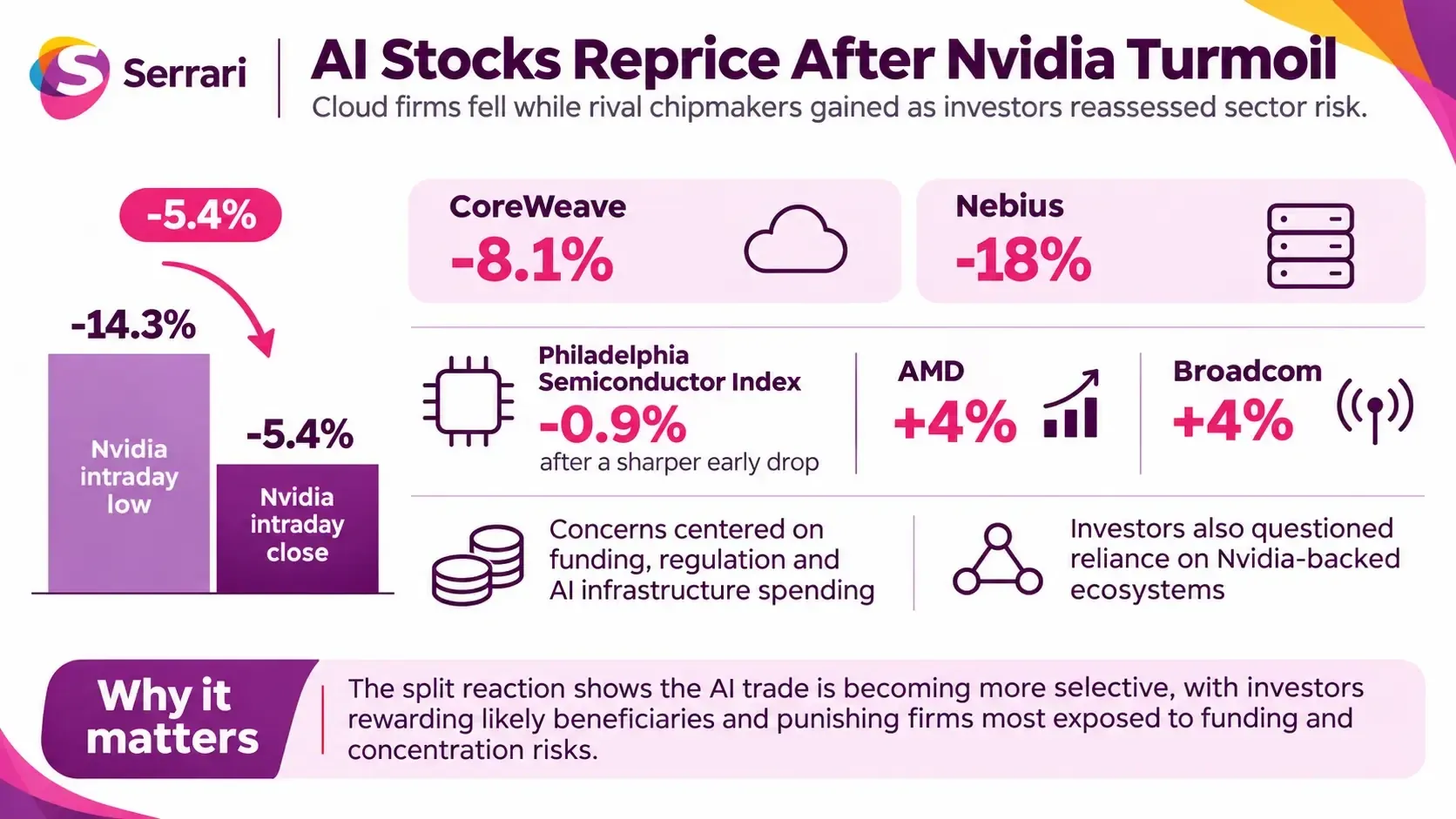
- Volatile market: In November 12 intraday reporting, Nvidia was down 5.4% after falling as much as 14.3%; these are snapshots, not its closing return.
- Cloud-sector losses: Nvidia-backed CoreWeave fell 8.1% in the same report, while Nebius declined 18% amid a lower revenue forecast linked to capacity delays.
- Chip rivals gain: AMD and Broadcom rose more than 4% in the reported trading window as investors speculated they might win additional business.
- Funding concern: Nvidia’s investments in chip-buying infrastructure companies are prompting questions about financial interdependence across the AI supply chain.
- Next catalyst: Nvidia is scheduled to publish quarterly results on November 17, providing another test of customer demand and management continuity.
Why Huang’s Departure Triggered a Sector-Wide Reassessment
The immediate catalyst was Nvidia’s confirmed leadership transition. The company announced on November 12 that Huang had resigned effective immediately and that Kress would hold the top role while the board searched for a permanent successor. Harvey Jones was appointed board chair, separating that function from the chief executive role.
The resignation followed news reports concerning Huang’s personal relationships and allegations that he had been targeted by a foreign intelligence operation. Nvidia’s board announced an independent investigation but expressly stated that it had no reason to believe national security or company secrets had been compromised. The allegations must not be treated as proof of espionage or disclosure of confidential technology.
Why should one executive’s exit affect so many listed companies? Huang was closely identified with Nvidia’s product strategy, commercial partnerships and role in shaping the wider AI computing market. Nvidia sells the hardware and integrated systems used by cloud providers and AI model developers, while also investing in businesses building capacity around that technology. An unexpected change at the centre of those relationships creates uncertainty for investors across the network.
The board says its customer commitments and product roadmap should continue uninterrupted. That is important reassurance, but investors now need evidence that a new management structure can maintain the same execution, negotiate major contracts and manage mounting political scrutiny. A temporary change in investor confidence can affect financing decisions even before orders or deliveries change.
Why Cloud Providers Suffered More Than Some Chip Rivals
The steepest falls were concentrated in some specialist AI infrastructure companies, often called neoclouds. They typically invest heavily in graphics processors and data-centre capacity, then rent computing power to AI developers and other customers. Their economics can depend on high equipment utilisation, continued access to capital and contracts that support costly expansion.
During Thursday’s trading, Nvidia-backed CoreWeave was down 8.1%, while Nebius fell 18% in the November 12 market update. Nebius faced an additional company-specific problem: delays in third-party capacity additions led it to reduce its 2026 revenue outlook. Its loss therefore should not be attributed solely to Nvidia’s leadership crisis.
Other infrastructure-related names, including IREN and Applied Digital, also weakened. Investors were assessing a common risk: if financing becomes more expensive, deployment takes longer or large customers slow their spending, businesses committed to buying and operating vast amounts of computing equipment may see their expected returns deteriorate.
AMD and Broadcom moved in the opposite direction, rising more than 4% in the same intraday report. Investors appeared to be considering whether enterprises would seek additional suppliers after the disruption at Nvidia. Alternative accelerators and custom chip designs can help customers avoid relying entirely on one vendor, although qualifying hardware and adapting software takes time.
These moves do not establish that Nvidia has lost market share. A rising competitor’s stock may represent an expectation rather than a signed contract. Equally, a falling cloud provider’s share price does not prove that customers are cancelling orders. The market was pricing potential changes in competition and financing before evidence of a lasting operational shift.
The Bigger Risk: Who Finances the AI Build-Out?
A central concern is the relationship between the companies that supply AI chips and those that finance, purchase and operate them. Nvidia has invested in some infrastructure businesses that also buy its technology. Such arrangements can support growth by helping promising customers secure capacity, but they also raise questions about how independent demand is from the funding circulating within the ecosystem.
Critics describe this concern as circular financing. The issue is not that supplier investments are inherently improper; it is whether future revenue assumptions depend on repeated capital injections and continued confidence from the same group of companies. If a financing source withdraws, a customer may have less room to expand equipment orders, potentially affecting both the cloud operator and its supplier.
The sell-off illustrates how quickly correlated risks can surface. Investors in a chipmaker, an AI cloud company and a data-centre contractor may appear to own different businesses, yet their fortunes can depend on the same underlying spending commitments. Portfolio diversification by ticker alone may therefore offer less protection than expected during a sector-wide reassessment.
Higher interest rates and growing borrowing needs make those links more consequential. Large data centres require upfront spending on chips, electrical infrastructure, cooling, networking and land. Even when demand is strong, there may be a substantial delay before assets are installed and generating revenue. Debt servicing can continue throughout that period, creating pressure when projects slip behind schedule.
For investors, the relevant questions are whether cloud customers are paying enough to justify capital spending, how much capacity is already contractually committed and whether firms can finance obligations without repeated fundraising. The answer is company-specific, not a simple verdict on all AI investment.
Context is everything. Stay ahead of shifting trends with today’s market updates, and uncover emerging opportunities using the Serrari Group Market Index and Marketplace. Then, take control of your own financial future by exploring our Money & Life Reset Transformation Blueprint ™ to build stronger habits, create better systems, and design a path toward lasting wealth.
Why Nvidia’s Financial Strength Still Matters
The leadership turmoil comes against an unusually strong operating backdrop. Nvidia reported second-quarter fiscal 2027 revenue of $96.2 billion, a 106% year-on-year increase, with its data-centre segment generating $89 billion. It also forecast approximately $108 billion in revenue for the next quarter, subject to its stated assumptions.
Those figures distinguish the company’s operational performance from its immediate governance problems. Investors were not reacting to an announced collapse in chip sales. Instead, they were reducing their willingness to pay for future earnings amid uncertainty about leadership, policy and the durability of AI-related capital expenditure.
That distinction helps explain the intraday rebound. Buyers who believed Nvidia’s technology advantages and customer relationships would survive the transition were prepared to purchase shares after the initial decline. An early-session $111 million net retail buying flow, reported using market-flow estimates, suggested considerable appetite to buy the dip, though such flows cannot establish the eventual direction of prices.
The rebound does not eliminate the larger debate about valuation. A company can deliver exceptional earnings while its share price declines if investors assign a lower multiple to those earnings. Conversely, strong results and reassuring guidance may help rebuild confidence, provided financing concerns elsewhere in the ecosystem do not worsen.
Regulation Adds Another Layer of Uncertainty
The corporate crisis is unfolding amid sensitivity over US restrictions on advanced technology exports, possible national-security exposures and the political consequences of building power-hungry data centres. Government decisions can influence where the most advanced chips may be sold, how overseas customers access computing capacity and whether large infrastructure projects receive local approvals.
Nvidia’s latest published outlook excluded data-centre compute revenue from China, illustrating that geopolitical limits already affect its assumptions. Heightened scrutiny following the investigation may increase uncertainty, but additional restrictions should not be presented as inevitable before authorities announce them.
Meanwhile, communities and policymakers are increasingly examining electricity demand, land use and environmental costs associated with AI facilities. Delayed permits or grid connections can make projects more expensive and complicate cloud providers’ revenue projections. For businesses pursuing rapid capacity growth, these practical barriers can be as important as chip availability.
What the Sell-Off Means for Investors and the AI Economy
The November 12 moves were not simply a referendum on Huang’s resignation. They exposed different expectations about which businesses might lose financing flexibility, which could benefit from customer diversification and which remain supported by substantial operating cash flow.
Nvidia’s November 17 earnings report will provide a near-term test of the demand picture, while the permanent CEO search and independent investigation will determine how quickly governance uncertainty recedes. Cloud providers will face their own tests through capacity delivery, contract performance, debt costs and cash generation.
For retail investors and retirement portfolios, the broader lesson is that AI exposure can be concentrated even across several apparently distinct technology holdings. When chipmakers, cloud operators and data-centre developers depend on one interconnected spending cycle, a disruption at a central firm can spread rapidly.
The AI boom may continue to generate strong commercial demand. The issue now is whether the industry’s financing structure and management institutions are resilient enough to sustain that growth. Thursday’s partial recovery showed that investors had not abandoned AI, but the breadth of the initial decline showed that confidence in its economics can no longer be taken for granted.
Sources
Reuters / NVIDIA / U.S. Securities and Exchange Commission / Associated Press / Yahoo Finance
Your financial future isn’t something you wait for—it’s something you build.
The real question is: when do you begin?
Move beyond simply staying informed.
Navigate the markets with clarity—track trends through the Serrari Group Market Index, uncover opportunities in the Serrari Marketplace, and build practical knowledge with our Curated Wealth Builder Platform.
Stay connected to what truly matters.
Get daily insights on macro trends and financial movements across Kenya, Africa, and global markets—delivered through the Serrari Newsletter.
Growth opens doors.
Advance your career through professional programs including ACCA, HESI A2, ATI TEAS 7 , HESI EXIT , NCLEX – RN and NCLEX – PN, Financial Literacy!🌟—designed to move you forward with confidence.
See where money is flowing—clearly and in real time.
Track Money Market Funds, Treasury Bills, Treasury Bonds, Green Bonds, and Fixed Deposits, alongside global and African indexes, key economic indicators, and the evolving Crypto and stablecoin landscape—all within Serrari’s Market Index.