
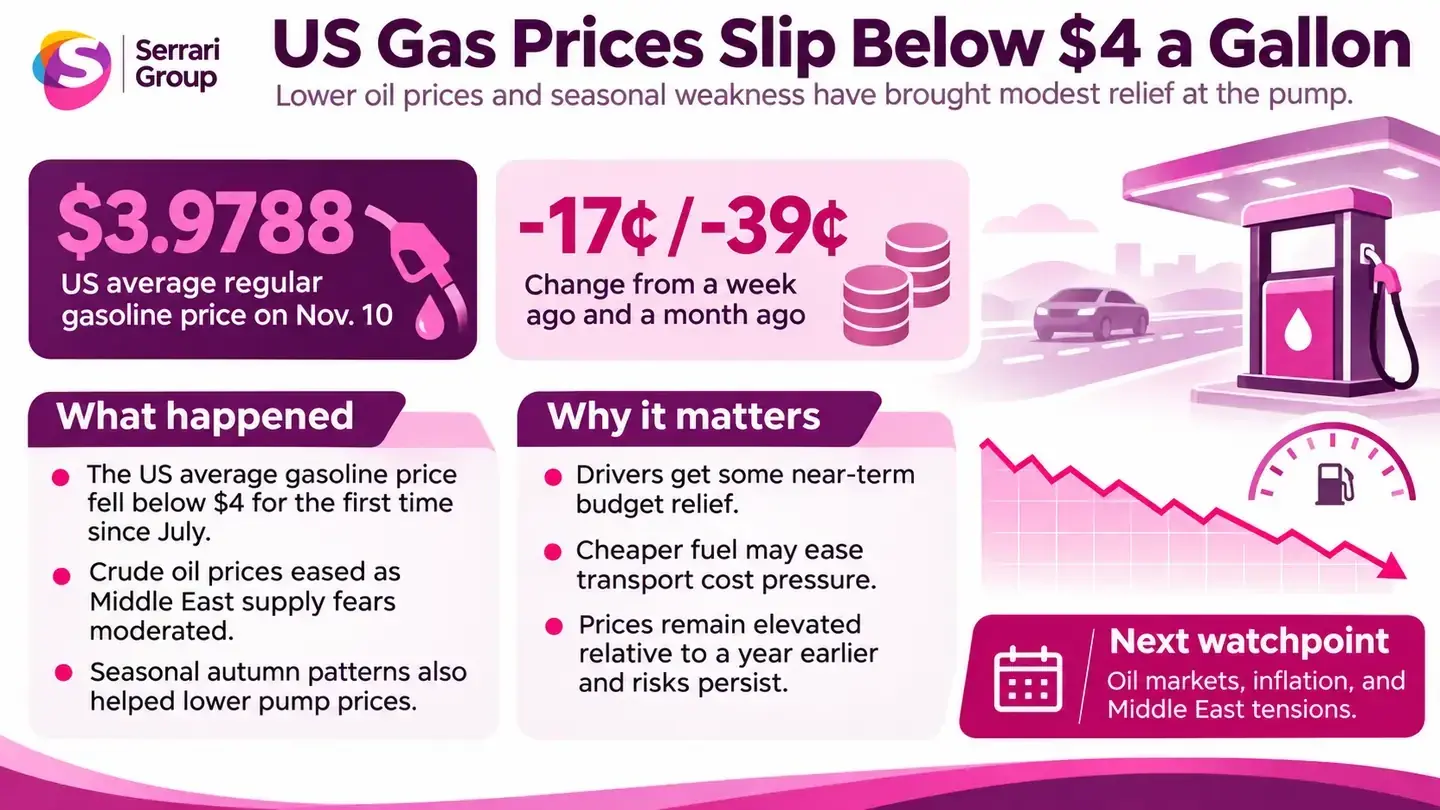
The average US price of regular gasoline fell below $4 a gallon on November 10, 2026, for the first time since July, bringing drivers some respite after months of expensive fuel. The national average reached $3.9788, about 17 cents below the previous week and 39 cents below a month earlier. The decline reflects cheaper crude oil as fears of further escalation in the US-Iran conflict ease, a partial recovery in Persian Gulf oil shipments and the normal autumn transition to lower-cost gasoline blends. Yet the relief is relative: pump prices remain substantially higher than a year earlier, diesel is still costly and Federal Reserve officials warn that previous energy shocks may continue feeding inflation even if oil retreats.
Key Overview
- Below $4: Regular gasoline averaged $3.9788 per gallon on November 10, its first reading below the threshold since July.
- Recent relief: The price was down approximately 17 cents in a week and 39 cents over a month, based on national fuel-price observations.
- Still expensive: Gasoline remained roughly 91 cents a gallon above its year-earlier level, so the latest decline does not erase 2026’s increases.
- Oil retreat: Brent crude briefly traded below $90 a barrel on November 10 as expectations of reduced US-Iran tensions weighed on prices.
- Supply recovery: Persian Gulf crude exports were estimated at 80%–85% of prewar levels, although refined-product exports had recovered much less.
- Inflation caution: October’s official gasoline price index increased 1% month on month, despite more recent falls at the pump.
Why Gasoline Has Finally Moved Below $4
The immediate trigger is a retreat in crude oil prices following signs that the conflict involving the United States and Iran may become less disruptive to energy trade. Crude is a major input in producing gasoline, so lower oil prices eventually ease the wholesale cost of fuel delivered to service stations. The November 10 oil-market retreat followed comments from President Donald Trump suggesting further US military strikes were less likely, prompting traders to reduce the premium they had attached to possible supply interruptions.
The change in expectations matters because global oil prices reflect not only barrels being consumed today but also the risk that tomorrow’s supply could be disrupted. Earlier concerns about shipping through the Strait of Hormuz had pushed up transport, insurance and energy costs. A lower perceived likelihood of escalation can pull crude prices down even before supply flows return fully to normal.
As of November 10, market estimates of Persian Gulf shipments placed crude exports at approximately 80% to 85% of their prewar levels, including pipeline volumes. That is a meaningful improvement, but it is not full restoration. Refined-product shipments were estimated at only 35% to 40% of prewar levels, demonstrating why cheaper crude may not immediately translate into equally large declines for every fuel.
The national gasoline reading itself comes from daily retail-price observations, which put regular unleaded fuel at $3.9788 per gallon on November 10. That was approximately 17 cents below the week-earlier figure of $4.1493 and 39 cents below the month-earlier figure of $4.3669. The threshold is psychologically important because drivers see it on station signs, but the economic significance lies in the direction and durability of the decline, not in crossing an arbitrary round number.
Seasonal Demand Is Helping, but It Is Not the Whole Explanation
American gasoline prices often soften in autumn as the summer driving season ends. Demand generally weakens when holiday travel subsides, schools reopen and households spend less time on long-distance road trips. Refiners also switch from more expensive summer-grade gasoline, designed to limit evaporation during hot weather, to blends that are generally less costly to produce.
These seasonal fuel-pricing patterns mean that a November decline is not unusual on its own. Indeed, retail prices may be expected to fall at this time of year even without a geopolitical breakthrough. What makes this year’s movement notable is the combination of seasonal weakness with a relatively rapid reversal in oil-market risk premiums after a period of exceptional tension.
The autumn transition helps explain why motorists can benefit even when crude prices do not collapse. But gasoline prices are also influenced by refining margins, fuel inventories, transport expenses, taxes and local competition. The breakdown of pump-price costs makes clear that oil is usually the largest component, not the only one. Consequently, cheaper crude tends to work through to consumers over time and at different speeds across states and cities.
The latest decline does not establish that fuel is cheap by historical or household standards. A November 5 national price update noted that pump prices were unusually high for the time of year despite having eased. By November 10, the national average was still about 91 cents above the roughly $3.07 recorded a year earlier. For regular drivers, that comparison may matter more to their budgets than the return below $4.
Context is everything. Stay ahead of shifting trends with today’s market updates, and uncover emerging opportunities using the Serrari Group Market Index and Marketplace. Then, take control of your own financial future by exploring our Money & Life Reset Transformation Blueprint ™ to build stronger habits, create better systems, and design a path toward lasting wealth.
What the Drop Means for Household Budgets and Businesses
The most direct benefit is a smaller bill at the pump. At the November 10 national average, buying 15 gallons cost approximately $59.68, compared with $65.50 at the month-earlier average. That represents a saving of around $5.82 on one such fill-up. A household purchasing 50 gallons across a month would save approximately $19.40 if prices held at the new level rather than the month-earlier rate.
Those examples show both the benefit and its limits. For a commuting household operating on a tight budget, every reduction helps free money for groceries, utilities or debt repayments. But the savings are unlikely to reverse broader pressures from housing, food and other services. Consumers with long commutes or limited public transport options benefit more in dollar terms than those who drive infrequently.
Businesses can also gain. Delivery firms, ride-hailing operators and tradespeople face direct fuel costs that affect profitability. However, freight rates and consumer prices do not necessarily adjust immediately. Companies may use lower fuel expenses to rebuild margins before lowering prices, particularly after months of higher transport and borrowing costs.
Diesel complicates the picture further. The national diesel average on November 10 was approximately $6.16 per gallon, substantially above regular gasoline. Diesel powers much of the trucking, agricultural and industrial equipment that moves goods through the economy. Persistent diesel expenses can keep distribution costs elevated even as motorists notice cheaper gasoline at roadside stations.
Why Falling Pump Prices Do Not Mean Inflation Is Defeated
The apparent contradiction is that US gasoline prices were falling in early November while the official October inflation report still showed an increase. The difference lies in timing and measurement. Daily station-price averages capture recent movements, whereas monthly consumer-price indexes measure price changes across a broader period and apply seasonal adjustments.
The October consumer-price release showed energy prices rising 0.7% during the month, down markedly from September’s 5.2% increase. Gasoline prices increased 1% on a seasonally adjusted monthly basis after rising 9.1% in September. Overall consumer prices rose 0.4% in October, versus 0.6% in September. That slowdown is encouraging, but it is not the same as falling overall prices.
In his November 10 economic outlook, Federal Reserve Governor Christopher Waller warned that energy shocks could have more persistent effects on the prices of other goods and services than they did before the pandemic. He also stressed that oil and fuel remained expensive compared with the beginning of the year and that lasting inflation relief would depend on how long lower prices persisted.
This matters for interest rates. If cheaper fuel reduces inflation expectations and business costs over several months, it could lessen one source of pressure on households and policymakers. But the Federal Reserve must consider broader price increases, employment and demand, not simply the gasoline average. Waller indicated that he still leaned toward tighter monetary policy in December because underlying inflation remained too high.
A temporary dip in energy costs therefore should not be mistaken for a signal that borrowing rates are about to fall. Mortgage payments, consumer credit costs and business financing conditions respond to a much wider set of economic developments.
Can the Relief Last as Middle East Risks Persist?
Further declines are possible if crude exports continue recovering, shipping routes become safer and the usual winter slowdown in gasoline demand holds. But the same mechanism that helped prices fall can also reverse them: any renewed threat to Gulf production or tanker traffic may quickly raise the risk premium embedded in crude prices.
Analysts have highlighted a continuing gap between the recovery in crude oil shipments and the much weaker rebound in refined fuels. Shipping insurance and alternative transport routes also remain costly. That means global energy supply has become more resilient than it was at the height of the disruption, without returning to normal operating conditions.
There are domestic uncertainties, too. Refinery outages, pipeline constraints, regional fuel specifications and inventory changes can generate local price spikes even if international crude remains cheaper. Americans in high-cost states may therefore continue paying well above $4 a gallon while the national average sits below it.
For the broader economy, the significance of November’s milestone is that an important cost-of-living pressure has started to ease at the same time that inflation remains elevated and monetary policy faces difficult choices. The improvement gives drivers immediate relief and may help contain transport costs, but it is not evidence that the year’s energy shock is over.
The next test will be whether cheaper crude survives changing diplomatic expectations and whether lower fuel costs persist long enough to influence business prices and inflation. Until then, the return below $4 is a welcome reprieve for motorists, not a definitive end to expensive energy.
Sources: AAA / Reuters / ING / U.S. Energy Information Administration / U.S. Bureau of Labor Statistics / Federal Reserve
Your financial future isn’t something you wait for—it’s something you build.
The real question is: when do you begin?
Move beyond simply staying informed.
Navigate the markets with clarity—track trends through the Serrari Group Market Index, uncover opportunities in the Serrari Marketplace, and build practical knowledge with our Curated Wealth Builder Platform.
Stay connected to what truly matters.
Get daily insights on macro trends and financial movements across Kenya, Africa, and global markets—delivered through the Serrari Newsletter.
Growth opens doors.
Advance your career through professional programs including ACCA, HESI A2, ATI TEAS 7 , HESI EXIT , NCLEX – RN and NCLEX – PN, Financial Literacy!🌟—designed to move you forward with confidence.
See where money is flowing—clearly and in real time.
Track Money Market Funds, Treasury Bills, Treasury Bonds, Green Bonds, and Fixed Deposits, alongside global and African indexes, key economic indicators, and the evolving Crypto and stablecoin landscape—all within Serrari’s Market Index.