Kazakhstan has presented its Country Climate Investment Platform (QCIP) at the 31st UN Climate Change Conference (COP31) in Antalya, Türkiye. The national mechanism is designed to coordinate climate initiatives, build a portfolio of priority projects, improve their investment readiness and attract domestic and international financing. Its key sectoral component, the Kazakhstan Just Energy Transition Investment Platform (QaJET), aims to support at least 10 gigawatts (GW) of renewable energy capacity by 2035, alongside electricity grid modernisation, energy storage development and electrification. Two memoranda of cooperation were also signed to strengthen institutional partnerships and support the platform’s implementation.
Key Takeaways
- Kazakhstan presented QCIP at its National Pavilion during COP31 in Antalya, Türkiye.
- The platform aims to coordinate climate projects across the economy and connect them with domestic and international financing.
- Kazakhstan’s Ministry of Ecology and Natural Resources will lead the platform, while IGTIC will serve as its secretariat.
- QaJET, a sectoral component of QCIP, targets at least 10GW of renewable energy capacity by 2035.
- The energy transition platform will also support electricity grid modernisation, energy storage systems and the electrification of end users.
- Two memoranda were signed, including an agreement between IGTIC and the Development Bank of Kazakhstan and a partnership involving the EBRD.
What Is Kazakhstan’s New Climate Investment Platform?
Kazakhstan has presented the framework of its Country Climate Investment Platform (QCIP), a national mechanism for coordinating climate initiatives and mobilising financing, at its National Pavilion during the 31st Conference of the Parties to the UN Framework Convention on Climate Change (COP31) in Antalya.
The platform is designed to build a portfolio of priority climate projects, improve their investment readiness and attract domestic and international capital.
The initiative is intended to address an important part of climate action: connecting national environmental ambitions with the financing and partnerships needed to put projects into practice.
Rather than operating as a renewable energy programme alone, QCIP is designed to cover all sectors of the economy. It will bring together government agencies, international financial institutions, climate funds, investors and project developers to coordinate efforts, prepare priority initiatives for investment and mobilise financing.
The platform’s main goal is to build a portfolio of key-priority climate projects, boost their investment appeal, and provide access to Kazakh and international financing sources.
This means the platform will focus not only on identifying projects but also on improving their readiness to attract investment. Project preparation and investment readiness are important because climate ambitions do not automatically translate into projects that investors and financial institutions can finance.
QCIP will operate under the leadership of Kazakhstan’s Ministry of Ecology and Natural Resources, which will serve as the national designated authority. The International Green Technologies and Investment Projects Center (IGTIC) has been assigned secretariat functions.
This structure places the platform under a government ministry while giving IGTIC responsibility for its secretariat. It is intended to provide a central point for coordination between public institutions, financing partners and businesses involved in climate-related projects.
How Will QCIP Help Mobilise Domestic and International Financing?
A central objective of QCIP is to connect priority climate projects with potential sources of capital.
The platform will bring together government bodies, international financial organisations, climate funds, and private investors to implement projects to develop a low-carbon economy.
The involvement of these different groups is significant because climate projects can require cooperation between project developers, government authorities, lenders and investors. QCIP is designed to provide a common platform through which these participants can coordinate their efforts.
Its approach also places emphasis on building a portfolio of projects that are sufficiently developed to attract financing.
The new mechanism will also expand the participation of financial institutions and investors in the environmental transformation of Kazakhstan’s economy.
For domestic investors, the platform is intended to provide access to a coordinated pipeline of climate-related opportunities. International financial institutions and climate funds, meanwhile, will be able to engage with priority projects through a national framework.
However, the presentation of the platform does not mean that all the projects have already secured funding. Its stated purpose is to improve project preparation, coordinate partnerships and mobilise capital. The actual amount of investment attracted will depend on the projects developed and the financing commitments secured.
What Is QaJET and Why Is It Important to Kazakhstan’s Energy Transition?
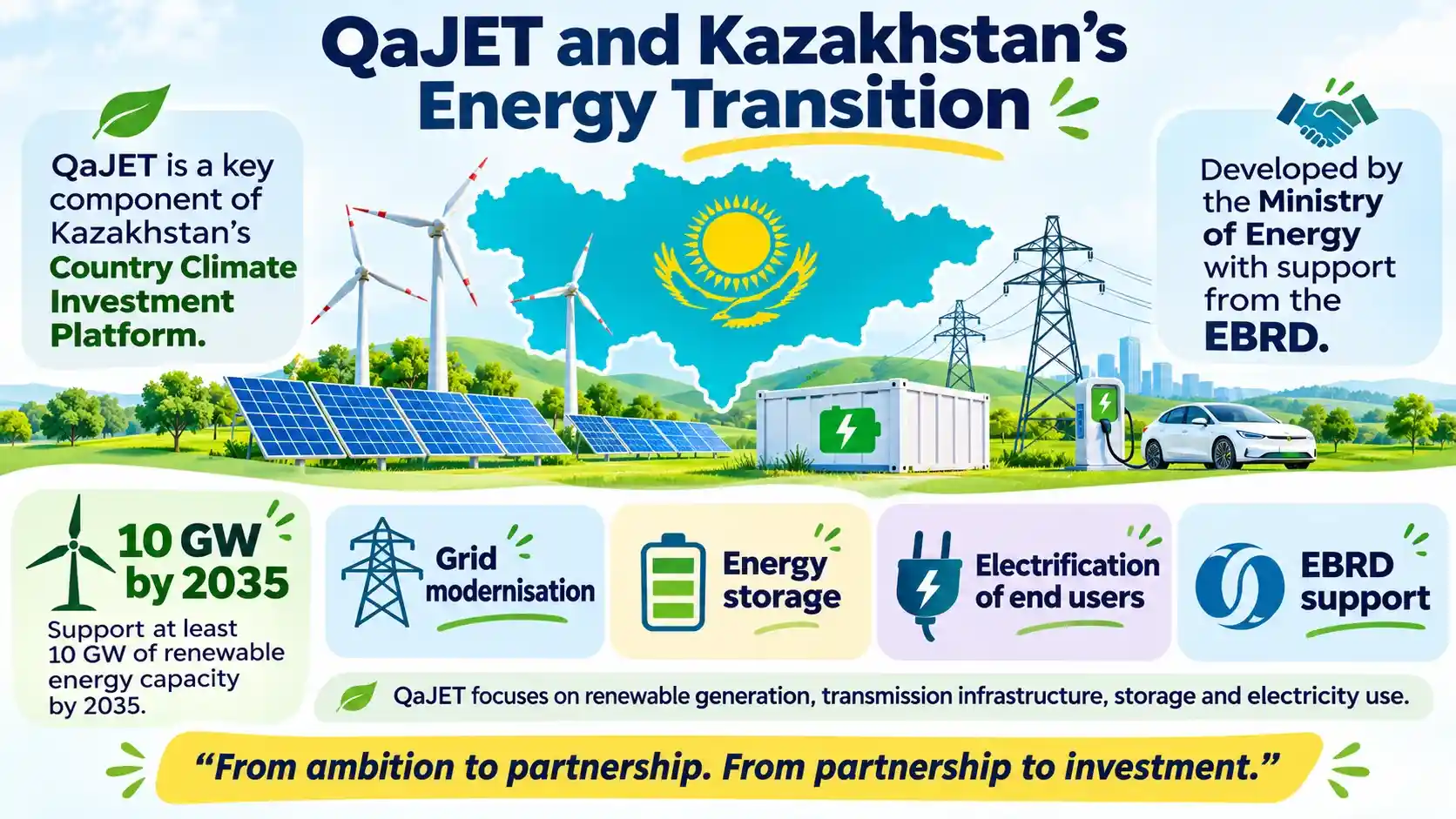
One of QCIP’s key components is the Kazakhstan Just Energy Transition Investment Platform (QaJET), developed by the Ministry of Energy with support from the European Bank for Reconstruction and Development (EBRD).
While QCIP provides the broader national framework for climate investment, QaJET focuses specifically on the energy transition.
Its objective is to support the development of at least 10 gigawatts (GW) of renewable energy capacity by 2035, as well as the modernisation of electricity grids, the development of energy storage systems and the electrification of end users.
The 10GW target gives the sectoral platform a measurable renewable energy ambition. However, its objectives extend beyond the construction of renewable energy facilities.
The planned modernisation of electricity grids is also important because the energy transition requires infrastructure capable of accommodating new sources of electricity. Energy storage systems form another part of the programme, while electrification is intended to support the wider transition among end users.
Together, these priorities show that QaJET is designed to address several connected areas of the energy system: renewable electricity generation, transmission infrastructure, storage and electricity use.
In a November 10 LinkedIn post announcing the launch, Cristian Carraretto, Head of Energy Transition – Sustainable Business and Infrastructure at the EBRD, described the initiative using the words: “From ambition to partnership. From partnership to investment.”
The statement reflects the platform’s intended approach of moving from climate and energy targets towards partnerships and investment that can support implementation.
Which Agreements Were Signed During the Platform’s Launch?
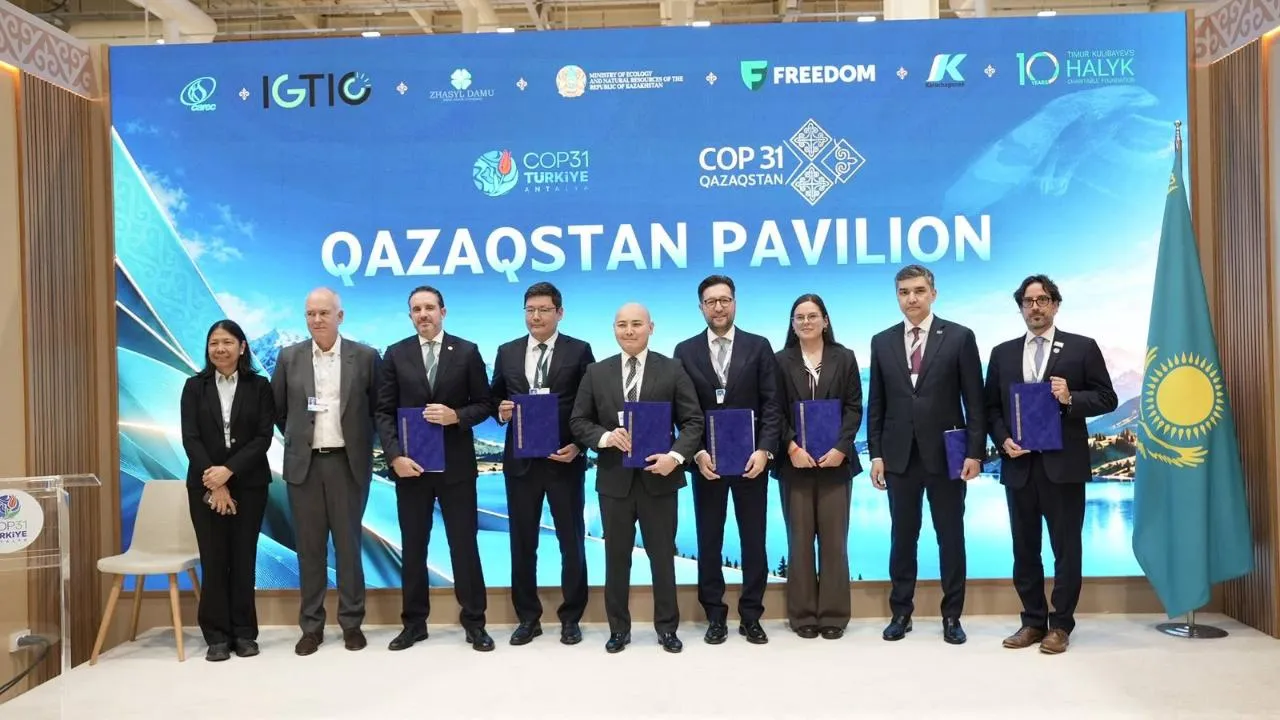
Two memoranda of cooperation were signed during the presentation of QCIP at COP31.
The first memorandum covers cooperation between IGTIC and the Development Bank of Kazakhstan within the framework of QCIP.
This agreement establishes cooperation between the institution serving as the platform’s secretariat and the Development Bank of Kazakhstan. It forms part of the wider effort to bring financing institutions into the national climate investment framework.
The second memorandum involves Kazakhstan’s Ministry of Energy, the Ministry of Ecology and Natural Resources, and QaJET partners led by the EBRD.
Its signing marked the official launch of the sectoral platform.
The two memoranda therefore cover different parts of the wider initiative. One concerns cooperation within the national QCIP framework, while the other establishes the partnership supporting the energy-focused QaJET platform.
Their signing provides an institutional foundation for cooperation between government bodies, financial institutions and international partners.
The EBRD’s involvement is particularly relevant to QaJET because the bank has supported the development of the sectoral platform alongside Kazakhstan’s Ministry of Energy.
Context is everything. Stay ahead of shifting trends with today’s market updates, and uncover emerging opportunities using the Serrari Group Market Index and Marketplace. Then, take control of your own financial future by exploring our Money & Life Reset Transformation Blueprint ™ to build stronger habits, create better systems, and design a path toward lasting wealth.
What Other Climate and Environmental Initiatives Is Kazakhstan Showcasing at COP31?
The launch of QCIP is part of a wider presentation of Kazakhstan’s climate, environmental and green technology initiatives at COP31.
Operating under the theme “Continuity of Times: Past, Present and Future,” Kazakhstan’s 250-square-metre National Pavilion showcases environmental projects, green technologies and investment opportunities.
Its exhibits include biodiversity conservation projects, the restoration of the Northern Aral Sea, saiga population recovery and saxaul forest planting on the dried seabed.
The pavilion also features AI-powered digital guides representing Turan tigers Umit and Amur. These exhibits highlight Kazakhstan’s biodiversity conservation initiatives alongside its broader environmental priorities.
Other initiatives presented include the Central Asian Green Shield programme, which forms part of the country’s regional environmental agenda.
Kazakhstan is also showcasing the KazMethane MRV digital platform for monitoring emissions and detecting methane leaks. The pavilion’s other industrial initiatives include industrial waste recycling and the introduction of best available technologies.
Traditional Kazakh craftsmanship is represented through a quraq korpe installation, a quilt mattress arrangement highlighting resource efficiency and the Zero Waste concept.
These initiatives demonstrate that Kazakhstan’s COP31 programme extends beyond renewable energy to include biodiversity, water security, methane monitoring, industrial decarbonisation, waste management and resource efficiency.
What Will Kazakhstan Discuss During Its 38 COP31 Pavilion Events?
The country’s National Pavilion will host 38 thematic events covering several areas of climate action and investment.
The events will cover climate finance, industrial decarbonisation, energy transition, carbon markets, water security, biodiversity and technological innovation.
These themes complement the objectives of QCIP by providing a platform for discussions on financing, technology and environmental priorities.
Regional priorities will include protecting the Caspian Sea ecosystem, restoring the Northern Aral Sea, combating desertification and developing renewable energy.
The focus on regional environmental challenges is also reflected in the pavilion’s exhibits, particularly those addressing biodiversity conservation, the restoration of degraded landscapes and the recovery of ecosystems.
Kazakhstan views COP31 as an opportunity to move from climate commitments to practical projects, measurable results and stronger international partnerships.
This broader programme provides context for the launch of QCIP. While the investment platform is intended to coordinate projects and mobilise capital, the pavilion’s events and exhibits showcase the wider environmental and technological areas in which Kazakhstan is seeking progress and cooperation.
The Bigger Picture: Can QCIP Turn Kazakhstan’s Climate Commitments Into Investment?
The launch of QCIP highlights Kazakhstan’s effort to establish a more coordinated approach to climate investment.
Its significance lies in bringing different participants into one national framework. Government agencies can identify priority areas, project developers can work towards preparing initiatives for investment, and financial institutions and investors can engage with projects through the platform.
The structure also creates a distinction between the broader climate investment programme and its sectoral components. QCIP is intended to cover all sectors of the economy, while QaJET focuses on energy transition priorities, including renewable energy, electricity grids, storage and electrification.
This approach could help Kazakhstan address several investment requirements at the same time rather than treating renewable energy development as an isolated activity.
For example, a renewable energy project may need more than generation capacity. The wider energy system also needs suitable transmission infrastructure and storage solutions. QaJET’s objectives reflect this connection by including grid modernisation and energy storage alongside its 10GW renewable energy target.
The involvement of the EBRD, the Development Bank of Kazakhstan, government ministries and other potential financing partners also demonstrates the importance of institutional cooperation in the platform’s design.
However, the announcement is a framework and launch milestone. Its longer-term significance will depend on the projects that enter its pipeline, how investment-ready they become and whether domestic and international capital is mobilised to support their implementation.
Why Does This Matter Now?
Kazakhstan’s presentation of QCIP at COP31 comes as the country seeks to move from climate commitments towards practical projects, measurable results and stronger international partnerships.
The platform creates a national mechanism for coordinating climate initiatives and attracting financing, while QaJET provides a specific energy transition programme with a target of at least 10GW of renewable energy capacity by 2035.
The two memoranda signed during the launch are an early step in establishing the partnerships needed to support these objectives. Cooperation between IGTIC and the Development Bank of Kazakhstan will take place within the broader QCIP framework, while the agreement involving the two government ministries and QaJET partners led by the EBRD marks the official launch of the sectoral platform.
The next important development will be how the platform translates its framework into a pipeline of priority projects and attracts the capital required to implement them.
For investors and financial institutions, the key issue will be whether the platform produces well-prepared projects that can move from proposals to financing and implementation. For Kazakhstan, progress under QaJET will also be measured against its 2035 renewable energy ambition.
Ultimately, QCIP’s success will depend not simply on the number of partnerships announced, but on whether those partnerships help deliver practical climate projects across the country’s economy.
Frequently Asked Questions
1. What is Kazakhstan’s Country Climate Investment Platform (QCIP)?
QCIP is a national mechanism designed to coordinate climate initiatives, build a portfolio of priority projects, improve their investment readiness and attract domestic and international financing.
2. What is the difference between QCIP and QaJET?
QCIP is the broader national climate investment framework covering all sectors of the economy. QaJET is one of its sectoral components, focusing on the energy transition, renewable energy development, electricity grid modernisation, energy storage and electrification.
3. What is Kazakhstan’s renewable energy target under QaJET?
QaJET aims to support the development of at least 10GW of renewable energy capacity by 2035.
4. Which organisations are involved in the platform?
The platform operates under Kazakhstan’s Ministry of Ecology and Natural Resources, with IGTIC serving as its secretariat. QaJET was developed by the Ministry of Energy with support from the EBRD. The Development Bank of Kazakhstan is also involved through a memorandum of cooperation with IGTIC.
Your financial future isn’t something you wait for—it’s something you build.
The real question is: when do you begin?
Move beyond simply staying informed.
Navigate the markets with clarity—track trends through the Serrari Group Market Index, uncover opportunities in the Serrari Marketplace, and build practical knowledge with our Curated Wealth Builder Platform.
Stay connected to what truly matters.
Get daily insights on macro trends and financial movements across Kenya, Africa, and global markets—delivered through the Serrari Newsletter.
Growth opens doors.
Advance your career through professional programs including ACCA, HESI A2, ATI TEAS 7 , HESI EXIT , NCLEX – RN and NCLEX – PN, Financial Literacy!🌟—designed to move you forward with confidence.
See where money is flowing—clearly and in real time.
Track Money Market Funds, Treasury Bills, Treasury Bonds, Green Bonds, and Fixed Deposits, alongside global and African indexes, key economic indicators, and the evolving Crypto and stablecoin landscape—all within Serrari’s Market Index.