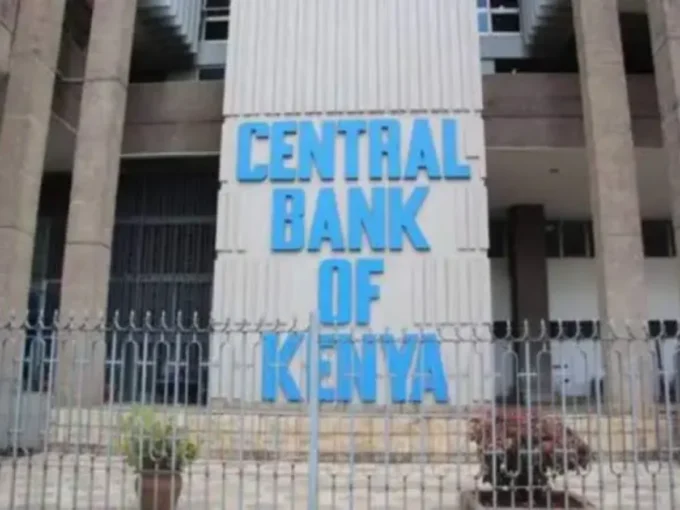
The Central Bank of Kenya has opened bids for KSh 50 billion of reopened Treasury bonds, inviting investments from KSh 50,000 ahead of a November 18, 2026 auction. The offer combines a bond maturing in January 2034 with another maturing in January 2041, providing the government with budgetary financing while giving households and institutions access to fixed coupon payments. Yet the key question is not simply whether investors can earn double-digit interest. It is why the government continues to borrow in the domestic market, what price investors will ultimately pay, and how a long-dated bond could perform if interest rates change before maturity.
LIVEKenya bond yields: Average yield 12.04% across 58 bonds · 10 NovSee yields →Key Overview
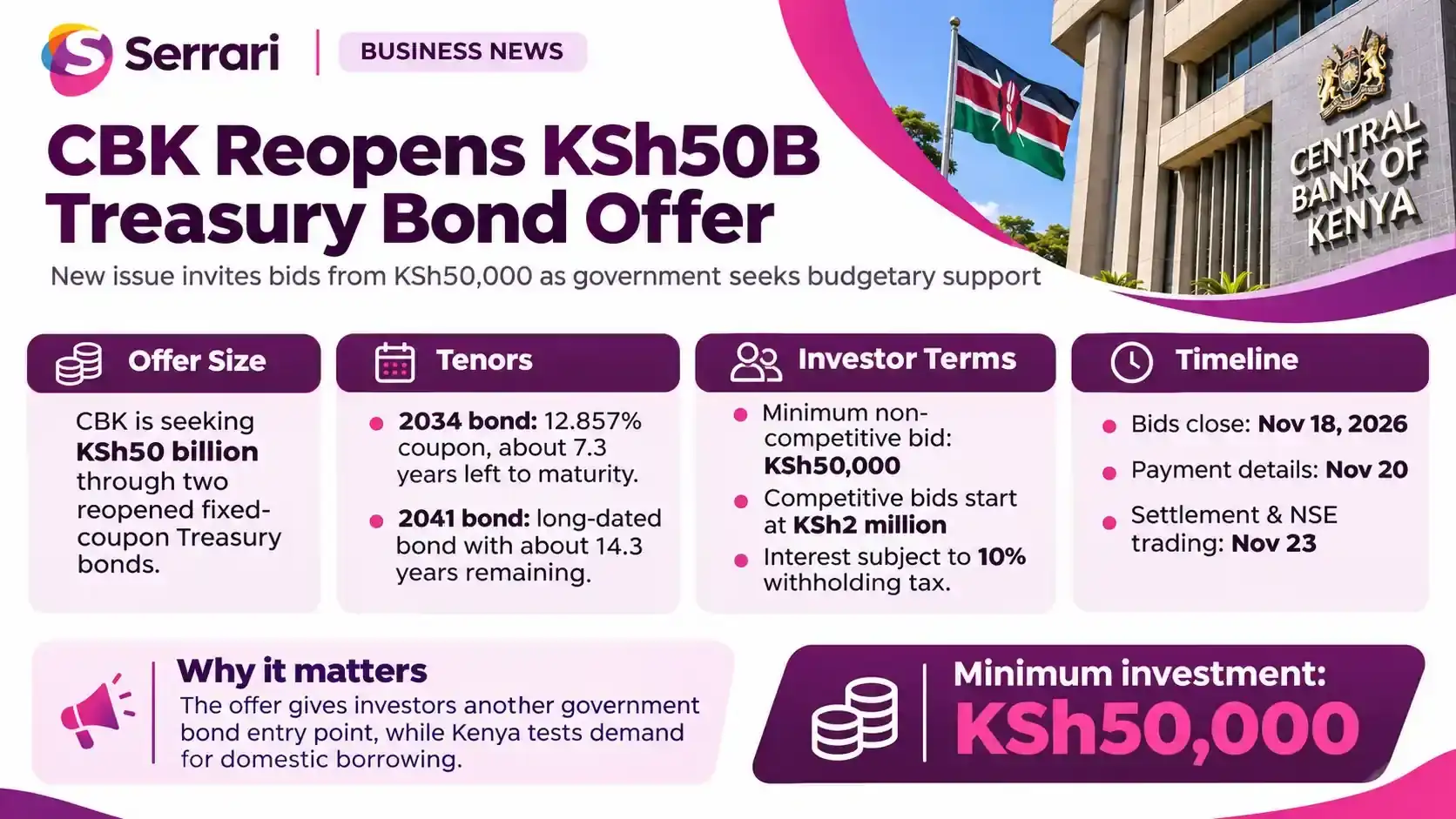
- Funding target: CBK is seeking a combined KSh 50 billion for budgetary support through two reopened securities.
- Bond choices: FXD1/2019/015 matures on January 9, 2034, while SDB1/2011/030 matures on January 21, 2041.
- Coupon clarification: The first bond pays 12.857% annually. CBK has published conflicting prospectus versions showing 12.0% and 12.5% for the second bond; investors should confirm the operative terms before bidding.
- Entry threshold: Non-competitive bids start at KSh 50,000 and are capped at KSh 50 million, while competitive bids start at KSh 2 million per tenor and CSD account.
- Auction calendar: Bids close at 10 a.m. on November 18, payment information becomes available on November 20, and settlement is scheduled for November 23.
- Return and risk: Both bonds carry 10% withholding tax on interest; the final investment yield depends on purchase price, accrued interest and the investor’s holding period.
Why Kenya Is Reopening Bonds Rather Than Issuing Entirely New Debt
The official bond offer identifies budgetary support as the reason for the sale. That means the proceeds are intended to help finance government obligations, rather than being earmarked in the offer for a particular road, hospital or other standalone project. Domestic bond issuance is part of how the Treasury covers the gap between expenditure and revenue while managing debts that come due.
Reopening an existing bond allows the government to raise additional funds under a security whose maturity date and payment structure are already established. It avoids creating a separate instrument for every borrowing operation and can concentrate trading activity in familiar issues. Greater outstanding volume may support secondary-market liquidity, although it does not guarantee that a holder can sell immediately at a favourable price.
The distinction between original tenor and remaining maturity is especially important here. The 15-year and 30-year descriptions refer to the bonds’ original structures. A buyer in November 2026 is not locking funds away for another 15 or 30 years. The issues mature in approximately 7.3 and 14.3 years, respectively, based on their scheduled redemption dates.
For the government, extending borrowing across different remaining maturities can spread refinancing requirements. But it also commits future budgets to coupon payments, creating an ongoing cost that competes with spending on services and development. A successful auction provides cash today; it does not remove the obligation to pay interest and ultimately redeem principal.
What the KSh 50,000 Minimum Really Means for Investors
The CBK auction terms permit a non-competitive bid of at least KSh 50,000, with a ceiling of KSh 50 million. Competitive bids require at least KSh 2 million for each bond tenor per Central Securities Depository account. Participants need an active DhowCSD account and must submit their bids before 10 a.m. on November 18.
A non-competitive bid means an investor requests an allocation without independently specifying a yield. A competitive bidder states the return required, and the auction mechanism determines which bids CBK accepts. The prospectus describes the sale as a multi-price auction, so the mechanics and actual prices matter more than simply selecting the bond with the highest stated coupon.
Investors should also distinguish a KSh 50,000 face-value bid from the eventual cash payment. Reopened bonds may sell above or below face value, and accrued interest can be included in the settlement amount. The payment obligation displayed after the auction can therefore differ from a simple multiplication of face value by one shilling.
According to the published timetable, successful bidders are to retrieve payment keys and amounts payable on November 20, with settlement on November 23. The securities are expected to trade on the Nairobi Securities Exchange from that settlement date, subject to market conditions and applicable trading rules.
Why a 12% Coupon Is Not Necessarily a 12% Investment Yield
A coupon is the annual interest payment expressed as a percentage of the bond’s face value. Yield to maturity, by contrast, incorporates the amount paid to acquire the security, the remaining coupon payments and the principal due at redemption. Buying at a discount can increase the yield relative to the coupon; paying a premium can reduce it. Actual realised returns may differ further if an investor sells before maturity.
For example, KSh 50,000 in face value of the 2034 bond carries annual gross coupon interest of KSh 6,428.50 at 12.857%. Before considering purchase-price differences, accrued interest or other costs, 10% withholding tax reduces those coupon receipts to KSh 5,785.65 annually, ordinarily paid in instalments according to the published schedule. This is an illustration of coupon income, not a guaranteed net annualised return on the cash invested.
There is also a discrepancy worth addressing before an investor submits a bid. One published prospectus version states a 12.5% coupon for the 2041 security, while another official version shows 12.0%. The latter also includes a 12.0% coupon pricing illustration. Because the difference affects expected interest income, the precise coupon should be reconfirmed against CBK’s operative auction notice or directly with the institution before funds are committed.
Context is everything. Stay ahead of shifting trends with today’s market updates, and uncover emerging opportunities using the Serrari Group Market Index and Marketplace. Then, take control of your own financial future by exploring our Money & Life Reset Transformation Blueprint ™ to build stronger habits, create better systems, and design a path toward lasting wealth.
Why the Auction Matters for Government Borrowing Costs
Investor demand offers a test of the price the government must pay to secure domestic financing. The November 9 auction results show that CBK received approximately KSh 99.47 billion in bids for a KSh 50 billion offer and accepted about KSh 70.86 billion. The weighted average yields on accepted bids were 12.7404% for the shorter of those two issues and 14.1266% for the longer issue.
Those results indicate substantial appetite for government securities in that auction, but they should not be treated as a prediction of the November 18 outcome. The bond issues, maturity profiles, prevailing yields and bid composition may differ. CBK also has discretion to accept less than the amount submitted, or to allocate bonds on a pro-rata basis.
LIVEKenya bond yields: Average yield 12.04% across 58 bonds · 10 NovSee yields →The wider significance is that the government faces a trade-off between obtaining enough cash and limiting future debt-service costs. Accepting bids at higher yields may help raise more funds immediately, but it increases the effective cost of borrowing. Rejecting expensive bids protects pricing discipline while potentially leaving more financing to be found elsewhere.
For banks and institutional investors, sovereign bonds also compete with lending to businesses and households for available funds. Strong demand for Treasury securities need not directly cause weaker private lending, but high government yields can make riskier private-sector loans relatively less attractive. That can affect the availability and pricing of credit across the economy.
Liquidity, Inflation and the Risk of Selling Early
Fixed coupon payments are attractive to investors planning future income, yet a fixed coupon does not mean a fixed market value. When prevailing interest rates rise, the prices of existing fixed-rate bonds generally fall. When yields decline, existing bonds can become more valuable because their coupons compare favourably with those of newly available securities.
The longer the remaining maturity, the more sensitive a bond can be to changes in market yields, all else being equal. That makes the 2041 security potentially more volatile in price than the 2034 bond. Investors who intend to hold to maturity may be less exposed to interim price movements, provided the issuer meets its obligations, while those expecting to sell early face market-price and liquidity risk.
The prospectus also describes CBK rediscounting as a last-resort facility, using a rate three percentage points above the prevailing market yield or coupon rate, whichever is higher. That is not the same as a promise to return the full face value whenever an investor wishes to exit. A bond can additionally be pledged as loan collateral, but borrowing against it introduces separate repayment obligations.
Inflation matters as well. A double-digit nominal coupon may preserve purchasing power if inflation stays comfortably below the investor’s after-tax return. If inflation accelerates, the real value of fixed cash payments declines. Investors comparing these bonds with money-market funds, fixed deposits or shorter Treasury bills should therefore evaluate net yields, liquidity requirements and investment horizons rather than coupon percentages alone.
The Bigger Picture: Borrowing Today Creates Commitments Tomorrow
Kenya’s latest reopening is part of a continuing domestic-debt funding programme, not an isolated invitation to retail savers. It arrives after other 2026 bond auctions and offers another opportunity for the government to test market appetite across different maturities. A successful transaction would support near-term financing needs, while the accepted yields would provide a fresh signal of how investors price the country’s longer-term obligations.
For households, the KSh 50,000 minimum broadens direct access to government securities, but accessibility should not be confused with suitability. Money needed soon for school fees, emergency spending or business operations may not belong in a bond whose market price could be unfavourable when cash is required.
The decisive numbers will emerge from the November 18 auction: the volume of bids, the yields accepted, the cash prices payable and the amount actually allocated. These will show whether the government can secure financing on terms investors find attractive without placing excessive additional pressure on future budgets. Ultimately, the offer is both an investment opportunity and a measure of Kenya’s cost of funding its fiscal needs.
Sources: Central Bank of Kenya / People Daily / The Kenya Times
Your financial future isn’t something you wait for—it’s something you build.
The real question is: when do you begin?
Move beyond simply staying informed.
Navigate the markets with clarity—track trends through the Serrari Group Market Index, uncover opportunities in the Serrari Marketplace, and build practical knowledge with our Curated Wealth Builder Platform.
Stay connected to what truly matters.
Get daily insights on macro trends and financial movements across Kenya, Africa, and global markets—delivered through the Serrari Newsletter.
Growth opens doors.
Advance your career through professional programs including ACCA, HESI A2, ATI TEAS 7 , HESI EXIT , NCLEX – RN and NCLEX – PN, Financial Literacy!🌟—designed to move you forward with confidence.
See where money is flowing—clearly and in real time.
Track Money Market Funds, Treasury Bills, Treasury Bonds, Green Bonds, and Fixed Deposits, alongside global and African indexes, key economic indicators, and the evolving Crypto and stablecoin landscape—all within Serrari’s Market Index.