A consortium of 21 major financial institutions has committed approximately $270 million to develop Project Faro, a planned US-based company that will issue a dollar-denominated stablecoin. The funding is expected to cover five years of operating costs, with the venture targeting a launch in the first half of 2027. Backed by institutions including Goldman Sachs, Citigroup, Banco Santander and Deutsche Bank, the initiative aims to compete with established stablecoin issuers such as Tether and Circle. A euro-denominated stablecoin is also planned, potentially followed by tokens linked to other currencies.
Key Takeaways
- A group of global banks has committed approximately $270 million to develop Project Faro.
- The venture plans to issue a US dollar-backed stablecoin, targeting a launch in the first half of 2027.
- Goldman Sachs, Citigroup, Banco Santander and Deutsche Bank are among the participating institutions.
- A euro-denominated stablecoin is expected to follow the initial dollar token.
- The consortium aims to compete with Tether and Circle, which together account for approximately 85% of the stablecoin market.
- The project is still in development and has not yet appointed a CEO or issued a token.
Why Are Global Banks Investing $270 Million in a Joint Stablecoin?
A group of some of the world’s largest financial institutions is committing around $270 million to establish a joint stablecoin venture, signalling a stronger push by traditional banks into digital currencies.
Goldman Sachs, Citigroup, Banco Santander and Deutsche Bank are among the institutions backing the initiative, known among participants as Project Faro.
The capital is meant to cover five years of operations for a planned U.S.-incorporated company that will issue a dollar-denominated stablecoin.
The venture grew out of a consortium of 21 financial institutions that announced plans in September to establish a company issuing a US dollar stablecoin, with a target launch in the first half of 2027.
The group has expanded significantly from an initial 10-bank initiative that began exploring the idea in October 2025. Its participants now span North America, Europe, East Asia, the Middle East and Africa.
Other institutions involved include Bank of America, Wells Fargo, Fidelity Investments, PNC, Capital One, TD Bank, UBS, BBVA, Lloyds Banking Group and MUFG.
The funding commitment is important because it moves the initiative beyond discussions and planning towards building the operational structure needed to launch the business.
However, Project Faro remains at an early stage. It is still searching for a chief executive, its final name has not been decided, and no stablecoin has been issued.
Context is everything. Stay ahead of shifting trends with today’s market updates, and uncover emerging opportunities using the Serrari Group Market Index and Marketplace. Then, take control of your own financial future by exploring our Money & Life Reset Transformation Blueprint ™ to build stronger habits, create better systems, and design a path toward lasting wealth.
What Is Project Faro, and How Will Its Stablecoin Work?
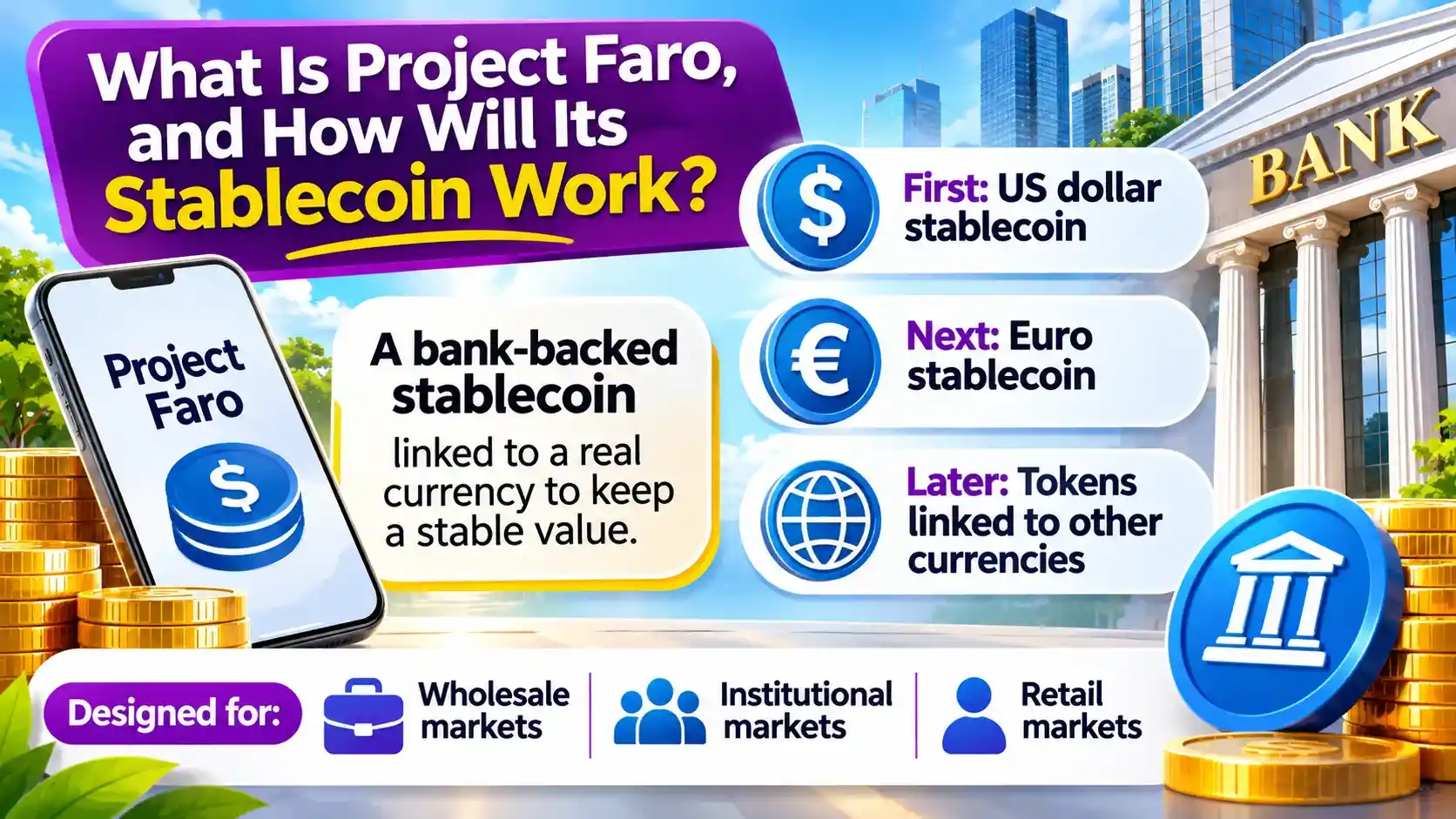
Project Faro is a planned US-incorporated company that will issue a dollar-denominated stablecoin.
A stablecoin is a type of cryptocurrency designed to maintain a relatively stable value by being linked to an underlying asset, usually a traditional currency such as the US dollar or euro.
Unlike cryptocurrencies such as Bitcoin, whose prices can fluctuate significantly, stablecoins are designed to maintain a more predictable value.
For example, a dollar-pegged stablecoin aims to maintain a value equivalent to one US dollar. This makes it useful for digital payments, transferring money and settling transactions without relying entirely on traditional banking payment systems.
The banks involved want the proposed token to serve wholesale, institutional and retail markets.
The initial focus will be a US dollar stablecoin, with a euro-denominated version expected to follow. The consortium is also considering stablecoins linked to other major currencies.
The group has said it wants the stablecoin used across wholesale, institutional and retail markets.
The venture’s design is intended to comply with the US GENIUS Act and, where applicable, the European Union’s Markets in Crypto-Assets (MiCA) regulatory framework.
This regulatory alignment is important because the banks are entering a market where trust, transparency and compliance are essential to attracting institutional users.
Why Are Traditional Banks Entering the Stablecoin Market?
Stablecoins have traditionally been dominated by cryptocurrency-focused companies. However, established financial institutions are increasingly exploring ways to participate in digital asset payments and settlement.
The banks behind Project Faro are betting that their existing customer relationships, regulatory experience and institutional credibility can give them an advantage.
The banks are betting that institutional trust, regulatory alignment and existing client networks can win them a share of a settlement business that promises round-the-clock, cross-border payments at lower cost than traditional rails.
Traditional cross-border payments can involve several financial institutions and payment networks. Stablecoins offer an alternative by allowing digital tokens to move across blockchain networks, potentially making transactions faster and available around the clock.
For banks, this creates an opportunity to participate in the infrastructure supporting digital payments rather than allowing cryptocurrency-native companies to control the market.
The proposed venture also shows that traditional finance is moving beyond simply observing the growth of digital assets. Major institutions are now committing capital and collaborating to develop their own products.
Who Will Project Faro Compete Against?
Project Faro will enter a stablecoin market already dominated by established issuers, particularly Tether and Circle.
Tether’s USDT and Circle’s USDC together account for approximately 85% of a stablecoin market valued at around $290 billion.
Both companies issue dollar-pegged stablecoins that are widely used across cryptocurrency markets and digital asset transactions.
The entry of major banks could introduce stronger competition, particularly in institutional payments and settlement services.
The consortium’s potential advantage lies in its access to established financial networks and relationships with businesses and institutional clients.
The market has already shown signs of reacting to the possibility of bank-backed competition. When the consortium first became public in September, Circle’s shares fell by approximately 6% as investors considered the potential threat to USDC.
However, Project Faro will not be entering an empty market. It will need to establish confidence in its product, attract users and build the infrastructure required to compete with existing issuers.
Are Other Financial Institutions Developing Stablecoins?
Yes. Project Faro is part of a wider trend in which financial institutions and major payment companies are exploring collaborative stablecoin initiatives.
More than 100 companies, including Visa, Mastercard and Stripe, are backing the issuer Open Standard, which is also developing stablecoin infrastructure.
In Europe, banks have established Qivalis, a consortium focused on issuing a euro-denominated stablecoin.
Not all major banks are following the same strategy. JPMorgan, for example, has pursued its own JPM Coin deposit token rather than joining Project Faro. Societe Generale has also issued its own fiat-backed stablecoin through a digital-asset subsidiary.
These different approaches show that financial institutions are exploring several ways to participate in the digital asset economy, from issuing their own tokens to collaborating with other banks.
What Does the Regulatory Environment Mean for Project Faro?
Regulation will be an important factor in determining whether Project Faro can launch and attract users.
The consortium intends to design its stablecoin to comply with the US GENIUS Act, which established a federal framework for dollar-pegged tokens in 2025, and the EU’s MiCA regime where applicable.
The US Office of the Comptroller of the Currency also finalised its GENIUS Act rule for stablecoin issuers in October 2026. The supplied reporting states that the law and rule are scheduled to take effect on January 18, 2027, shortly before Project Faro’s targeted launch window.
This timing makes regulatory preparation particularly important.
For the banks, operating within established regulatory frameworks could help build confidence among institutional customers who may be cautious about using digital currencies issued by less familiar providers.
However, regulatory compliance alone will not guarantee adoption. The venture will still need to demonstrate that its stablecoin is reliable, useful and competitive with existing alternatives.
The Bigger Picture
The $270 million commitment highlights how traditional financial institutions are positioning themselves for a financial system increasingly influenced by blockchain technology and digital assets.
Stablecoins are becoming an important part of this transition because they combine the digital transferability of cryptocurrencies with the relative price stability of traditional currencies.
For banks, the opportunity extends beyond issuing another cryptocurrency. It involves participating in the infrastructure used to move money, settle transactions and support cross-border payments.
Project Faro also demonstrates the growing importance of collaboration. Rather than each institution developing a separate stablecoin, 21 financial institutions are pooling resources to build a shared venture.
Whether this approach can challenge established issuers will depend on adoption, regulatory execution and the ability to deliver practical benefits to customers.
Why Does This Matter Now?
The commitment of approximately $270 million suggests that major banks are becoming more serious about competing in the stablecoin market.
For years, companies such as Tether and Circle have dominated dollar-pegged digital currencies. Project Faro could introduce a new category of competition backed by established financial institutions with extensive customer networks.
The first half of 2027 will be an important period to watch as the consortium works towards incorporation, appointing a CEO and preparing its first token.
However, the launch is not guaranteed. Project Faro has not yet issued a stablecoin, and its leadership and final company name remain unsettled.
For now, the funding commitment is a clear indication that major banks want a stronger role in the future of digital payments and onchain finance.
Frequently Asked Questions
1. What is Project Faro?
Project Faro is a planned US-incorporated company backed by a consortium of 21 financial institutions. It aims to issue a US dollar-denominated stablecoin, with a euro version expected to follow.
2. Which banks are investing in Project Faro?
Goldman Sachs, Citigroup, Banco Santander and Deutsche Bank are among the named participants. Other members include Bank of America, Wells Fargo, UBS, Fidelity Investments and MUFG.
3. What is a stablecoin?
A stablecoin is a cryptocurrency designed to maintain a relatively stable value by being linked to an asset such as the US dollar or euro. It can be used for digital payments, transfers and settlement.
4. When will Project Faro launch?
The consortium is targeting the first half of 2027 for the launch of its US dollar stablecoin. However, the venture is still in development and has not yet issued a token or appointed a chief executive.
Your financial future isn’t something you wait for—it’s something you build.
The real question is: when do you begin?
Move beyond simply staying informed.
Navigate the markets with clarity—track trends through the Serrari Group Market Index, uncover opportunities in the Serrari Marketplace, and build practical knowledge with our Curated Wealth Builder Platform.
Stay connected to what truly matters.
Get daily insights on macro trends and financial movements across Kenya, Africa, and global markets—delivered through the Serrari Newsletter.
Growth opens doors.
Advance your career through professional programs including ACCA, HESI A2, ATI TEAS 7 , HESI EXIT , NCLEX – RN and NCLEX – PN, Financial Literacy!🌟—designed to move you forward with confidence.
See where money is flowing—clearly and in real time.
Track Money Market Funds, Treasury Bills, Treasury Bonds, Green Bonds, and Fixed Deposits, alongside global and African indexes, key economic indicators, and the evolving Crypto and stablecoin landscape—all within Serrari’s Market Index.