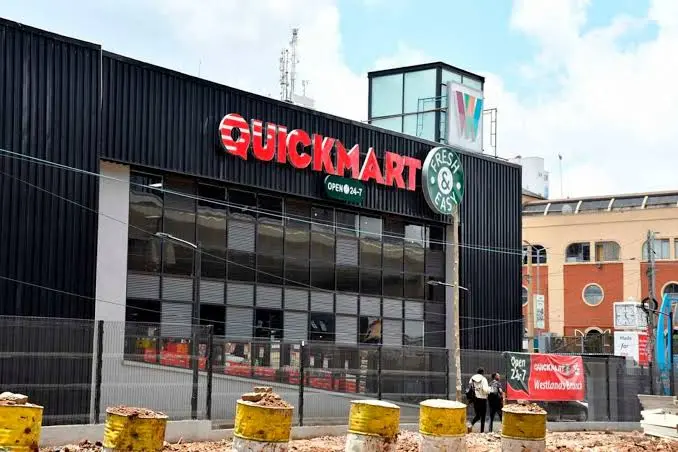
Quick Mart PLC has disclosed a more diversified ownership structure after its KSh 15 billion initial public offering attracted applications worth KSh 18.41 billion, exceeding the shares on sale by 22.7%. The supermarket operator is preparing to begin trading on the Nairobi Securities Exchange (NSE) on November 12, 2026, with Sokoni Retail Kenya Limited retaining a 50% stake and the remaining shares spread among institutional, foreign and retail investors. However, the transaction is primarily an ownership transfer rather than a cash injection into Quickmart: the proceeds are payable to the selling shareholder. The distinction matters because the new listing may broaden market participation and strengthen oversight, but it does not directly finance additional stores or other expansion projects.
LIVENSE market summarySee NSE data →Key Overview
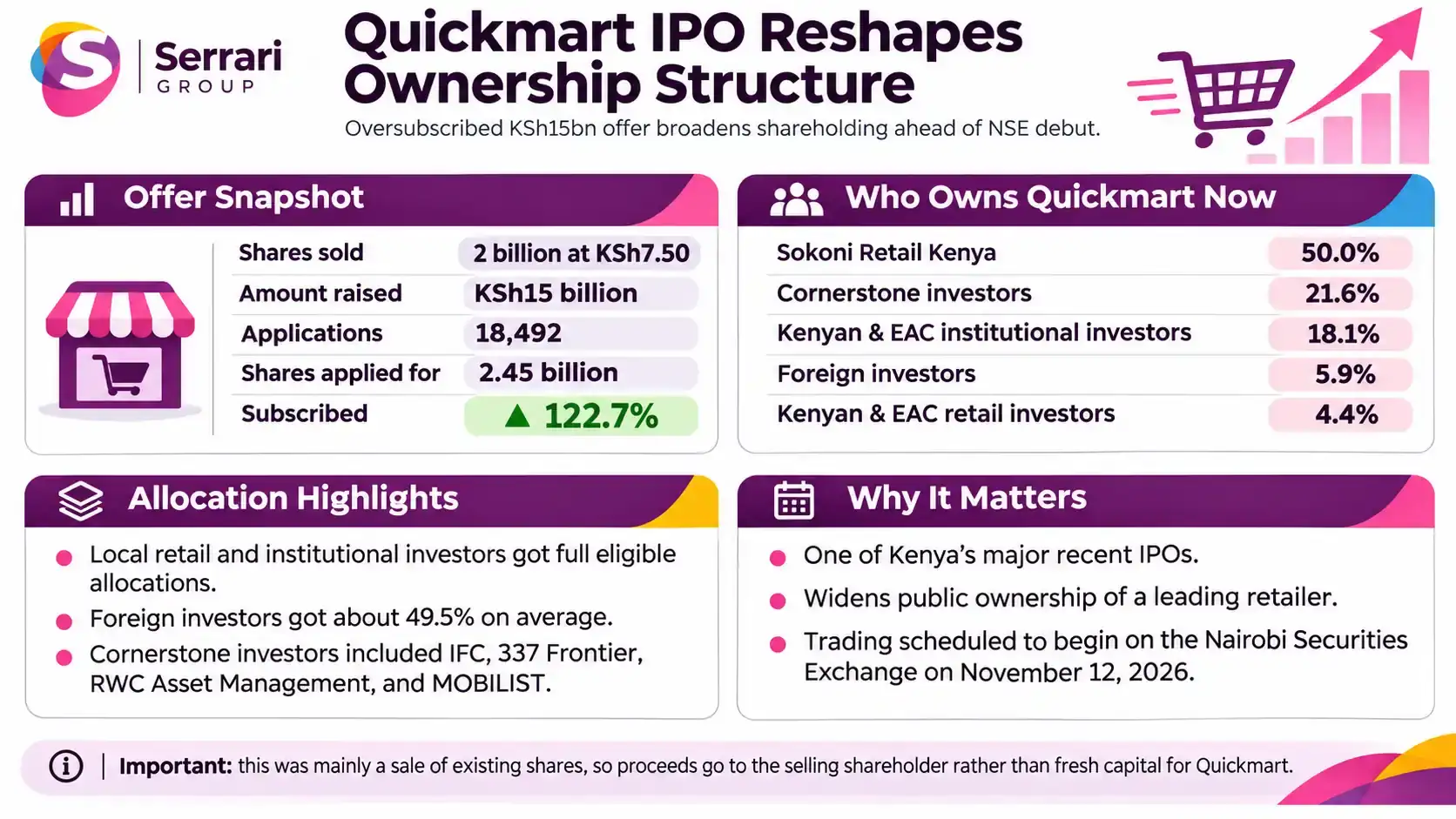
- Demand exceeded supply: 18,492 applications sought 2.455 billion shares, compared with 2 billion offered at KSh 7.50 each.
- Sokoni remains in control: The existing shareholder retains 2 billion of Quickmart’s 4 billion issued shares, equivalent to 50%.
- Institutions take a major stake: Cornerstone investors own approximately 21.6%, while Kenyan and EAC institutional investors account for approximately 18.1%.
- Retail participation is smaller: Kenyan and EAC retail investors hold approximately 4.4%, while foreign investors own approximately 5.9%.
- Allocation was uneven: Eligible local retail and institutional applications were satisfied in full, but foreign investors received about 49.5% of their requested shares.
- Trading is approaching: CDS transfers and refunds are scheduled to begin November 11, ahead of the expected November 12 market debut.
Why Quickmart’s Oversubscribed IPO Changes Its Ownership
Quickmart’s official IPO results show that investors requested 2,454,598,686 shares worth KSh 18,409,490,145 against 2 billion shares worth KSh 15 billion. That is a subscription rate of 122.7%, meaning demand exceeded the offer by 454.6 million shares, or 22.7%. Importantly, the widely reported 122.7% is the proportion subscribed, not the amount of oversubscription.
The strong response indicates investor appetite for an established consumer-facing company at a time when the Kenyan exchange is seeking to broaden its investable universe. Supermarket shares give investors exposure to household spending, store operations and the distribution of everyday essentials rather than only the banks, telecommunications and other sectors already prominent in local portfolios. Still, oversubscription measures demand at the offer price; it does not guarantee that shares will trade above KSh 7.50 after listing.
The structure also explains why the ownership transition is substantial without changing the number of shares in circulation. Sokoni Retail Kenya Limited sold existing shares, and Quickmart issued no new equity. At the IPO price, all 4 billion issued shares imply a KSh 30 billion equity valuation. The KSh 15 billion sale proceeds belong to Sokoni, subject to settlement and transaction arrangements, rather than being available as fresh capital on Quickmart’s balance sheet.
That distinction matters for anyone expecting the IPO itself to pay for new branches. Quickmart has indicated that it expects organic expansion to be financed primarily through internally generated cash flows. The listing may improve visibility, accountability and future access to capital, but the completed share sale should not be presented as a KSh 15 billion fundraising exercise for the operating company.
Who Owns Quickmart After the Share Sale?
The published allocation announcement gives the following final share counts, subject to completion and settlement:
| Shareholder category | Shares | Ownership |
| Sokoni Retail Kenya Limited | 2,000,000,000 | 50.0% |
| Cornerstone investors | 864,183,333 | 21.6% |
| Kenyan and EAC institutional investors | 723,500,200 | 18.1% |
| Foreign investors | 235,207,847 | 5.9% |
| Kenyan and EAC retail investors | 177,108,620 | 4.4% |
| Total | 4,000,000,000 | 100.0% |
These percentages are calculated from the disclosed share counts. The announcement’s printed percentages for Kenyan and EAC institutional and retail investors are inconsistent with those counts; the mathematically supported figures are 18.1% and 4.4%, respectively. The shareholding table also differs from the IPO allotment table because final ownership includes existing shareholdings and transfers, not simply the 2 billion shares distributed through the offer.
The central governance implication is that Sokoni retains half the company. It remains the single largest shareholder and a powerful voice in shareholder decisions. Nevertheless, a 50% stake does not automatically mean unilateral control over every resolution: voting outcomes depend on attendance, shareholder agreements, governance rules and the thresholds applicable to particular decisions.
Other investors collectively hold the other half, with cornerstone and domestic institutional investors making up the largest blocks. Their presence may increase scrutiny of financial reporting, profitability, capital allocation and management performance. Public-market obligations also create an additional layer of disclosure that private shareholders do not face in the same way.
Context is everything. Stay ahead of shifting trends with today’s market updates, and uncover emerging opportunities using the Serrari Group Market Index and Marketplace. Then, take control of your own financial future by exploring our Money & Life Reset Transformation Blueprint ™ to build stronger habits, create better systems, and design a path toward lasting wealth.
Why Foreign Investors Received Fewer Shares
The IPO was divided into investor pools, but demand was not distributed evenly. Foreign investors applied for 476.8 million shares against an initially reserved pool of 160 million, equivalent to 298% subscription. Their final allocation was approximately 236 million shares, about 49.5% of what they requested. In contrast, Kenyan and East African Community institutional investors received their eligible 700.2 million-share applications in full.
Local retail demand requires a closer look. The headline retail application total was 318.3 million shares, apparently above the 240 million shares reserved for the category. But that figure included five applications from founder shareholders seeking 118.7 million shares, which received no allocation. Once those applications are excluded, eligible retail demand was approximately 199.6 million shares, below the original pool. Eligible retail investors, including qualifying employees, therefore received full allocations.
This matters because an oversubscribed IPO does not necessarily leave every category short of stock. It can reflect intense demand in certain pools alongside weaker participation in others. Here, the strongest pressure came from overseas applicants, while the allocation process protected eligible local participation and adjusted the distribution between investor groups.
The four cornerstone investors were the International Finance Corporation (IFC), 337 Frontier Capital, RWC Asset Management and the United Kingdom’s MOBILIST programme. Together they were allocated approximately 864.2 million shares. MOBILIST accepted a scale-back of roughly US$5 million from its initial application to make additional shares available to institutional and foreign investors. The presence of such investors can support confidence in a listing, but it does not eliminate the commercial risks of the underlying business.
LIVENSE market summarySee NSE data →Why Institutional Investors Are Interested in the Supermarket Chain
Quickmart’s attraction lies partly in its position within Kenya’s organised grocery market. The company reported 72 stores in 16 counties and KSh 50.4 billion in revenue for 2025. Those figures establish a significant trading footprint, although revenue by itself does not reveal profit margins, cash generation or the sustainability of dividends.
A grocery chain benefits from repeat customer visits and demand for basic necessities. Its future returns, however, depend on controlling operating costs while maintaining competitive prices. Food inflation, rent, electricity, staffing, distribution expenses, inventory losses and consumer purchasing power can all materially influence performance. Rapid store expansion can increase sales but also requires careful management of location economics and working capital.
Institutional investors may see an opportunity to participate in a familiar domestic business with a measurable retail footprint. Yet the listing also exposes Quickmart to regular comparisons with other public companies. Investors will expect evidence that revenue growth translates into profits and cash flow, not merely a rising store count.
The company’s offer information outlines an intended dividend payout of 95% of profit after tax for 2026, 90% for 2027 and at least 80% thereafter, subject to board discretion and the business’s financial needs. Such targets may appeal to income-focused investors, but they are not guaranteed payments. A high payout can also leave less retained profit to fund expansion, making cash generation and investment discipline especially important.
What the NSE Listing Means for Investors and Kenya’s Market
Quickmart’s planned November 12 debut would bring a major grocery retailer into the NSE’s Main Investment Market Segment. For ordinary Kenyans, that creates a new route to owning a stake in a business whose shops they may already use. For fund managers and pension schemes, it creates another domestic equity option that may behave differently from financial or telecommunications shares.
The transaction also matters for the broader capital market. Successful offerings can encourage other privately held businesses to consider listing by demonstrating that there is demand from local and international investors. The approved offer timetable sets November 10 as the payment deadline for qualified institutional investors, November 11 for CDS transfers and the start of applicable refunds, and November 12 for public trading. These milestones remained prospective as of November 10.
The first trading sessions will test whether investor demand persists once the fixed IPO price gives way to open-market pricing. A strong subscription result can create interest, but price performance will depend on buyers and sellers, liquidity, financial disclosures and investors’ assessments of future profits. Neither cornerstone participation nor a popular brand guarantees gains.
Ultimately, Quickmart’s IPO is significant because it transfers half the shares of a major Kenyan retailer into a wider set of hands while leaving the original shareholder with a 50% stake. The next question is not simply how much investors were willing to subscribe, but whether the listed company can deliver operating results and governance standards that justify the confidence behind those applications.
Sources: Quickmart / Business Daily Africa / Khusoko / bne IntelliNews
Your financial future isn’t something you wait for—it’s something you build.
The real question is: when do you begin?
Move beyond simply staying informed.
Navigate the markets with clarity—track trends through the Serrari Group Market Index, uncover opportunities in the Serrari Marketplace, and build practical knowledge with our Curated Wealth Builder Platform.
Stay connected to what truly matters.
Get daily insights on macro trends and financial movements across Kenya, Africa, and global markets—delivered through the Serrari Newsletter.
Growth opens doors.
Advance your career through professional programs including ACCA, HESI A2, ATI TEAS 7 , HESI EXIT , NCLEX – RN and NCLEX – PN, Financial Literacy!🌟—designed to move you forward with confidence.
See where money is flowing—clearly and in real time.
Track Money Market Funds, Treasury Bills, Treasury Bonds, Green Bonds, and Fixed Deposits, alongside global and African indexes, key economic indicators, and the evolving Crypto and stablecoin landscape—all within Serrari’s Market Index.