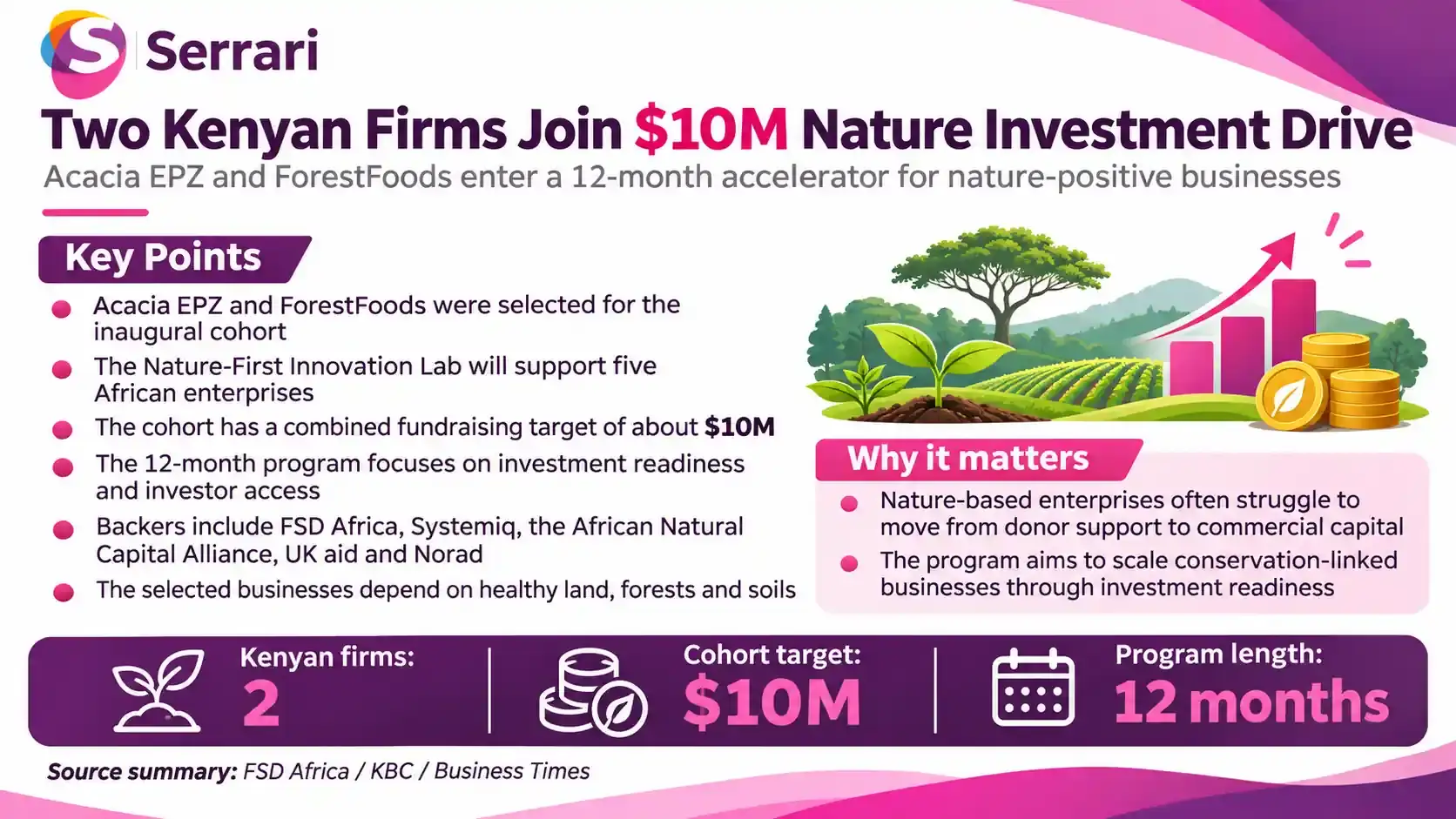
Two Kenyan businesses, Acacia EPZ and ForestFoods, have joined the inaugural Nature-First Innovation Lab, a 12-month programme helping five African enterprises prepare to raise a combined $10 million. The initiative targets businesses whose income depends on maintaining or restoring healthy ecosystems, and aims to make them more attractive to commercial investors. The $10 million is a collective fundraising ambition, not funding already secured or promised to the companies.
Key Overview
- Two Kenyan participants: Gum arabic exporter Acacia EPZ and regenerative farming business ForestFoods.
- Programme: A 12-month Nature-First Innovation Lab supported by FSD Africa, Systemiq and the African Natural Capital Alliance.
- Funding objective: Approximately $10 million in combined fundraising across five businesses, not a guaranteed grant or investment award.
- Support offered: Grants, financial planning, governance improvements, environmental impact measurement and investor introductions.
- Other participants: Forested, NovFeed and Savanna Agri Chains, working across East and West Africa.
Kenya’s Acacia EPZ Expands a Nature-Linked Export Business
Founded in 2015 by Sam Ombogo Nyamboga, Acacia EPZ exports gum arabic, a natural ingredient used in drinks, confectionery and pharmaceuticals. Its supply depends on acacia woodlands and local harvesting networks. More than 70% of its collectors are women, making the health of the trees important to both the company’s supply chain and household incomes.
With conflict disrupting production and trade in Sudan, a major global source of gum arabic, the Kenyan business is positioning itself as a traceable alternative. Organisers say Acacia EPZ’s revenue has grown 56% over two years, according to reporting on the selected enterprises. That growth is company information reported by the programme, rather than an independently audited result made public in the announcement.
ForestFoods Seeks to Scale Regenerative Farming
ForestFoods operates around Limuru, Naivasha and Naro Moru, using syntropic agroforestry to combine trees, crops and other farm activities in production systems designed to improve soil health. It is also working toward expansion in Shimba Hills, with a focus on connecting growers to processing, training and reliable markets.
Co-founder and chief executive Sven Verwiel said the accelerator could help strengthen the company’s commercial model and unlock partnerships for expansion, as described in coverage of the new cohort. For investors, the proposition is that regenerative production can create saleable agricultural output while sustaining the land on which future harvests depend.
Context is everything. Stay ahead of shifting trends with today’s market updates, and uncover emerging opportunities using the Serrari Group Market Index and Marketplace. Then, take control of your own financial future by exploring our Money & Life Reset Transformation Blueprint ™ to build stronger habits, create better systems, and design a path toward lasting wealth.
Five Enterprises Prepare to Raise Commercial Capital
Alongside the Kenyan companies, the cohort includes Forested, which sources regenerative honey, beeswax and other ingredients across East Africa; NovFeed in Tanzania, which converts organic waste into fish feed and fertiliser; and Savanna Agri Chains in Ghana, which works with women harvesters supplying shea and baobab products. The five businesses were announced as the inaugural cohort in late October.
The accelerator’s programme framework focuses on enterprises with demonstrable business models whose principal revenues come from nature-positive goods, services or supply chains rather than carbon-credit sales. It offers support to improve investment readiness, including the financial records, governance and evidence of environmental outcomes that potential financiers need to assess risk.
Importantly, the lab does not take equity in participating companies. Its role is to prepare them for investor decisions, not to guarantee that the targeted $10 million will materialise.
Why Nature-Based Businesses Struggle to Attract Funding
Dorothy Maseke, who leads the African Natural Capital Alliance Secretariat at FSD Africa, has highlighted the gap between early donor support and commercial finance. Businesses may already be generating revenue but still lack sufficiently developed financial forecasts, investor-grade governance or documentation to attract larger investments.
That gap matters well beyond the five participants. Research cited in coverage of the programme’s economic rationale estimates that roughly 62% of Africa’s GDP depends on nature. The estimate indicates economic exposure to natural systems; it does not mean that 62% of GDP comes from conservation businesses.
For Acacia EPZ and ForestFoods, success will ultimately be measured by financing raised, sustainable revenue growth and credible evidence that expansion protects the ecosystems supporting their operations. The accelerator is a step toward that outcome, rather than a completed investment deal.
Sources: FSD Africa / Kenya Broadcasting Corporation / The East African Business Times / African Sustainability Matters / Africa Business Communities
Your financial future isn’t something you wait for—it’s something you build.
The real question is: when do you begin?
Move beyond simply staying informed.
Navigate the markets with clarity—track trends through the Serrari Group Market Index, uncover opportunities in the Serrari Marketplace, and build practical knowledge with our Curated Wealth Builder Platform.
Stay connected to what truly matters.
Get daily insights on macro trends and financial movements across Kenya, Africa, and global markets—delivered through the Serrari Newsletter.
Growth opens doors.
Advance your career through professional programs including ACCA, HESI A2, ATI TEAS 7 , HESI EXIT , NCLEX – RN and NCLEX – PN, Financial Literacy!🌟—designed to move you forward with confidence.
See where money is flowing—clearly and in real time.
Track Money Market Funds, Treasury Bills, Treasury Bonds, Green Bonds, and Fixed Deposits, alongside global and African indexes, key economic indicators, and the evolving Crypto and stablecoin landscape—all within Serrari’s Market Index.