Google is preparing to expand its digital-asset infrastructure with Google Multi-Party Compute (MPC), a security service designed to help banks and other financial institutions protect and transfer cryptocurrencies and tokenized assets. The service is in private preview, with commercial availability planned for early 2027. It distributes private-key control across separate environments and applies transaction policies before signing. Alphabet is already using the technology to secure digital assets on Ethereum and Solana, while several financial institutions are testing it. The launch comes amid continuing cryptocurrency theft, with compromised private keys accounting for 43.8% of cryptocurrency stolen in 2024.
Key Takeaways
- Planned launch: Google Multi-Party Compute is in private preview, with commercial availability planned for early 2027.
- Institutional testing: Several financial institutions are testing the service, and Alphabet is using it to secure digital assets on Ethereum and Solana.
- Distributed security: The system divides private-key control across separate participants and environments, reducing reliance on a single point of failure.
- Persistent risks: Private-key compromises accounted for 43.8% of cryptocurrency stolen in 2024, while transaction-policy controls cannot eliminate every security threat.
Google introduces MPC security for institutional crypto custody
The service, known as Google Multi-Party Compute, is designed to help financial institutions safeguard cryptocurrencies and tokenized assets. It is undergoing private testing with several major financial institutions and is not yet generally available. Commercial availability is planned for early 2027, although pricing has not been disclosed.
Alphabet, Google’s parent company, has already begun using the technology to secure digital assets on the Ethereum and Solana blockchains. The institutions participating in the testing have not been publicly identified, and the specific assets Alphabet is securing have not been disclosed.
The service builds on technology Google has previously explored through its Confidential Space infrastructure. The new offering combines distributed signing, transaction policies and key recovery in a dedicated digital-asset security service, rather than requiring customers to assemble these components themselves.
How multi-party computation protects crypto assets
A cryptocurrency private key is a secret credential used to authorize transactions from a digital wallet. Someone who gains sufficient control of that key may be able to transfer the associated assets without the owner’s permission.
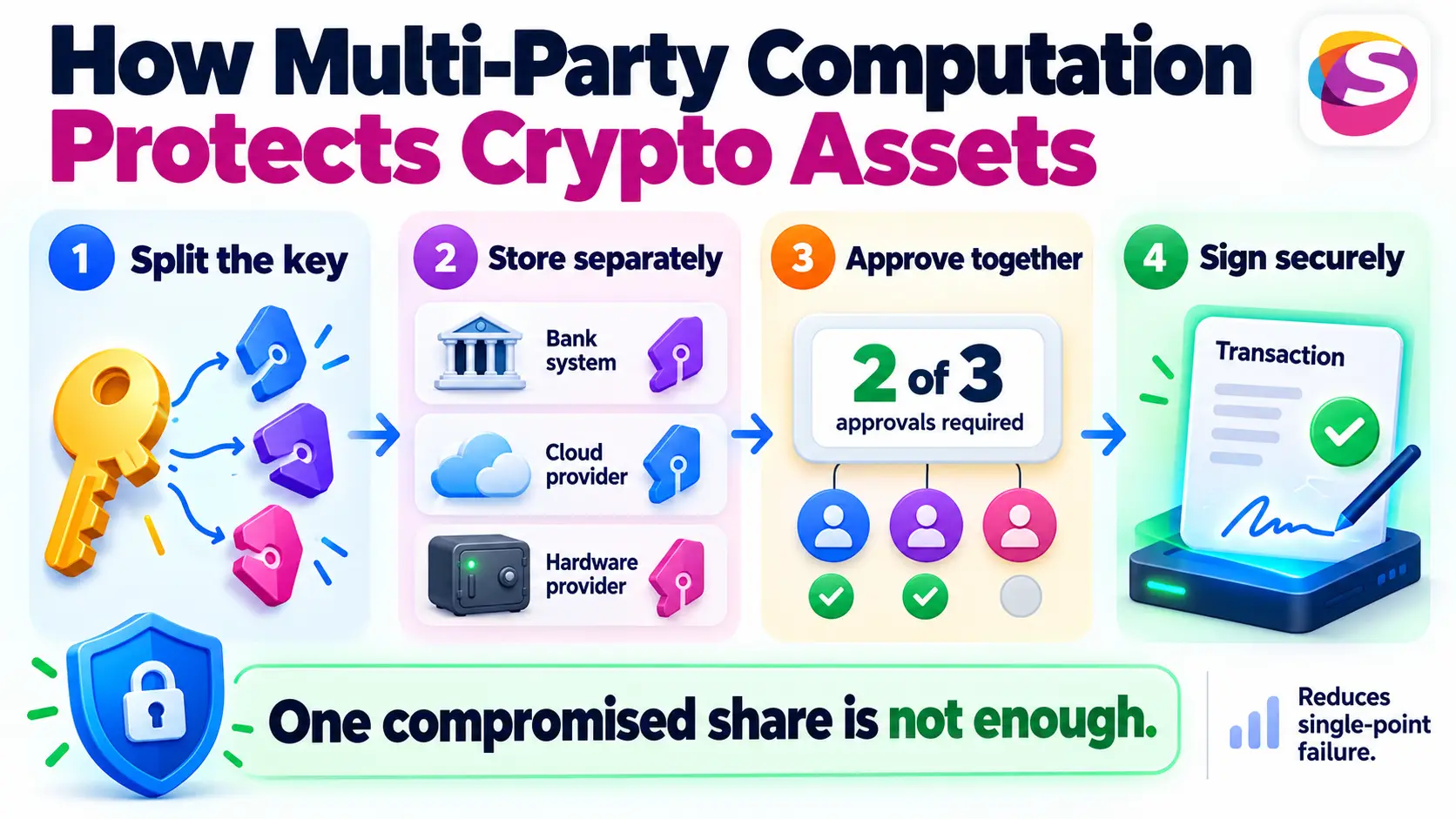
Google’s MPC approach distributes private-key control among separate participants and computing environments. Instead of keeping a complete key in one location, the system uses cryptographic shares that participants combine through a coordinated signing process.
For example, a bank could distribute signing shares across Google Cloud, its own hardware and another cloud provider. The institution could require two of three participants or five of seven participants to approve a transaction before it is signed.
This arrangement reduces dependence on a single device or administrator. If an attacker compromises only one participant, that access should not be sufficient to authorize a transfer when the institution has configured a higher approval threshold.
Google’s earlier technical guidance on MPC explains how distributed signing can allow participants to authorize transactions without exposing their individual key shares to one another or to the platform operator.
However, distributing key control does not eliminate every security risk. Protection still depends on how institutions configure the system, manage recovery procedures and secure the participants involved in signing.
Transaction policies provide another layer of protection
Dividing key control is only part of the security process. Financial institutions must also establish rules governing where assets can move, how much can be transferred and who must approve transactions.
Google’s service incorporates transaction policies that check activity against institutional rules before signing takes place. These can include transfer limits, approved destination addresses and requirements for additional authorisation.
A bank, for instance, could require extra approvals before transferring a large amount of cryptocurrency or restrict transfers to a predefined list of wallets. The checks can run within Google’s Confidential Space environment, which is designed to isolate sensitive workloads and protect information while it is being processed.
These controls could help institutions reduce the risk of unauthorised transfers. Nevertheless, a legitimate employee who is deceived into approving a fraudulent transaction could still expose assets to loss. The service should therefore be viewed as an additional security layer, not a guarantee against cryptocurrency theft.
Private-key theft remains a major industry risk
The launch comes amid persistent concerns about cryptocurrency security. According to Chainalysis research, compromised private keys accounted for 43.8% of cryptocurrency stolen in 2024.
Separately, data attributed to DeFiLlama showed that blockchain projects had suffered cumulative losses of $16.69 billion from hacks and exploits as of June 2026, with roughly 40% of those losses attributed to private-key compromises.
These incidents illustrate why key management is a critical issue for banks, asset managers and custodians entering digital-asset markets. Blockchain transactions, once completed, generally cannot be reversed, making secure authorisation especially important.
The market is also developing as financial institutions explore tokenised assets, blockchain-based payments and digital-asset custody services. These activities require infrastructure that can support institutional controls while allowing transactions to be processed securely.
Google Cloud’s director of digital assets strategy, Rich Widmann, told CoinDesk that regulated institutions adopting blockchain and tokenisation need scalable infrastructure to protect clients’ assets.
Context is everything. Stay ahead of shifting trends with today’s market updates, and uncover emerging opportunities using the Serrari Group Market Index and Marketplace. Then, take control of your own financial future by exploring our Money & Life Reset Transformation Blueprint ™ to build stronger habits, create better systems, and design a path toward lasting wealth.
AI and quantum computing add to security concerns
Google is also positioning the service against a changing cybersecurity landscape involving artificial intelligence and future quantum-computing capabilities.
Figures included in the supplied reporting attributed to Chainalysis indicate that scams associated with AI-tool vendors averaged $3.2 million in proceeds per operation in 2025, compared with $719,000 for other scams. Although the difference highlights the scale of the concern, it does not establish that AI itself caused the higher proceeds.
Quantum computing presents a separate, longer-term challenge. A sufficiently powerful future quantum computer could threaten some cryptographic systems used to protect digital assets. However, the reporting does not establish that such an attack is currently feasible on existing quantum computers.
Google says its MPC architecture is designed to accommodate future upgrades to post-quantum cryptography. The company has not provided a timetable for those capabilities, so they should not be treated as protections already available in the service.
Competition in institutional crypto security
Google’s planned offering brings it into closer competition with specialist digital-asset security providers, including Fireblocks, Fordefi and BitGo.
Its established cloud infrastructure and relationships with financial institutions could appeal to banks seeking security services from a large technology provider. Google is also positioning the service as infrastructure that institutions can use while retaining control over their own custody operations.
However, financial institutions will still need to evaluate their dependence on technology providers, including the risks associated with software, transaction policies and recovery systems. Distributing signing credentials across different environments does not remove every operational dependency.
Outlook
Google Multi-Party Compute reflects the growing importance of institutional-grade security as financial firms explore cryptocurrencies and tokenised assets. Its planned early-2027 commercial availability could give banks another option for distributing signing authority and enforcing transaction controls.
The service’s effectiveness will depend on its implementation, security configuration and ability to meet institutional requirements. With pricing, participating test institutions and independently verified performance comparisons still undisclosed, its competitive position remains to be established.
FAQs
1. What is Google Multi-Party Compute?
Google Multi-Party Compute is a security service designed to help financial institutions protect and transfer cryptocurrencies and tokenised assets by distributing private-key control across separate participants and environments.
2. When will Google Multi-Party Compute launch?
Commercial availability is planned for early 2027. The service is currently in private preview, and pricing has not been disclosed.
3. How does MPC help protect cryptocurrency?
MPC distributes key control among multiple participants and allows them to jointly authorise transactions without storing the complete private key in one location. Transaction policies can add controls such as transfer limits and destination restrictions.
4. Does Google’s MPC service eliminate cryptocurrency theft risks?
No. It is designed to reduce risks associated with compromised credentials and unauthorised transfers, but security also depends on institutional configuration, approval procedures and recovery controls.
Your financial future isn’t something you wait for—it’s something you build.
The real question is: when do you begin?
Move beyond simply staying informed.
Navigate the markets with clarity—track trends through the Serrari Group Market Index, uncover opportunities in the Serrari Marketplace, and build practical knowledge with our Curated Wealth Builder Platform.
Stay connected to what truly matters.
Get daily insights on macro trends and financial movements across Kenya, Africa, and global markets—delivered through the Serrari Newsletter.
Growth opens doors.
Advance your career through professional programs including ACCA, HESI A2, ATI TEAS 7 , HESI EXIT , NCLEX – RN and NCLEX – PN, Financial Literacy!🌟—designed to move you forward with confidence.
See where money is flowing—clearly and in real time.
Track Money Market Funds, Treasury Bills, Treasury Bonds, Green Bonds, and Fixed Deposits, alongside global and African indexes, key economic indicators, and the evolving Crypto and stablecoin landscape—all within Serrari’s Market Index.