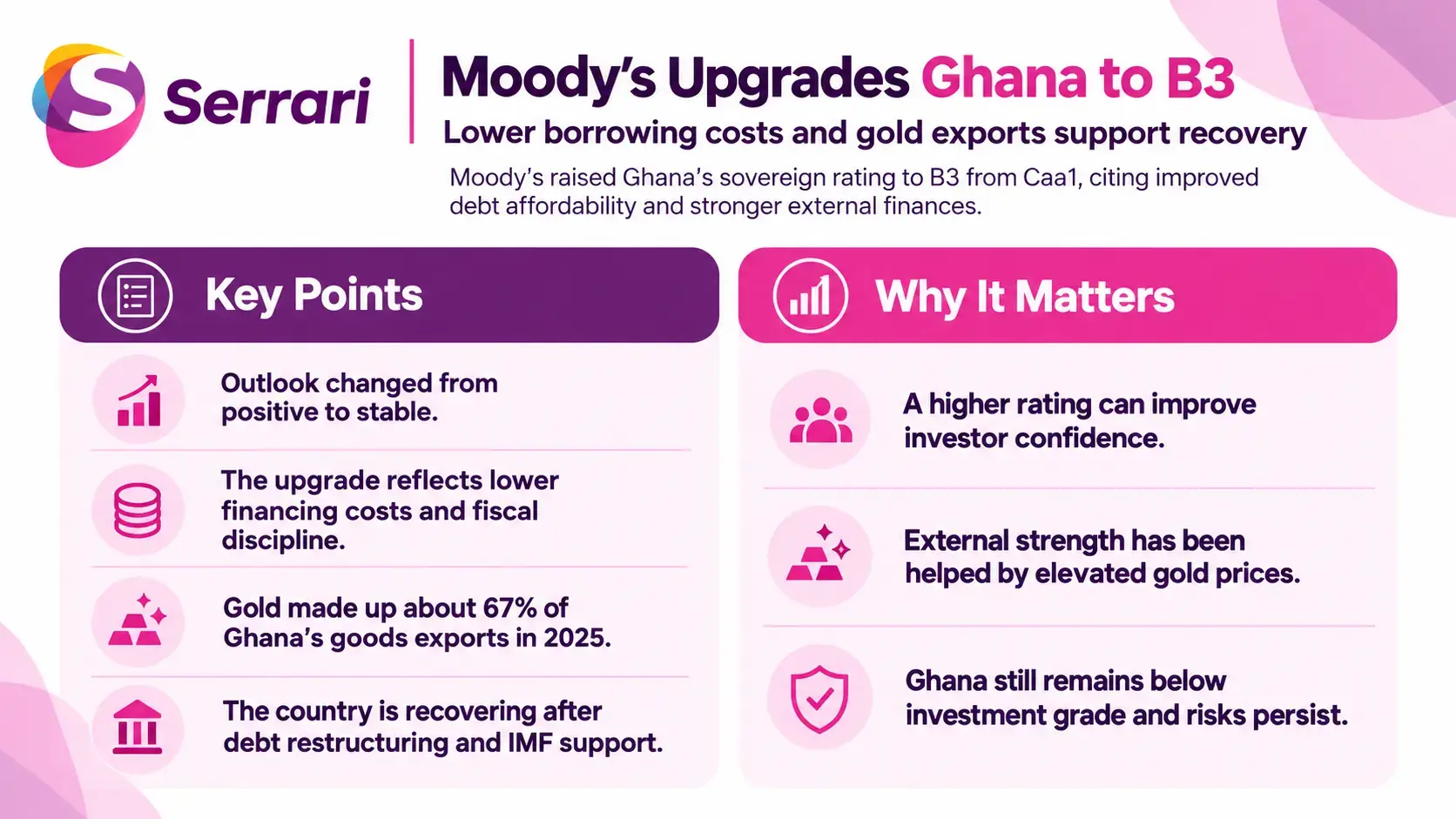
Moody’s Ratings has upgraded Ghana’s sovereign credit rating from Caa1 to B3, citing lower domestic borrowing costs, improved debt affordability and stronger external finances. The rating decision announced on October 9 also changed the outlook from positive to stable, reflecting expectations that recent gains can be sustained rather than indicating another imminent upgrade.
The decision is Ghana’s second Moody’s upgrade in approximately a year, following debt restructuring and an International Monetary Fund (IMF)-supported recovery from the country’s 2022 financial crisis. B3 is still a speculative-grade rating, meaning meaningful credit risks remain despite the improvement.
Key Overview
- Credit rating: Moody’s raised Ghana by one notch from Caa1 to B3 on October 9, 2026.
- Outlook: The outlook shifted from positive to stable, signalling expectations of steadier credit conditions.
- Debt affordability: Lower domestic financing costs and fiscal discipline were central to the decision.
- Gold exports: Gold represented roughly two-thirds of Ghana’s goods exports in 2025, strengthening foreign-exchange inflows.
- Economic recovery: The IMF’s $3 billion financing programme concluded its final review in July 2026.
- Remaining vulnerabilities: Commodity-price swings, debt-service costs and public-sector obligations still pose risks.
Why Moody’s Raised Ghana’s Rating
The upgrade reflects an easing of the financing pressures that followed Ghana’s debt crisis. Lower domestic interest costs have improved the government’s ability to service its obligations, while fiscal reforms and institutional changes have supported investor confidence.
The rating agency had already moved Ghana’s outlook to positive in April while keeping its rating at Caa1. At that time, it highlighted declining financing costs and the resumption of domestic bond issuance after a suspension introduced during the debt restructuring. October’s move converts part of that improving assessment into a higher rating.
A stable outlook does not represent a downgrade. It means the agency expects the government’s risk profile to remain broadly consistent with its new B3 assessment over the outlook horizon. Further upgrades would require durable progress in debt affordability and fiscal management.
Gold Exports Strengthen Ghana’s External Position
Elevated gold prices have provided Ghana with an important cushion against external pressures. Gold accounted for approximately 67% of goods exports in 2025, according to sovereign credit analysis of the export mix, making the metal central to the country’s foreign-currency earnings.
The IMF’s 2026 economic assessment reported a current-account surplus of 7.9% of GDP in 2025. Gross international reserves reached about $11.9 billion at the end of 2025 and $12.2 billion by the end of May 2026, supported by export receipts and improved economic management.
These gains can help Ghana meet external payments and absorb periods of market stress. However, reliance on gold also creates vulnerability if international prices fall sharply, while oil-price increases can raise domestic inflation and import costs.
Context is everything. Stay ahead of shifting trends with today’s market updates, and uncover emerging opportunities using the Serrari Group Market Index and Marketplace. Then, take control of your own financial future by exploring our Money & Life Reset Transformation Blueprint ™ to build stronger habits, create better systems, and design a path toward lasting wealth.
Debt Restructuring and IMF Support Underpin Recovery
Ghana’s current position follows its domestic and external debt restructuring and a multiyear adjustment programme. In July 2026, the IMF completed the sixth and final financing review, releasing approximately $371 million and bringing disbursements under the arrangement to about $3 billion.
The Fund recognised progress on stabilisation, reserves and debt sustainability while stressing that stronger revenue collection, financial management and oversight of state-owned enterprises remain necessary. Ghana also requested a non-financing Policy Coordination Instrument to help anchor reforms after the lending arrangement.
How Ghana’s Rating Compares With Its Peers’ Assessments
Other major rating agencies have also recognised improvement, although their scales and assessments differ. Fitch raised Ghana to B in May 2026 and retained a positive outlook, citing fiscal consolidation, easing inflation and stronger reserves. S&P Global Ratings affirmed its B-/B ratings with a stable outlook, while pointing to debt-servicing and institutional risks.
The common theme is recovery from acute financial distress, not the disappearance of sovereign credit risk. Better ratings may support market confidence, but they do not guarantee lower bond yields or immediate access to inexpensive international financing.
What Investors Should Watch Next
Ghana’s next test is whether fiscal restraint, debt affordability and foreign-exchange reserves hold up if commodity markets or global borrowing conditions become less favourable. Investors will be watching domestic financing costs, budget performance, gold earnings and the government’s progress on remaining reforms.
Sources: Citi Newsroom / Reuters / International Monetary Fund / S&P Global Ratings
Your financial future isn’t something you wait for—it’s something you build.
The real question is: when do you begin?
Move beyond simply staying informed.
Navigate the markets with clarity—track trends through the Serrari Group Market Index, uncover opportunities in the Serrari Marketplace, and build practical knowledge with our Curated Wealth Builder Platform.
Stay connected to what truly matters.
Get daily insights on macro trends and financial movements across Kenya, Africa, and global markets—delivered through the Serrari Newsletter.
Growth opens doors.
Advance your career through professional programs including ACCA, HESI A2, ATI TEAS 7 , HESI EXIT , NCLEX – RN and NCLEX – PN, Financial Literacy!🌟—designed to move you forward with confidence.
See where money is flowing—clearly and in real time.
Track Money Market Funds, Treasury Bills, Treasury Bonds, Green Bonds, and Fixed Deposits, alongside global and African indexes, key economic indicators, and the evolving Crypto and stablecoin landscape—all within Serrari’s Market Index.