Binance resumed cryptocurrency withdrawals in stages on November 1, 2026, after a cyberattack on October 29 drained approximately $6.3 billion in digital assets from its hot wallets. US investigators attributed the theft to North Korea’s TraderTraitor operation, while the exchange pledged to absorb customer losses and rebuild the affected reserves. The unprecedented scale of the attack has renewed scrutiny of how major trading platforms safeguard assets and respond to security breaches.
Key Overview
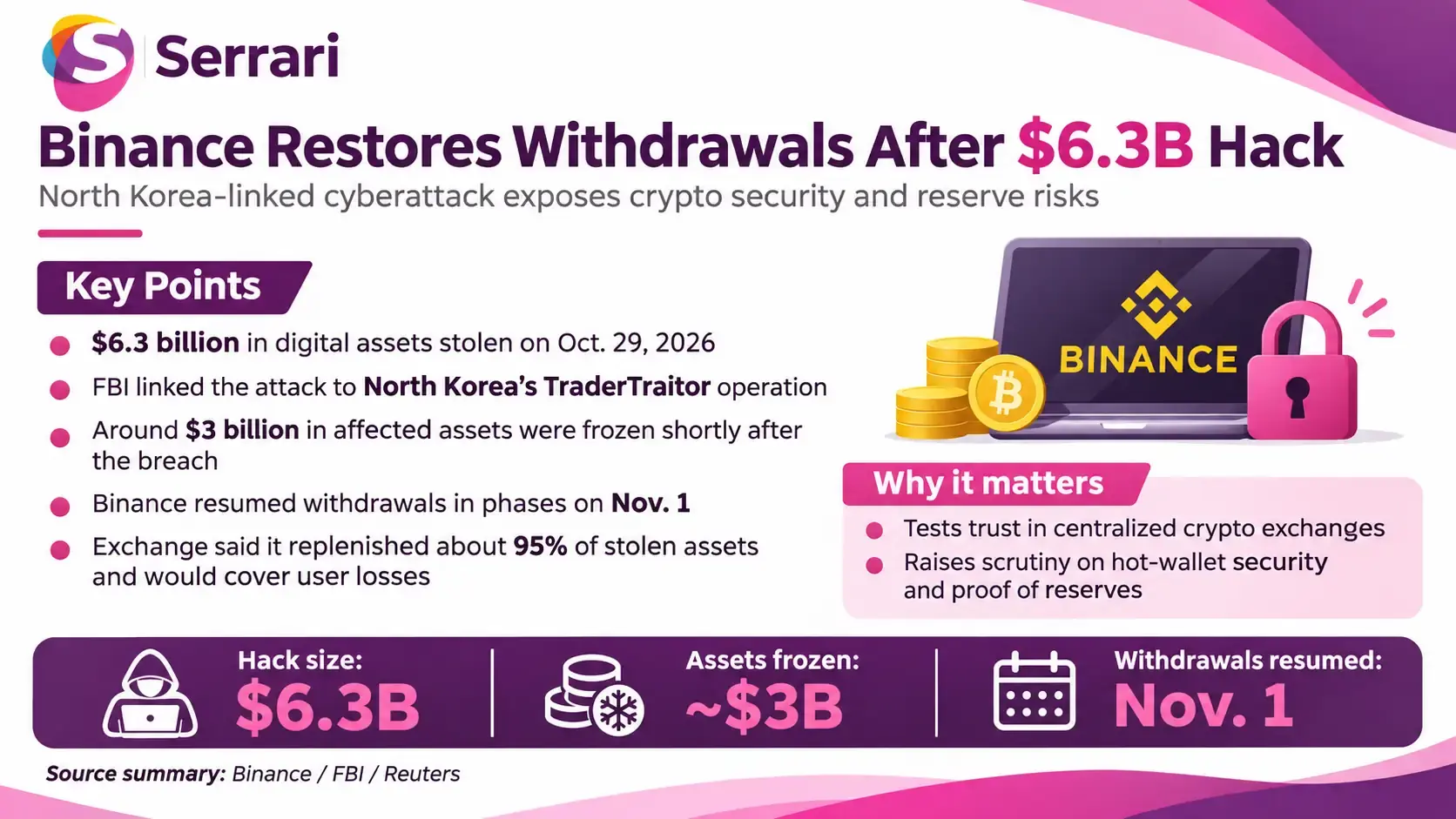
- Hackers stole approximately $6.3 billion in digital assets on October 29, 2026.
- The FBI attributed the attack to North Korea-linked TraderTraitor cyber operators.
- Binance said approximately $3 billion in affected assets had been frozen shortly after the incident.
- Withdrawals restarted in phases on November 1, as the exchange replenished approximately 95% of stolen assets.
- The exchange has committed to cover users’ losses, while investigators continue tracing the stolen funds.
How the $6.3 Billion Binance Breach Unfolded
The attack began at approximately 20:05 UTC on October 29, when Binance’s hot wallets were compromised and unauthorized withdrawals followed. In its October 30 security update, the exchange confirmed the scale of the losses and said it had revoked affected authorizations, strengthened security checks and temporarily suspended withdrawals.
Its preliminary findings pointed to a compromised employee laptop, but subsequent examination uncovered additional points of intrusion. Binance said investigators had not found evidence that wallet private keys were leaked. The full sequence of the attack remains under investigation.
The theft surpassed the approximately $1.5 billion stolen from Bybit in February 2025, placing it among the most consequential breaches in cryptocurrency history. The size of the incident also raised questions about operational controls around online wallets, where assets are accessible for day-to-day transfers.
US Investigators Link Theft to North Korea
In an October 31 public alert, the FBI attributed the theft to North Korea’s TraderTraitor cyber operation. Investigators said the actors were converting stolen assets primarily into ether and could subsequently use decentralized finance platforms and instant-swap services to obscure their origins.
The FBI called on cryptocurrency service providers and blockchain infrastructure operators to block transfers associated with identified laundering addresses. The attribution is an investigative finding; the precise technical route used to penetrate Binance’s systems has not yet been fully established publicly.
Binance separately reported that around $3 billion in affected assets had been frozen on-chain through cooperation with token issuers, intelligence specialists and industry partners. Freezing assets can stop some transfers, but it does not automatically mean the exchange has recovered the money.
Context is everything. Stay ahead of shifting trends with today’s market updates, and uncover emerging opportunities using the Serrari Group Market Index and Marketplace. Then, take control of your own financial future by exploring our Money & Life Reset Transformation Blueprint ™ to build stronger habits, create better systems, and design a path toward lasting wealth.
Withdrawals Resume as Binance Rebuilds Reserves
Binance began restoring withdrawal services in phases on November 1. By then, the exchange said it had replenished approximately 95% of the stolen assets using its own funds and designated protection and insurance reserves. The remaining assets were less liquid and therefore harder to replace immediately.
Earlier, an October 31 reserve update stated that ten major tokens, including bitcoin, ether, USDT and USDC, were fully backed. It also disclosed a fresh proof-of-reserves snapshot, although the full cryptographic verification was expected to take longer to complete.
The exchange has promised that customers, rather than account holders, will bear no financial losses from the theft. However, replacement assets and published reserve figures are distinct from recovering stolen funds or establishing that every security vulnerability has been eliminated.
What the Breach Means for the Crypto Industry
The incident tests trust in centralized cryptocurrency exchanges at a time when institutional and retail participation depend heavily on reliable custody arrangements. Customers may now scrutinize reserve transparency, separation of corporate and client assets, withdrawal continuity and independent security assessments more closely.
For regulators and investors, the key questions are whether Binance can complete asset replenishment, demonstrate verifiable customer backing and publish a sufficiently detailed account of how the breach occurred. The next milestones will be its final technical findings, ongoing law-enforcement recovery efforts and confirmation that all affected tokens are fully covered.
Sources: Binance / FBI / Reuters
Your financial future isn’t something you wait for—it’s something you build.
The real question is: when do you begin?
Move beyond simply staying informed.
Navigate the markets with clarity—track trends through the Serrari Group Market Index, uncover opportunities in the Serrari Marketplace, and build practical knowledge with our Curated Wealth Builder Platform.
Stay connected to what truly matters.
Get daily insights on macro trends and financial movements across Kenya, Africa, and global markets—delivered through the Serrari Newsletter.
Growth opens doors.
Advance your career through professional programs including ACCA, HESI A2, ATI TEAS 7 , HESI EXIT , NCLEX – RN and NCLEX – PN, Financial Literacy!🌟—designed to move you forward with confidence.
See where money is flowing—clearly and in real time.
Track Money Market Funds, Treasury Bills, Treasury Bonds, Green Bonds, and Fixed Deposits, alongside global and African indexes, key economic indicators, and the evolving Crypto and stablecoin landscape—all within Serrari’s Market Index.