
Technology stocks suffered a broad selloff on Friday, October 30, 2026, after disappointing forecasts from Intel and mounting cash-flow pressure at Amazon sharpened investors’ doubts about the cost of artificial intelligence. The Nasdaq Composite lost roughly 2.9%, while selling spread from US chipmakers to semiconductor suppliers in Asia and Europe. The results have shifted attention from the scale of AI investment to how quickly those investments can generate returns.
Key Overview
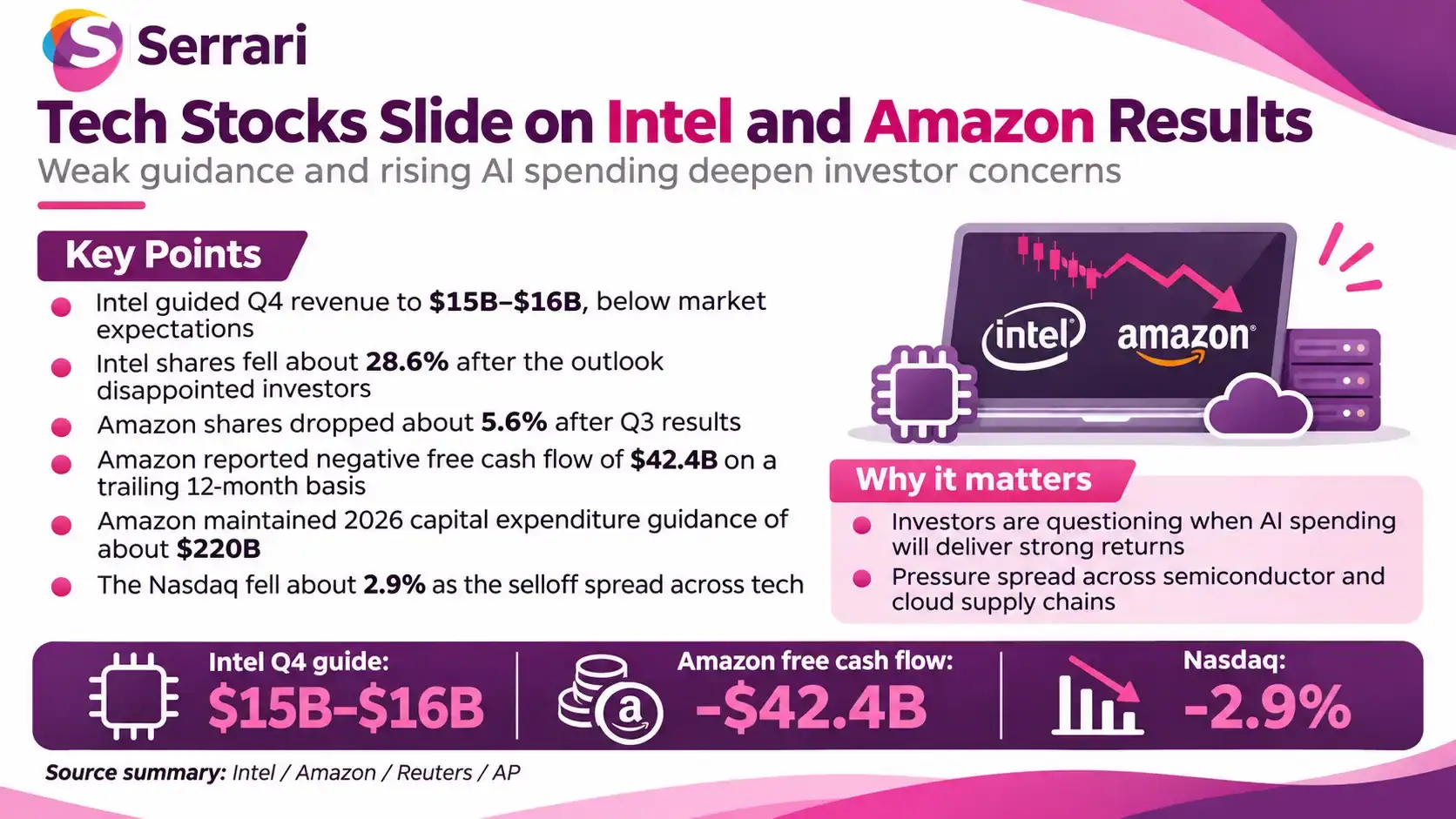
- Intel fell approximately 29% after forecasting fourth-quarter revenue of 15 – 16 billion, below analysts’ expectations.
- Amazon shares declined about 5.6% as trailing 12-month free cash flow fell to negative $42.4 billion.
- The Nasdaq dropped 2.9%, while the S&P 500 fell approximately 1.8% on October 30.
- Amazon maintained its 2026 capital expenditure outlook of around $220 billion, much of it connected to AI infrastructure.
- The losses spread across semiconductor companies as investors reassessed the potential returns on heavy AI spending.
Intel’s Weak Forecast Triggers a Sharp Share Decline
Intel’s third-quarter financial results showed revenue rising 21% year over year to $16.5 billion. Its outlook, however, overshadowed that growth: the chipmaker projected fourth-quarter revenue of 15billion–16 billion, below the roughly $17.05 billion estimate cited in market commentary.
The company warned that a weaker personal-computer market was likely to persist into at least the first half of 2027. Higher memory prices and softer demand have complicated the outlook, even as Intel reported strong growth in its data-centre business.
Intel shares lost approximately 28.6% by Friday’s close, according to the October 30 market report. The collapse illustrated how quickly investors were willing to punish a weaker outlook despite an improvement in reported quarterly revenue.
Amazon’s Cash Outflow Raises Questions About AI Spending
Amazon’s third-quarter earnings release recorded net sales growth and a 39% increase in Amazon Web Services revenue to $46 billion. Yet the company reported negative free cash flow of $42.4 billion over the trailing 12 months, compared with positive $14.8 billion a year earlier.
The reversal largely reflected higher spending on property and equipment, including AI infrastructure. Amazon also reiterated that cash capital expenditure would reach approximately $220 billion in 2026.
Its shares fell around 5.6% on Friday. Investors are increasingly distinguishing between demand for cloud-based AI services and the cost of expanding the data centres, computing capacity and supporting infrastructure required to deliver them.
Context is everything. Stay ahead of shifting trends with today’s market updates, and uncover emerging opportunities using the Serrari Group Market Index and Marketplace. Then, take control of your own financial future by exploring our Money & Life Reset Transformation Blueprint ™ to build stronger habits, create better systems, and design a path toward lasting wealth.
Selloff Spreads Across Global Semiconductor Stocks
The pressure extended beyond the two companies. The wider technology selloff pushed the Nasdaq down approximately 2.9% and the S&P 500 down about 1.8%. Nvidia and Broadcom also declined as investors reduced exposure to semiconductor companies linked to AI infrastructure spending.
Alphabet had already experienced a steep decline following its earnings announcement, while Reddit shares dropped sharply after weaker-than-expected guidance and concerns about traffic from AI-powered search. In Asia, SK Hynix and Samsung Electronics fell, and European chip-equipment companies faced similar pressure.
The selling suggested that worries about the economics of AI infrastructure were spreading throughout the supply chain, including memory producers, chip designers and equipment manufacturers.
Investors Shift Focus From AI Growth to Investment Returns
Amazon, Alphabet, Microsoft and Meta are committing enormous sums to data centres, specialised chips and computing infrastructure. Their spending has benefited suppliers, but it has also raised the stakes for future revenue growth.
The broader reassessment of technology valuations comes after a powerful rally driven by expectations that AI adoption would transform productivity and corporate earnings. Investors now want clearer evidence that these investments can produce durable profits and sufficient free cash flow.
For the sector, the central question is no longer simply whether AI demand is growing. It is whether revenue growth can keep pace with the infrastructure costs required to support it. Future earnings reports, capital expenditure guidance and cash-flow trends will be crucial in determining whether confidence returns.
Sources: Intel / Amazon / Reuters / Associated Press / Morningstar
Your financial future isn’t something you wait for—it’s something you build.
The real question is: when do you begin?
Move beyond simply staying informed.
Navigate the markets with clarity—track trends through the Serrari Group Market Index, uncover opportunities in the Serrari Marketplace, and build practical knowledge with our Curated Wealth Builder Platform.
Stay connected to what truly matters.
Get daily insights on macro trends and financial movements across Kenya, Africa, and global markets—delivered through the Serrari Newsletter.
Growth opens doors.
Advance your career through professional programs including ACCA, HESI A2, ATI TEAS 7 , HESI EXIT , NCLEX – RN and NCLEX – PN, Financial Literacy!🌟—designed to move you forward with confidence.
See where money is flowing—clearly and in real time.
Track Money Market Funds, Treasury Bills, Treasury Bonds, Green Bonds, and Fixed Deposits, alongside global and African indexes, key economic indicators, and the evolving Crypto and stablecoin landscape—all within Serrari’s Market Index.