The International Monetary Fund (IMF) has urged the United Kingdom to maintain its deficit-reduction strategy despite mounting pressure from higher government borrowing costs, energy prices and demands for public spending. In its latest assessment of Britain’s fiscal outlook, the Fund praised the UK’s relatively clear medium-term borrowing plan while warning that credibility depends on following through.
The warning comes ahead of Chancellor John Healey’s first Budget, scheduled for October 28, 2026. The IMF has upgraded its projection for UK economic growth this year, but expects slower expansion in 2027 and inflation to remain above the Bank of England’s target.
Key Overview
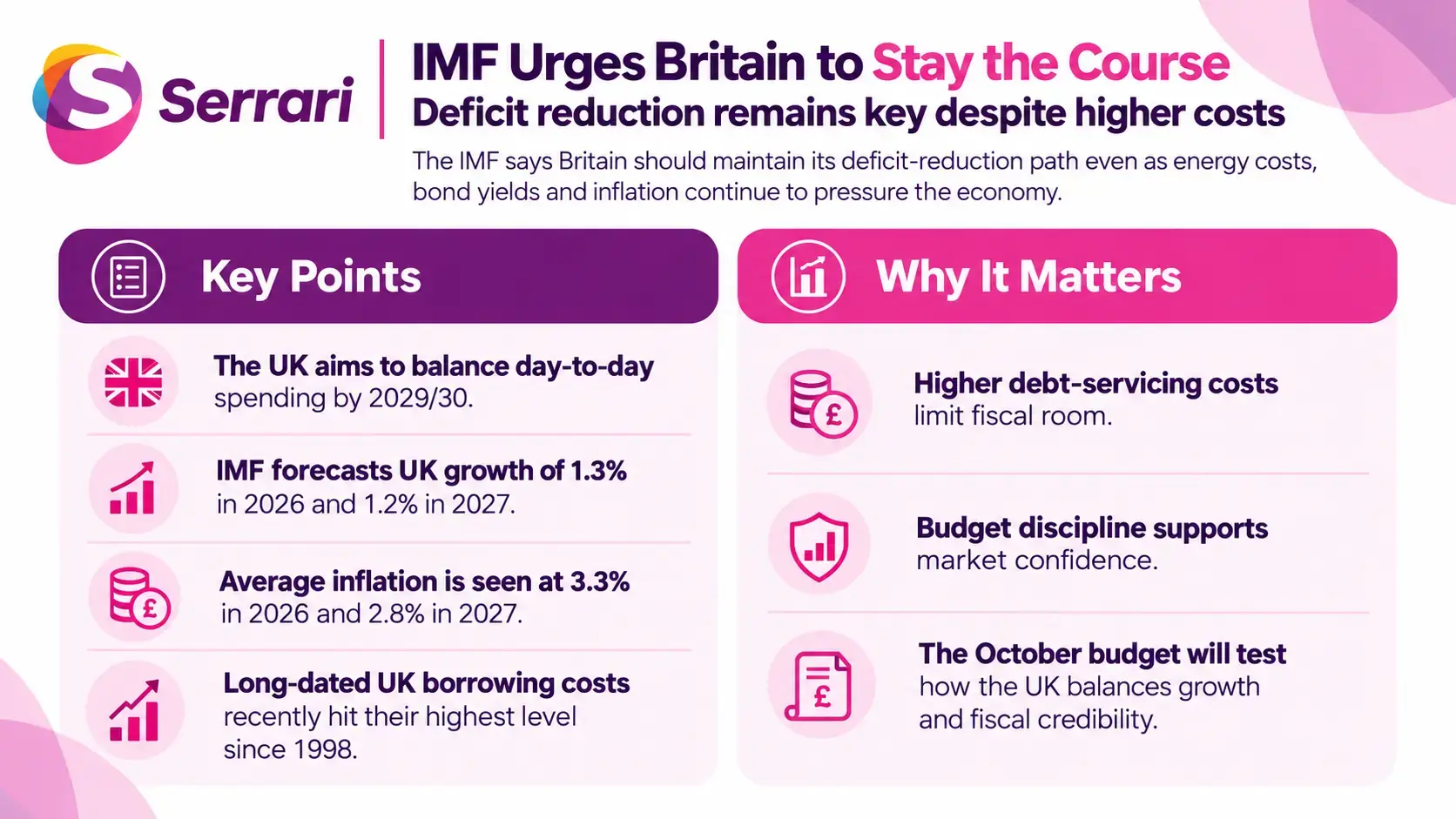
- Fiscal discipline: The IMF wants Britain to stick to its planned reduction in government borrowing rather than relax its targets.
- Budget target: The government aims to cover day-to-day spending with revenues by the 2029/30 financial year.
- Growth forecasts: UK GDP is projected to expand 1.3% in 2026 and 1.2% in 2027.
- Inflation outlook: The IMF forecasts average inflation of 3.3% in 2026 and 2.8% in 2027.
- Borrowing pressure: Long-dated UK government bond yields recently reached their highest levels since 1998.
- Interest rates: The Bank of England has maintained its policy rate at 3.75%, with policymakers divided over further tightening.
Why the IMF Is Urging Fiscal Restraint
At the IMF–World Bank annual meetings in Bangkok on October 13, IMF chief economist Silvana Tenreyro said Britain had begun a credible fiscal consolidation path and should continue along it. The Fund described the UK as the only major advanced economy with a sufficiently clear plan to reduce borrowing over the coming years, although that assessment is not a guarantee the targets will be met.
The government’s existing fiscal framework requires the current budget to move into balance or surplus by 2029/30 and net financial liabilities to decline relative to the economy. Balancing the current budget is not the same as eliminating all government borrowing: borrowing for capital investment can continue, provided the relevant fiscal rules are satisfied.
Maintaining the plan is becoming harder as debt-interest payments rise and ministers face competing demands to fund defence, energy relief and public services. Changes to taxes or spending will determine whether the government can preserve fiscal credibility without unnecessarily weakening growth.
Rising Bond Yields Increase the Cost of Debt
Investors have demanded higher returns on UK government bonds, known as gilts, as energy-driven inflation concerns and global debt issuance unsettle markets. The yield on the 30-year gilt climbed above 6% on October 7, reaching a 28-year high. Britain has faced some of the highest government borrowing costs among G7 economies.
Higher yields increase the cost of issuing new debt and refinancing maturing bonds. They can also constrain public investment and reduce room to support households during economic shocks. Independent pre-Budget analysis of the public finances identifies inflation, debt servicing and pressure on departmental spending as key challenges facing the Chancellor.
Context is everything. Stay ahead of shifting trends with today’s market updates, and uncover emerging opportunities using the Serrari Group Market Index and Marketplace. Then, take control of your own financial future by exploring our Money & Life Reset Transformation Blueprint ™ to build stronger habits, create better systems, and design a path toward lasting wealth.
Growth Improves in 2026 but Risks Persist
The IMF now expects the British economy to grow 1.3% in 2026, compared with its July forecast of 1.0% and April estimate of 0.8%. The revised forecast for next year is 1.2%, reflecting the drag from elevated energy costs and long-term interest rates on consumption and business investment.
The upgrade indicates that activity has been more resilient than previously anticipated. However, stronger near-term growth does not automatically repair the public finances: fiscal outcomes also depend on inflation, tax receipts, debt interest and how much the government spends.
Inflation Complicates the Interest Rate Outlook
The IMF expects UK inflation to average 3.3% this year and 2.8% in 2027, remaining above the central bank’s 2% target. Higher fuel and energy costs have made the outlook especially uncertain.
At its September monetary policy meeting, the Bank of England held Bank Rate at 3.75% by a 6–3 vote, with three members favouring an increase. Policymaker Megan Greene has argued that current rates may not be restrictive enough to contain inflation. That is an individual policy position, not an announced decision to raise rates at the next meeting.
What to Watch Ahead of the October Budget
The October 28 Budget will test whether Britain can reconcile its borrowing rules with rising costs and demands on public services. The most important signals will be updated fiscal forecasts, realistic spending assumptions, tax measures and the government’s remaining room to absorb economic shocks.
For markets and households, the IMF’s message is twofold: Britain’s stronger 2026 growth outlook provides some reassurance, but sustained deficit reduction and credible inflation control remain important to containing borrowing costs over the longer term.
Sources: Reuters / International Monetary Fund / UK Parliament / Institute for Fiscal Studies / Bank of England
Your financial future isn’t something you wait for—it’s something you build.
The real question is: when do you begin?
Move beyond simply staying informed.
Navigate the markets with clarity—track trends through the Serrari Group Market Index, uncover opportunities in the Serrari Marketplace, and build practical knowledge with our Curated Wealth Builder Platform.
Stay connected to what truly matters.
Get daily insights on macro trends and financial movements across Kenya, Africa, and global markets—delivered through the Serrari Newsletter.
Growth opens doors.
Advance your career through professional programs including ACCA, HESI A2, ATI TEAS 7 , HESI EXIT , NCLEX – RN and NCLEX – PN, Financial Literacy!🌟—designed to move you forward with confidence.
See where money is flowing—clearly and in real time.
Track Money Market Funds, Treasury Bills, Treasury Bonds, Green Bonds, and Fixed Deposits, alongside global and African indexes, key economic indicators, and the evolving Crypto and stablecoin landscape—all within Serrari’s Market Index.