





President William Ruto’s economic adviser David Ndii has linked shortages of packaged milk in Kenyan supermarkets to rising consumption, particularly among workers on affordable housing construction sites. Speaking on November 3, Ndii argued that growing national milk production and higher processor intake over the administration’s term point to stronger demand rather than an overall shortage of milk.
However, monthly official statistics and government explanations of the supply squeeze show that deliveries to formal processors have recently declined as dry weather and costly animal feed constrain production. The evidence suggests that growing demand and reduced availability of packaged milk can occur simultaneously.
Key Overview
- Ndii’s explanation: Higher consumption, including at affordable housing sites, is contributing to supermarket stock-outs, he argues.
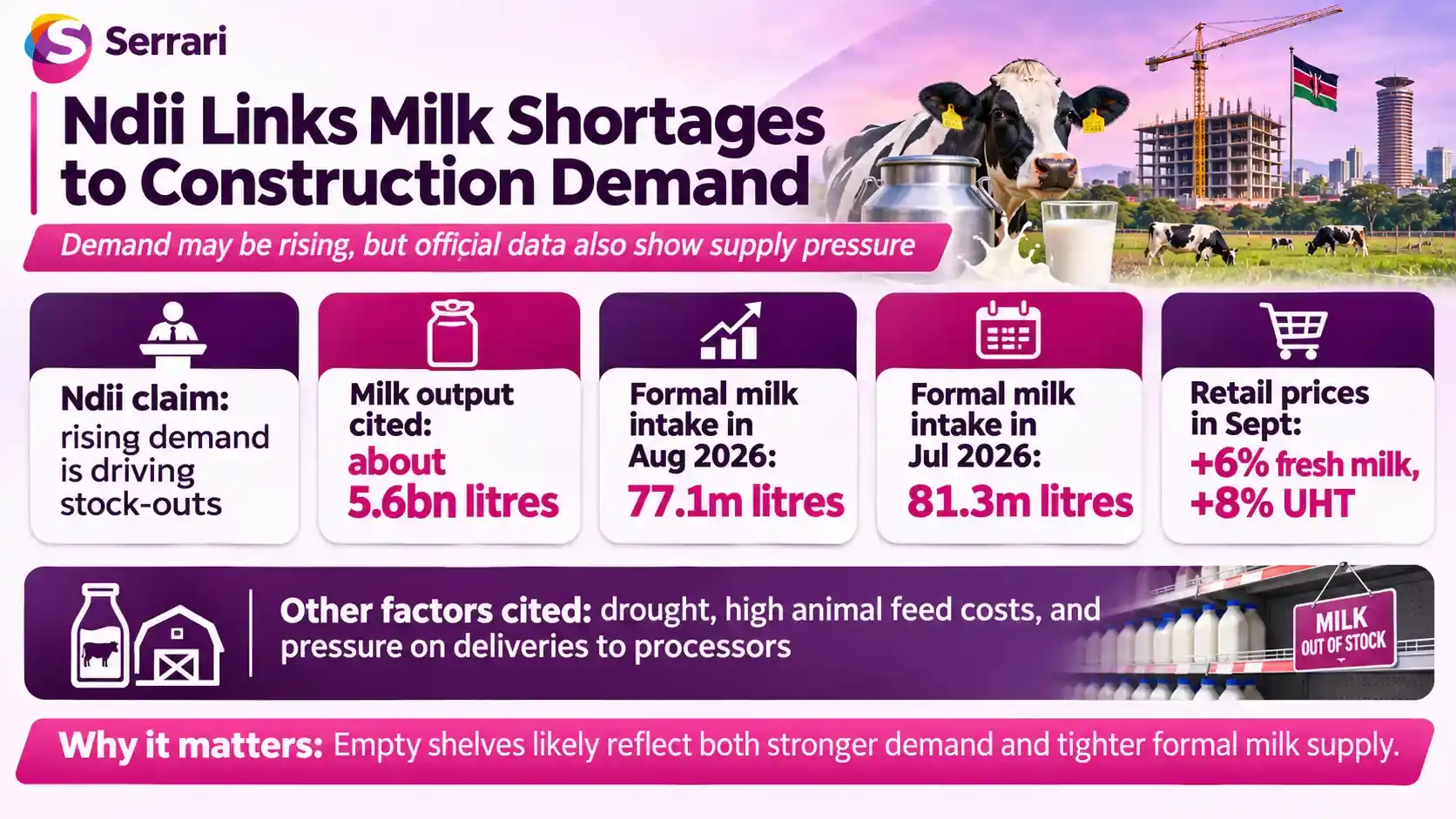
- Long-term production claim: Ndii cited a 20% rise in national milk production to around 5.6 billion litres and a 34% increase in processor intake since the administration took office; these are his comparisons, not independently confirmed causal findings.
- Latest official intake: Formal milk intake fell to 77.1 million litres in August 2026, from 81.3 million litres in July, a 5.1% monthly decline.
- Supply pressures: Drought, limited pasture, feed costs and milk moving outside formal processing channels have also been identified as constraints.
- Retail prices: In September, prices rose 6% for fresh packaged cow milk and 8% for long-life UHT milk compared with August.
Ndii Attributes Empty Shelves to Stronger Consumption
In remarks reported on November 3, Ndii questioned why supermarkets would experience shortages if production and milk received by processors had increased over a longer period. He pointed to workers on affordable housing projects as an example of consumers whose demand for milk may have grown.
He described crates of milk at construction sites and suggested that consumption patterns among lower-income workers were changing. But the remarks did not include a quantified assessment of how much milk construction workers consume or what proportion of recent supermarket shortages that demand explains.
His argument also compares longer-term sector growth with short-term retail shortages. These measures can move in different directions: annual national output may increase even when recent deliveries to processors decline, or when demand for packaged products exceeds what manufacturers and distributors can supply at particular locations.
Official Data Show Milk Deliveries Falling
The August 2026 economic indicators recorded 77.1 million litres of formal-sector milk intake, down from 81.3 million litres in July. July itself had fallen from 84.4 million litres in June. That is a clear recent decline in milk reaching formal processors, although the series does not measure all milk produced or sold informally.
Separately, livestock officials attributed the contraction to prolonged dry conditions, reduced pasture and pressure on animal feeds. The government subsequently identified purchases by informal brokers as another factor diverting raw milk away from processing plants.
The two August figures circulating in coverage—roughly 75 million litres from one dairy-industry account and 77.1 million litres from the official statistics dashboard—should not be treated as identical readings. The published official dashboard records 77.1 million litres; a difference in sources or reporting revisions would need reconciliation before using the alternative figure as definitive.
Context is everything. Stay ahead of shifting trends with today’s market updates, and uncover emerging opportunities using the Serrari Group Market Index and Marketplace. Then, take control of your own financial future by exploring our Money & Life Reset Transformation Blueprint ™ to build stronger habits, create better systems, and design a path toward lasting wealth.
Milk Prices Rise as Retailers Ration Supplies
Pressure on packaged supplies has reached households. The September inflation figures show month-on-month increases of 6% for fresh packaged cow milk and 8% for UHT milk, adding to food costs.
Reports from Nyeri supermarkets describe rationing and higher prices, while some processors have received fewer litres from farmers. These are signs of a tight formal supply chain, even if total milk consumption is increasing.
Government measures to ease feed shortages have included plans for duty-free yellow maize imports and efforts to improve feed distribution. Whether these steps restore shelves will depend on rainfall, farmers’ costs, deliveries to processors and distribution capacity.
What the Data Can—and Cannot—Explain
Ndii’s hypothesis that stronger demand is contributing to stock-outs is plausible, but the construction-worker explanation has not been demonstrated with consumption data. At the same time, the recent fall in formal milk intake contradicts any suggestion that supply to processors has been consistently rising throughout 2026.
A full explanation requires both sides of the market: who is buying more milk and how much is reaching processors and shops. Until those figures are reconciled, construction-site demand should be presented as Ndii’s assessment, not as the established cause of Kenya’s milk shortages.
Sources: The Star / Kenya National Bureau of Statistics / Kenya News Agency
Your financial future isn’t something you wait for—it’s something you build.
The real question is: when do you begin?
Move beyond simply staying informed.
Navigate the markets with clarity—track trends through the Serrari Group Market Index, uncover opportunities in the Serrari Marketplace, and build practical knowledge with our Curated Wealth Builder Platform.
Stay connected to what truly matters.
Get daily insights on macro trends and financial movements across Kenya, Africa, and global markets—delivered through the Serrari Newsletter.
Growth opens doors.
Advance your career through professional programs including ACCA, HESI A2, ATI TEAS 7 , HESI EXIT , NCLEX – RN and NCLEX – PN, Financial Literacy!🌟—designed to move you forward with confidence.
See where money is flowing—clearly and in real time.
Track Money Market Funds, Treasury Bills, Treasury Bonds, Green Bonds, and Fixed Deposits, alongside global and African indexes, key economic indicators, and the evolving Crypto and stablecoin landscape—all within Serrari’s Market Index.