Binance, the world’s largest cryptocurrency exchange, reported a security incident involving approximately $6.3 billion in digital assets on 29 October 2026. Blockchain analysis firms said the bulk of the theft unfolded in about 20 minutes. Binance and its partners froze around $3 billion in assets, while the exchange pledged to cover all losses. Investigators have linked the attack to North Korean hackers, though Binance said it had not attributed responsibility to any individual.
Key Takeaways
- Binance reported an estimated $6.3 billion impact, potentially the largest crypto heist on record.
- Around $3 billion in affected assets had been frozen, while the status of the remaining funds remained uncertain.
- Binance initially cited a compromised engineer’s laptop, then reported additional breach points.
- Blockchain analytics firms linked the attack to North Korean hacking group TraderTraitor.
- Binance pledged to cover losses and temporarily suspended withdrawals while strengthening security.
Binance Reports Record Crypto Theft
Binance, the world’s largest cryptocurrency exchange, says hackers stole about $6.3 billion in what appears to have been the biggest crypto heist on record.
The company said the estimated total impact was around $6.3 billion after an attacker moved approximately 6.36 billion USD out of Binance wallets across multiple blockchains. The bulk of the theft unfolded over about 20 minutes, starting late on Thursday, 29 October.
The incident dwarfs the previous record of $1.5 billion, stolen from the Bybit exchange in February 2025.
Binance temporarily suspended withdrawals while it worked with law enforcement and blockchain intelligence firms to secure its infrastructure and locate stolen funds. The exchange said deposits remained unaffected and pledged to cover all losses.
Around $3 Billion in Assets Frozen
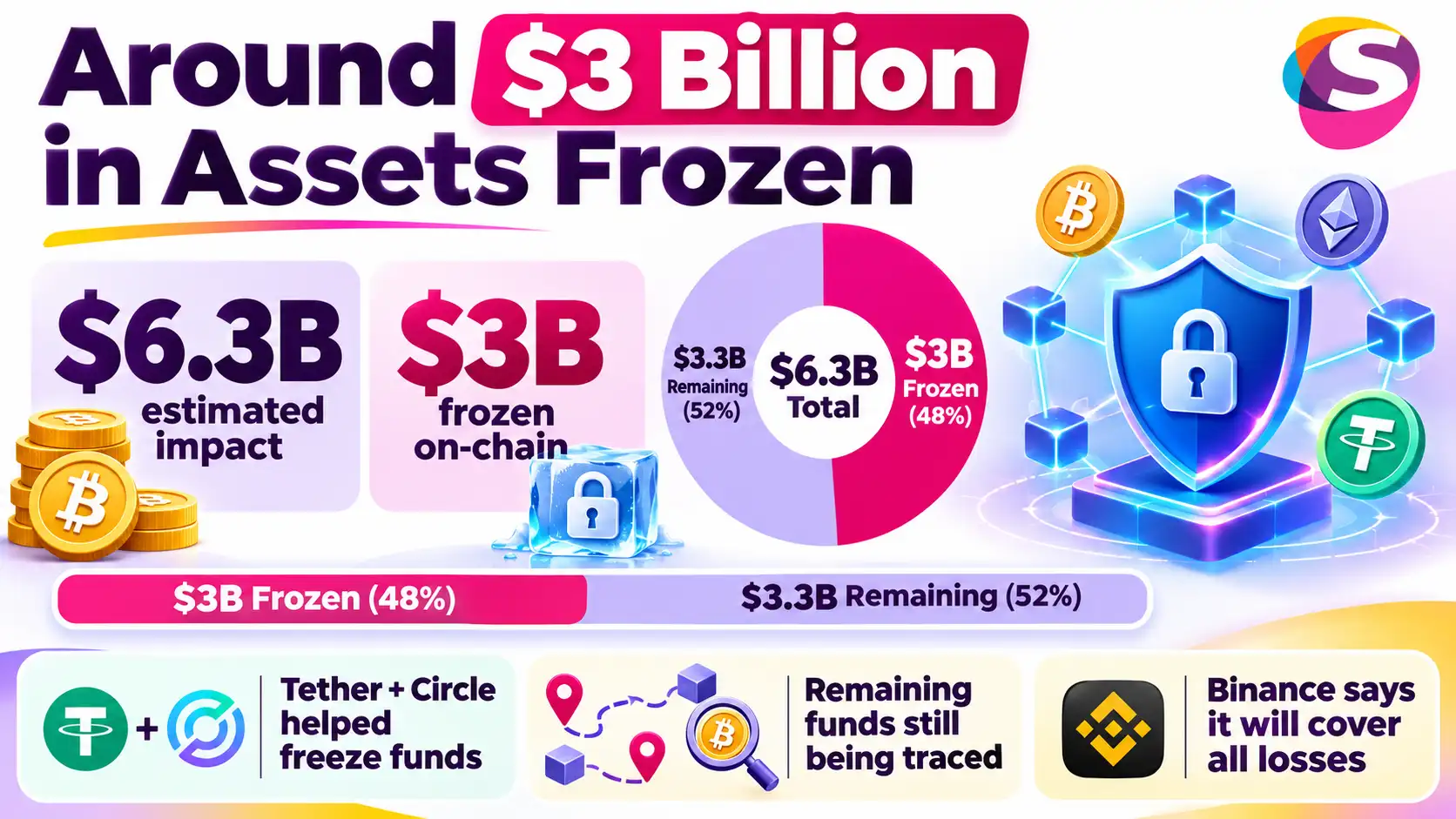
Binance said approximately $3 billion of affected assets had been frozen on-chain. Stablecoin issuers Tether and Circle accounted for a significant share of the freezes, with other crypto firms also moving to secure funds connected to the breach.
The exchange said the frozen amount could change as teams trace and freeze additional assets. Binance had not clarified what happened to the remaining funds.
The company said it would cover losses using its Secure Asset Fund for Users (SAFU), established in 2018, and company funds. It later said it had set aside more than $6.34B to cover the stolen assets.
Investigation Finds Additional Breach Points
Binance initially said the incident may have involved a compromised DevOps engineer’s laptop, which allowed an attacker to access a service container and submit unauthorized withdrawal transactions.
Co-CEO Richard Teng later said the attack was more complex than the misuse of a single engineer’s permissions. The investigation uncovered additional points of breach, and Teng said attackers used a self-destruct mechanism that destroyed tooling and traces, making the investigation more difficult.
Binance said it had found no evidence that any wallet’s private key had been leaked. It also revoked affected address authorizations and began reviewing its withdrawal security systems.
The exchange said it would publish a detailed technical post-mortem once the investigation was complete and the facts were verified.
Context is everything. Stay ahead of shifting trends with today’s market updates, and uncover emerging opportunities using the Serrari Group Market Index and Marketplace. Then, take control of your own financial future by exploring our Money & Life Reset Transformation Blueprint ™ to build stronger habits, create better systems, and design a path toward lasting wealth.
North Korean Hackers Suspected
Blockchain analysis firms TRM Labs and Chainalysis assessed that the attack was likely carried out by TraderTraitor, a North Korean hacking unit linked to the Lazarus Group.
TRM Labs said several features matched earlier North Korea-linked heists, including the Bybit hack and the KelpDAO hack in April 2026. Chainalysis also pointed to on-chain activity observed after the breach.
Binance, however, said its investigation had not attributed responsibility to any individual. North Korea routinely denies involvement in hacking.
The FBI said it was aware of the incident and was coordinating with relevant public and private partners to understand its scope, evaluate potential impacts and investigate.
Crypto Markets React to the Breach
The hack spooked cryptocurrency markets, with major digital assets falling after news of the incident.
Bitcoin hit a six-week low of $76,368, while Ether fell more than 3 percent to a two-month low of $2,178. Shares in Coinbase, which said it was unaffected by the breach, also declined.
The incident came as crypto markets were already under pressure from higher US interest rates and weaker demand from exchange-traded fund buyers.
Risks for Centralized Exchanges
The breach highlighted risks associated with centralized exchanges, which hold users’ assets on their behalf. Crypto market expert Sean Foley said assets held at a centralized exchange are only as safe as the exchange itself, and that larger holdings can make an exchange a bigger target.
Insurance offers limited protection, as most crime and cyber-insurance policies do not cover stolen cryptocurrency. Crypto-specific coverage remains a niche business offered largely by specialist insurers.
The incident follows a series of major crypto thefts. Hackers stole $2.87 bn across nearly 150 attacks in 2025, according to TRM Labs’ 2026 Crypto Crime Report.
Outlook
Binance said it was working with law enforcement, blockchain intelligence firms and industry partners to trace and recover stolen assets. The exchange also said it was on track to resume withdrawals within approximately 45 hours of its initial announcement.
The incident has renewed scrutiny of centralized exchange security, withdrawal controls and the risks of holding digital assets with third-party platforms. Binance said user funds were safe and that it would cover all losses.
FAQs
1. How much cryptocurrency was stolen from Binance?
Binance estimated the impact at around $6.3 billion, making it potentially the largest crypto heist on record.
2. How much of the stolen cryptocurrency was frozen?
Around $3 billion in affected assets had been frozen on-chain.
3. Who is suspected of carrying out the attack?
TRM Labs and Chainalysis linked the attack to TraderTraitor, a North Korean hacking unit, but Binance had not attributed responsibility to an individual.
4. Did Binance promise to cover users’ losses?
Yes. Binance said it would cover all losses using its SAFU fund and company funds.
Your financial future isn’t something you wait for—it’s something you build.
The real question is: when do you begin?
Move beyond simply staying informed.
Navigate the markets with clarity—track trends through the Serrari Group Market Index, uncover opportunities in the Serrari Marketplace, and build practical knowledge with our Curated Wealth Builder Platform.
Stay connected to what truly matters.
Get daily insights on macro trends and financial movements across Kenya, Africa, and global markets—delivered through the Serrari Newsletter.
Growth opens doors.
Advance your career through professional programs including ACCA, HESI A2, ATI TEAS 7 , HESI EXIT , NCLEX – RN and NCLEX – PN, Financial Literacy!🌟—designed to move you forward with confidence.
See where money is flowing—clearly and in real time.
Track Money Market Funds, Treasury Bills, Treasury Bonds, Green Bonds, and Fixed Deposits, alongside global and African indexes, key economic indicators, and the evolving Crypto and stablecoin landscape—all within Serrari’s Market Index.