Bank for International Settlements chief Pablo Hernández de Cos has warned that central banks could face a more complicated environment when responding to the next financial crisis. In remarks delivered in Vienna , he highlighted rising government debt, the growing importance of non-bank financial institutions and rapidly evolving technologies as factors that could make emergency intervention harder to design and explain.
His warning comes as policymakers confront higher sovereign borrowing needs and a financial system in which hedge funds, pension funds and asset managers play increasingly important roles in government bond markets.
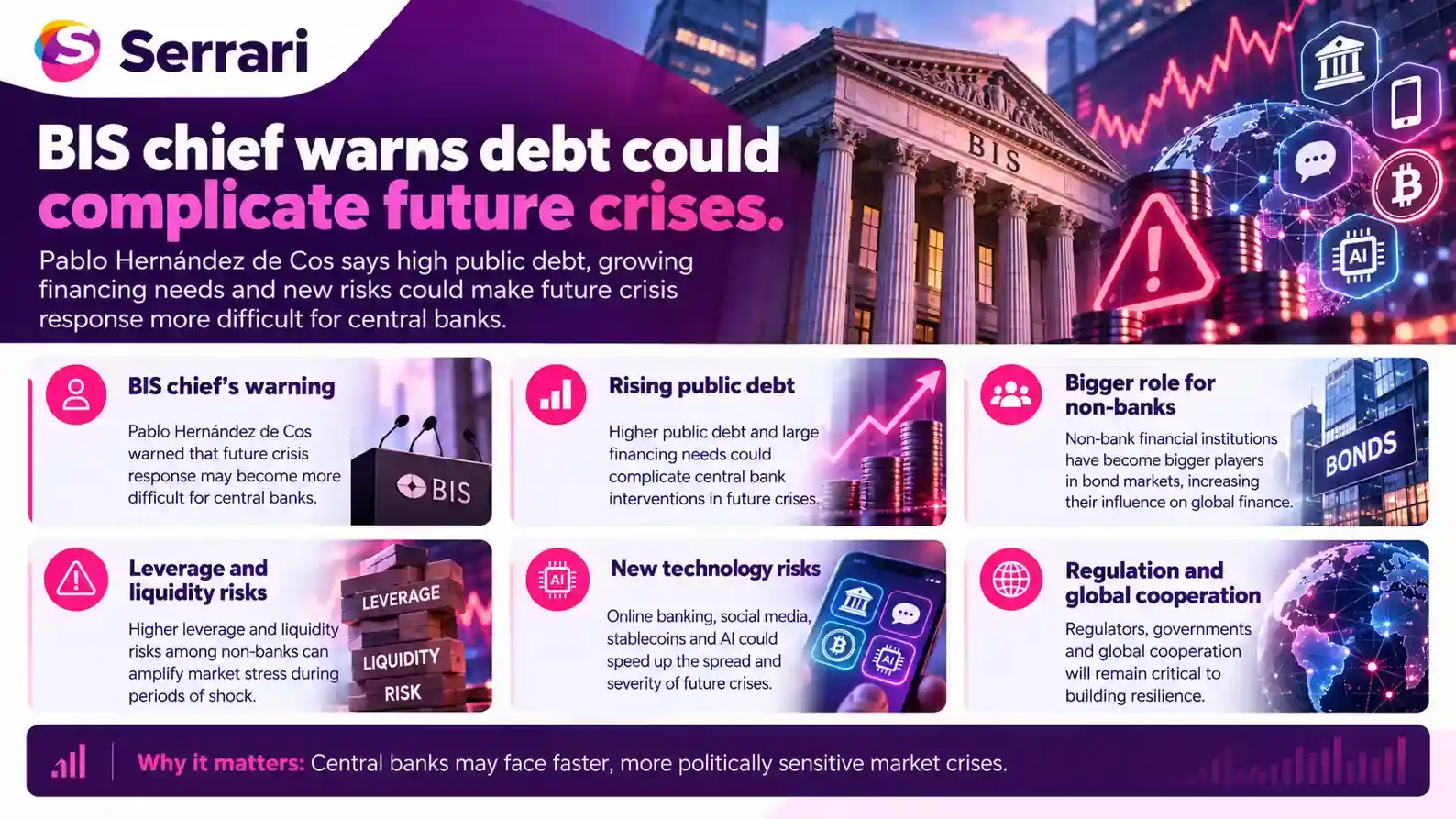
Key Overview
- Public debt is near post-World War Two highs in several major economies, while fiscal deficits remain elevated.
- High government financing needs could make central bank bond purchases more politically and economically sensitive.
- Non-bank financial institutions have become increasingly important participants in sovereign debt markets.
- Leverage and liquidity pressures among non-banks can amplify market stress during periods of rapid selling.
- The Bank of England’s temporary 2022 gilt purchases provide a potential model for targeted crisis intervention.
- Online banking, social media, stablecoins and AI could accelerate the speed at which future financial crises develop.
- Hernández de Cos says regulation, government action and international cooperation must complement central bank intervention.
High Government Debt Complicates Central Bank Action
Central banks have repeatedly played a decisive role during financial shocks, from the global financial crisis to the pandemic-era market turmoil. Hernández de Cos argued, however, that the environment surrounding the next intervention could look significantly different.
One of the biggest challenges is government debt. He warned that elevated debt and financing needs could blur the distinction between central bank action intended to restore orderly markets and intervention that appears to support government borrowing.
That distinction matters because central banks may need to buy government bonds when market dysfunction threatens financial stability or disrupts the transmission of monetary policy.
When sovereign debt is already high, however, emergency purchases could be interpreted as monetary financing or an attempt to suppress borrowing costs rather than a narrowly targeted response to financial instability.
This could make communication and credibility increasingly important during future interventions.
Non-Banks Become More Important to Bond Markets
A second concern is the growing influence of non-bank financial institutions, including hedge funds, pension funds and asset managers.
These institutions can provide significant market liquidity during normal conditions. But some strategies depend heavily on leverage, derivatives or short-term market funding, creating vulnerabilities when asset prices move suddenly.
The March 2020 “dash for cash” demonstrated how rapid selling could overwhelm even highly liquid markets, including U.S. Treasuries. Similar vulnerabilities were exposed during Britain’s 2022 gilt crisis, when leveraged liability-driven investment strategies used by pension funds came under severe pressure.
As government bond markets become more dependent on leveraged and market-based institutions, policymakers may increasingly need to address weaknesses outside the conventional banking system before periods of stress emerge.
Context is everything. Stay ahead of shifting trends with today’s market updates, and uncover emerging opportunities using the Serrari Group Market Index and Marketplace. Then, take control of your own financial future by exploring our Money & Life Reset Transformation Blueprint ™ to build stronger habits, create better systems, and design a path toward lasting wealth.
UK Gilt Crisis Offers a Crisis-Response Blueprint
Hernández de Cos pointed to Britain’s 2022 gilt-market intervention as a useful example of how central banks can respond to severe market dysfunction without turning emergency asset purchases into permanent support.
The temporary gilt purchase programme was launched on September 28, 2022, after extreme moves in long-dated government bonds threatened financial stability.
Purchases were explicitly temporary and targeted, with the programme ending on October 14 as initially planned.
The central bank ultimately purchased £19.3 billion of gilts and later sold the entire portfolio back into the market by January 2023.
The intervention was designed to buy time for affected liability-driven investment funds to reduce leverage and strengthen their financial positions rather than permanently insulating investors from losses.
Hernández de Cos said features such as defined purchase periods, limited intervention amounts, strong governance and clear communication provide useful lessons for future crises. He nevertheless cautioned that predetermined limits might be harder to maintain during a larger or more persistent financial shock.
Technology Could Make the Next Crisis Faster
Future financial instability may also unfold much more quickly than previous episodes.
Digital banking allows depositors to withdraw funds almost instantly, while social media can spread both legitimate information and misinformation at extraordinary speed.
Hernández de Cos also identified stablecoins and artificial intelligence as technologies capable of changing the transmission of financial stress. Faster payments and automated decision-making could accelerate movements of money across institutions and markets.
That could leave policymakers with significantly less time to determine whether a market movement represents normal price discovery or a threat to financial stability requiring intervention.
Regulation Must Reduce the Need for Bailouts
The broader message is that central banks cannot be expected to resolve every financial vulnerability after a crisis begins.
Stronger oversight of non-bank institutions, leverage and emerging financial technologies could reduce the probability that policymakers need to intervene in the first place. Well-designed regulation can also limit moral hazard, where investors take excessive risks because they expect central banks to rescue markets during periods of stress.
International coordination will remain equally important. Hernández de Cos emphasised that central bank swap lines continue to provide an important mechanism for supplying foreign-currency liquidity when global financial markets experience severe disruptions.
Central banks are therefore likely to remain crucial crisis managers, but rising debt, changing market structures and faster technology mean their future interventions may need to be more targeted, better coordinated and more clearly separated from government fiscal policy.
Sources: Reuters / Bank of England
Your financial future isn’t something you wait for—it’s something you build.
The real question is: when do you begin?
Move beyond simply staying informed.
Navigate the markets with clarity—track trends through the Serrari Group Market Index, uncover opportunities in the Serrari Marketplace, and build practical knowledge with our Curated Wealth Builder Platform.
Stay connected to what truly matters.
Get daily insights on macro trends and financial movements across Kenya, Africa, and global markets—delivered through the Serrari Newsletter.
Growth opens doors.
Advance your career through professional programs including ACCA, HESI A2, ATI TEAS 7 , HESI EXIT , NCLEX – RN and NCLEX – PN, Financial Literacy!🌟—designed to move you forward with confidence.
See where money is flowing—clearly and in real time.
Track Money Market Funds, Treasury Bills, Treasury Bonds, Green Bonds, and Fixed Deposits, alongside global and African indexes, key economic indicators, and the evolving Crypto and stablecoin landscape—all within Serrari’s Market Index.