
The latest Zimbabwe crypto regulation framework marks the country’s first dedicated legal structure for cryptocurrency businesses. The new rules require virtual asset service providers to register annually, comply with anti-money laundering requirements, and operate under regulatory oversight as Zimbabwe moves to formalize its growing digital asset market.
Key Overview
- Zimbabwe has introduced its first dedicated cryptocurrency regulatory framework.
- Virtual asset businesses must register annually with the Financial Intelligence Unit (FIU).
- The FIU operates under the Reserve Bank of Zimbabwe’s anti-money laundering framework.
- Cryptocurrency firms must pay an annual registration fee of $500.
- Businesses operating without registration will be in violation of the law.
- Companies must establish a legally registered domestic subsidiary.
- The regulations were introduced through Statutory Instrument 99 of 2026.
- Zimbabwe banned financial institutions from trading cryptocurrencies in 2018.
- Sub-Saharan Africa recorded over $205 billion in on-chain crypto transaction value between July 2024 and June 2025.
- The framework seeks to combat money laundering and formalize the digital asset sector.
Zimbabwe Cryptocurrency Regulation Introduces Formal Oversight
The introduction of Zimbabwe cryptocurrency regulation marks a major shift in the country’s approach to digital assets after years of operating without a dedicated legal framework.
The Zimbabwean government has announced new rules requiring cryptocurrency businesses to register with regulators, pay annual fees, and comply with anti-money laundering obligations.
The framework is designed to bring virtual asset activities under formal supervision while addressing concerns surrounding illicit financial activity.
For the first time, digital asset companies will operate within a clearly defined regulatory environment rather than the largely informal ecosystem that has existed for years.
The move reflects growing recognition of cryptocurrency’s role within Zimbabwe’s economy and the need to balance innovation with regulatory oversight.
Context is everything. Stay ahead of shifting trends with today’s market updates, and uncover emerging opportunities using the Serrari Group Market Index and Marketplace. Then, take control of your own financial future by exploring our Money & Life Reset Transformation Blueprint ™ to build stronger habits, create better systems, and design a path toward lasting wealth.
Zimbabwe Crypto Regulation Targets Formal Market Development
The new Zimbabwe crypto regulation framework seeks to transform a market that has historically operated outside formal financial supervision.
Under the new rules, businesses involved in buying, selling, transferring, safeguarding, or facilitating transactions involving virtual assets must register annually with the Financial Intelligence Unit (FIU).
The FIU functions as Zimbabwe’s primary anti-money laundering authority and operates under the Reserve Bank of Zimbabwe’s oversight structure.
The regulations were introduced through Statutory Instrument 99 of 2026 and represent the country’s first comprehensive attempt to establish dedicated rules for cryptocurrency-related activities.
Officials believe that formal oversight will improve transparency while helping integrate digital asset businesses into the broader financial system.
The framework also provides legal clarity for companies seeking to operate within the sector.
Cryptocurrency Regulation Zimbabwe Introduces Licensing Requirements
A central component of cryptocurrency regulation Zimbabwe is the introduction of mandatory registration requirements.
All qualifying digital asset businesses must complete annual registration procedures and maintain compliance with regulatory obligations.
The government has set the registration fee at $500 per year, creating a formal licensing mechanism for market participants.
In addition to paying the fee, cryptocurrency firms must establish a legally registered domestic subsidiary to operate within Zimbabwe.
These requirements are intended to ensure that businesses maintain a physical and legal presence within the country, improving accountability and regulatory oversight.
Operating without registration will constitute a violation of the new regulations and could expose businesses to enforcement actions.
The requirements mirror licensing frameworks commonly applied to traditional financial institutions.
Digital Asset Regulation Expands Anti-Money Laundering Oversight
A key objective of the new digital asset regulation framework is strengthening anti-money laundering controls.
Cryptocurrencies have attracted increased attention from regulators worldwide because of concerns regarding illicit financial flows, fraud, and other financial crimes.
Zimbabwe’s framework places virtual asset businesses under direct oversight by the Financial Intelligence Unit, requiring compliance with anti-money laundering standards similar to those applied within the traditional banking sector.
The government believes stronger compliance measures will help improve market integrity and reduce risks associated with unregulated financial activity.
By integrating cryptocurrency businesses into existing financial monitoring systems, authorities aim to improve transparency while preserving legitimate innovation.
The approach aligns with broader international regulatory trends affecting digital asset markets.
Crypto Policy Zimbabwe Reflects Changing Government Approach
The new crypto policy Zimbabwe represents a notable change from previous government positions toward cryptocurrencies.
In 2018, Zimbabwe prohibited financial institutions from trading or facilitating cryptocurrency transactions. The restriction effectively pushed many users and businesses toward peer-to-peer trading networks and informal marketplaces.
Despite these restrictions, cryptocurrency adoption continued growing.
Economic instability, hyperinflation, and repeated currency reforms contributed to public demand for alternative stores of value and alternative methods of transferring funds.
Many Zimbabweans turned to Bitcoin and other digital assets as tools for preserving purchasing power and conducting transactions outside traditional financial channels.
The latest regulatory framework acknowledges this reality while seeking to bring market activity under official supervision.
Virtual Asset Regulation Responds to Growing Adoption
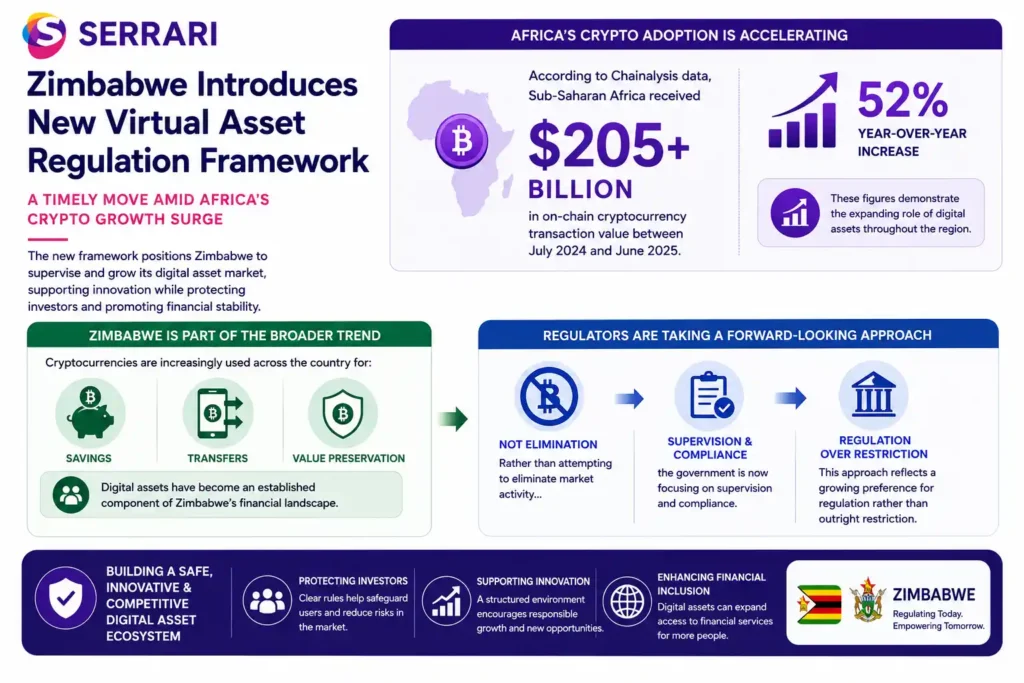
The new virtual asset regulation framework arrives amid rapid growth in cryptocurrency adoption across Africa.
According to Chainalysis data, Sub-Saharan Africa received more than $205 billion in on-chain cryptocurrency transaction value between July 2024 and June 2025, representing a 52% year-over-year increase.
The figures demonstrate the expanding role of digital assets throughout the region.
Zimbabwe has been part of this broader trend, with cryptocurrencies increasingly used for savings, transfers, and value preservation.
Regulators appear to recognize that digital assets have become an established component of the financial landscape.
Rather than attempting to eliminate market activity, the government is now focusing on supervision and compliance.
This approach reflects a growing preference for regulation rather than outright restriction.
Cryptocurrency Market Zimbabwe Enters New Era
The introduction of formal rules may significantly reshape the cryptocurrency market Zimbabwe.
For businesses, the framework provides legal certainty that could encourage investment and long-term planning.
Companies willing to meet regulatory requirements may benefit from operating within a recognized legal structure.
For consumers, oversight could improve confidence in the market by introducing accountability and compliance standards.
At the same time, increased regulatory requirements may raise operating costs for smaller businesses and startups.
The long-term impact will depend on how regulators implement and enforce the new rules.
However, the transition from an informal market to a regulated environment represents a significant milestone for Zimbabwe’s digital asset ecosystem.
Why Cryptocurrency Remains Popular in Zimbabwe
Zimbabwe’s history helps explain why cryptocurrency adoption has remained resilient despite regulatory uncertainty.
Hyperinflation during the late 2000s severely damaged confidence in traditional financial systems and eroded household savings.
Subsequent currency changes and economic instability further weakened trust in conventional stores of value.
In response, many individuals sought alternative assets capable of preserving wealth and facilitating transactions.
Cryptocurrencies emerged as one such alternative.
The government’s decision to regulate rather than prohibit the sector suggests recognition of the role digital assets now play within the broader economy.
As adoption continues expanding, policymakers are increasingly focused on managing risks while supporting innovation.
Conclusion
The introduction of Zimbabwe cryptocurrency regulation represents a major step toward formalizing the country’s digital asset sector. By requiring registration, annual licensing fees, domestic incorporation, and anti-money laundering compliance, the government is creating a structured framework for cryptocurrency businesses.
The move reflects both the growing importance of digital assets within Zimbabwe and broader regional trends in cryptocurrency adoption. While compliance requirements may increase operational responsibilities for businesses, the new framework provides long-awaited legal clarity and could support the long-term development of a more transparent and regulated digital asset market.
FAQs
1. What are the new cryptocurrency regulations in Zimbabwe?
Zimbabwe’s new regulations require businesses involved in buying, selling, transferring, or safeguarding virtual assets to register annually with the Financial Intelligence Unit. Companies must also comply with anti-money laundering requirements, establish a local subsidiary, and pay a yearly registration fee.
2. How much is the annual registration fee for crypto businesses?
The annual registration fee has been set at $500. Cryptocurrency companies that fail to register and continue operating may be considered in violation of the regulations and could face enforcement action from authorities.
3. Why is Zimbabwe regulating cryptocurrencies now?
The government aims to bring the largely informal cryptocurrency market under official oversight, reduce money laundering risks, improve transparency, and provide a legal framework for businesses operating in the digital asset sector. The move reflects growing cryptocurrency adoption within the country and across Africa.
4. Does Zimbabwe still ban cryptocurrency trading?
The 2018 restriction primarily prohibited financial institutions from facilitating cryptocurrency transactions. The new framework does not legalize all activities without conditions but instead creates a regulatory structure under which qualifying cryptocurrency businesses can operate legally if they comply with registration and regulatory requirements.
Sources: Reuters, Trading View, Binance, Bitcoin News, Crypto Briefing
Your financial future isn’t something you wait for—it’s something you build.
The real question is: when do you begin?
Move beyond simply staying informed.
Navigate the markets with clarity—track trends through the Serrari Group Market Index, uncover opportunities in the Serrari Marketplace, and build practical knowledge with our Curated Wealth Builder Platform.
Stay connected to what truly matters.
Get daily insights on macro trends and financial movements across Kenya, Africa, and global markets—delivered through the Serrari Newsletter.
Growth opens doors.
Advance your career through professional programs including ACCA, HESI A2, ATI TEAS 7 , HESI EXIT , NCLEX – RN and NCLEX – PN, Financial Literacy!🌟—designed to move you forward with confidence.
See where money is flowing—clearly and in real time.
Track Money Market Funds, Treasury Bills, Treasury Bonds, Green Bonds, and Fixed Deposits, alongside global and African indexes, key economic indicators, and the evolving Crypto and stablecoin landscape—all within Serrari’s Market Index.