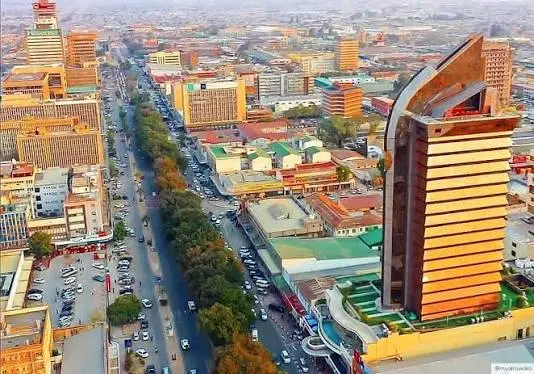
Zambia is aiming to lift economic growth to an average of about 7% over the next three years as the government shifts its focus from macroeconomic stabilisation toward investment, exports and job creation.
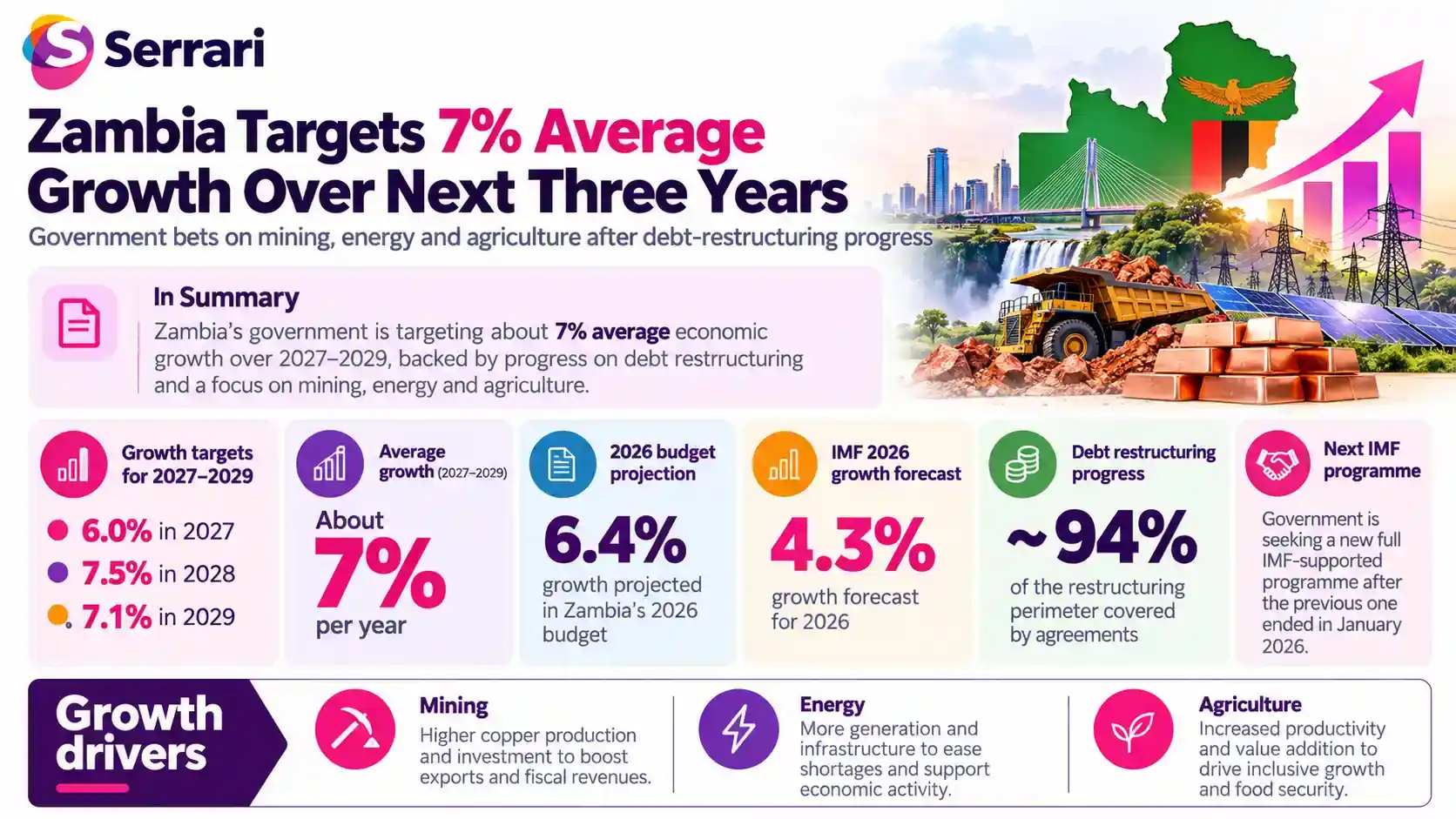
The country’s medium-term framework projects real GDP growth of 6.0% in 2027, 7.5% in 2028 and 7.1% in 2029. The targets are significantly stronger than the IMF’s current 2026 growth forecast of 4.3%, highlighting the scale of the government’s ambitions as Zambia emerges from a lengthy sovereign debt restructuring process.
Key Overview
- Zambia is targeting average economic growth of roughly 7% between 2027 and 2029.
- The government projects 6.0% growth in 2027, 7.5% in 2028 and 7.1% in 2029.
- Zambia’s 2026 budget had projected growth of 6.4%, while the IMF currently forecasts 4.3% for 2026.
- Mining, energy and agriculture are expected to be major drivers of the next phase of expansion.
- Debt restructuring agreements now cover about 94% of Zambia’s restructuring perimeter.
- The government is seeking a new full IMF-supported programme after its previous Extended Credit Facility ended in January 2026.
Zambia Moves From Stabilisation Toward Expansion
The government’s latest medium-term framework sets out a more ambitious growth path after several years dominated by debt restructuring, fiscal consolidation and efforts to restore macroeconomic stability.
The Ministry of Finance has outlined growth targets of 6.0%, 7.5% and 7.1% for 2027, 2028 and 2029 respectively.
Finance Minister Situmbeko Musokotwane has said the next stage will focus on attracting more investment, expanding exports and creating jobs, particularly through mining, energy and agriculture.
The strategy reflects Zambia’s effort to convert improvements in debt sustainability and inflation into stronger productive growth rather than simply preserving financial stability.
IMF Forecast Shows a More Cautious Near-Term Outlook
The government’s medium-term targets are more optimistic than current IMF projections.
The IMF forecasts real GDP growth of 4.3% in 2026, below the 6.4% estimate contained in Zambia’s 2026 budget.
The Fund has attributed the weaker 2026 outlook partly to softer mining production, normalisation in agriculture after a strong 2025 harvest, energy constraints and weaker trade activity.
Even so, the IMF has acknowledged substantial progress elsewhere in the economy. Inflation had fallen back into the Bank of Zambia’s target band earlier in 2026, while the country recorded a primary fiscal surplus in 2025.
Those gains provide a stronger base for investment-led growth, but achieving the government’s 7% average target will require faster expansion in productive sectors than currently assumed by the IMF.
Context is everything. Stay ahead of shifting trends with today’s market updates, and uncover emerging opportunities using the Serrari Group Market Index and Marketplace. Then, take control of your own financial future by exploring our Money & Life Reset Transformation Blueprint ™ to build stronger habits, create better systems, and design a path toward lasting wealth.
Debt Restructuring Progress Creates More Fiscal Space
Zambia’s growth strategy is closely linked to the progress made in restructuring its external debt.
The country defaulted on its sovereign obligations during the COVID-19 period, triggering years of negotiations with official and commercial creditors.
By May 2026, restructuring agreements covered about 94% of the relevant debt perimeter, marking one of the most important advances in restoring Zambia’s access to normal financing conditions.
Debt relief and maturity extensions can reduce near-term repayment pressure, but Zambia still faces high debt risks and must maintain fiscal discipline as it resumes investment.
The challenge is therefore to use improved fiscal space to support growth without rebuilding unsustainable debt.
Mining, Energy and Agriculture Lead the Growth Strategy
Copper remains central to Zambia’s economic outlook.
The government is seeking to increase mining investment and production at a time when global demand for copper is being supported by renewable-energy systems, electric vehicles, transmission networks and data-centre infrastructure.
Energy investment will also be critical. Electricity shortages have constrained industrial activity, meaning additional generation and transmission capacity could directly support mining, manufacturing and other productive sectors.
Agriculture represents another major growth pillar. Greater irrigation, access to finance, processing capacity and export infrastructure could help reduce Zambia’s exposure to weather-related shocks while expanding value-added production.
The government’s broader ambition is to turn these sectors into sources of higher exports and employment rather than relying mainly on commodity extraction.
Zambia Seeks New IMF Programme
Zambia is also seeking a successor programme with the IMF after its previous Extended Credit Facility expired in January 2026.
The earlier programme, approved in 2022 and later expanded, ultimately provided about $1.7 billion in financing support.
Rather than pursuing another short extension, the government has said it wants a new full IMF-supported programme that reflects its shift from economic stabilisation toward a longer-term growth agenda.
Lusaka hopes to reach agreement on the successor programme before the end of 2026.
If Zambia can combine debt discipline with stronger mining, energy and agricultural investment, the government’s 7% growth ambition could mark a transition from post-default recovery to a more sustained expansion phase.
Sources: Reuters / Ministry of Finance and National Planning Zambia / International Monetary Fund
Your financial future isn’t something you wait for—it’s something you build.
The real question is: when do you begin?
Move beyond simply staying informed.
Navigate the markets with clarity—track trends through the Serrari Group Market Index, uncover opportunities in the Serrari Marketplace, and build practical knowledge with our Curated Wealth Builder Platform.
Stay connected to what truly matters.
Get daily insights on macro trends and financial movements across Kenya, Africa, and global markets—delivered through the Serrari Newsletter.
Growth opens doors.
Advance your career through professional programs including ACCA, HESI A2, ATI TEAS 7 , HESI EXIT , NCLEX – RN and NCLEX – PN, Financial Literacy!🌟—designed to move you forward with confidence.
See where money is flowing—clearly and in real time.
Track Money Market Funds, Treasury Bills, Treasury Bonds, Green Bonds, and Fixed Deposits, alongside global and African indexes, key economic indicators, and the evolving Crypto and stablecoin landscape—all within Serrari’s Market Index.