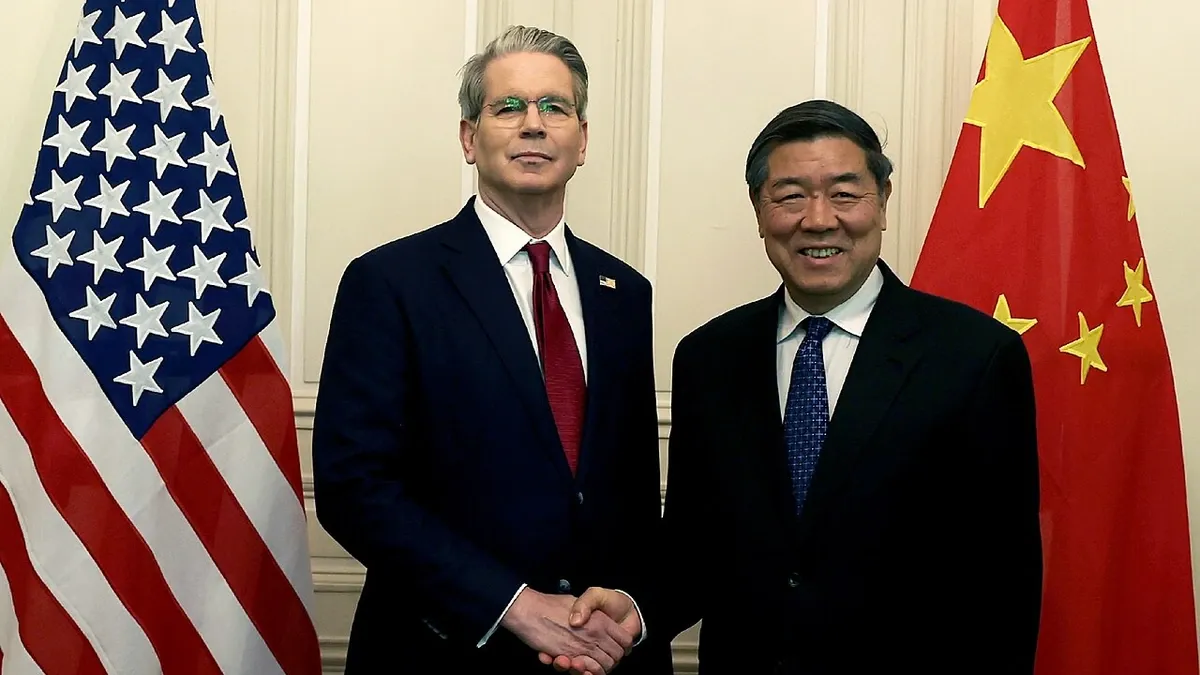
Senior Chinese and U.S. officials have held a new round of economic and trade consultations in New York, with discussions expanding beyond tariffs and investment to include artificial intelligence and economic-security issues.
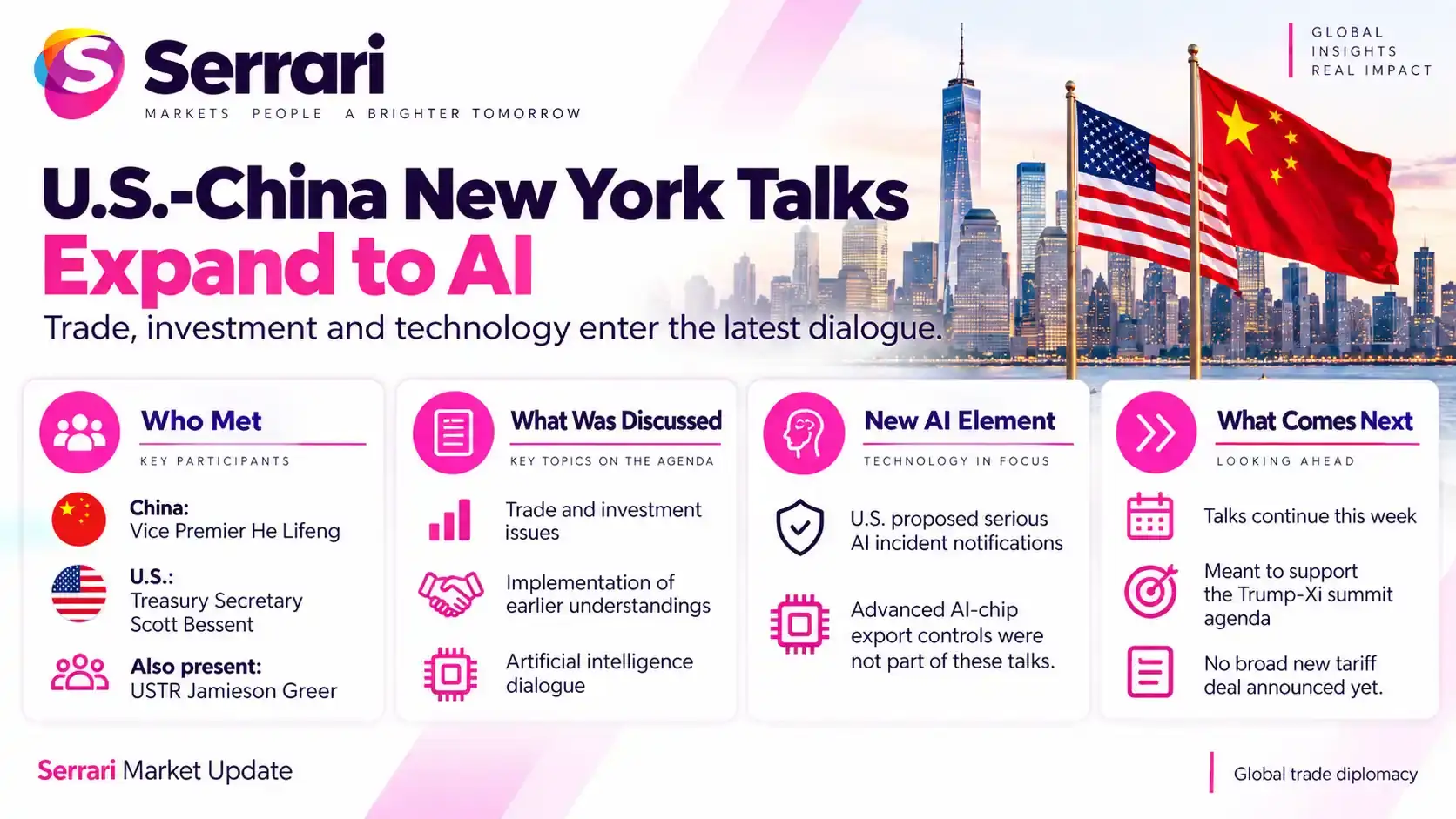
Chinese Vice Premier He Lifeng led Beijing’s delegation, while U.S. Treasury Secretary Scott Bessent headed the American side alongside U.S. Trade Representative Jamieson Greer. The talks came just days before President Donald Trump is scheduled to host Chinese President Xi Jinping in Washington on September 24.
The discussions focused on implementing earlier trade understandings, facilitating bilateral commerce and investment, and creating new mechanisms for dialogue on artificial intelligence. Neither side announced a sweeping new trade agreement after the talks.
Key Overview
- Chinese Vice Premier He Lifeng met U.S. Treasury Secretary Scott Bessent and Trade Representative Jamieson Greer in New York.
- Talks covered trade, investment, implementation of earlier agreements and artificial intelligence.
- Washington proposed a mechanism for notifying each other about serious AI incidents with national-security implications.
- The two sides are working on a “Board of Trade” framework for selected non-sensitive goods.
- Advanced AI-chip export restrictions were not part of the trade discussions, according to U.S. officials.
- The negotiations are helping prepare for the Trump-Xi summit scheduled for September 24.
- No comprehensive new tariff agreement or extension of the existing trade truce was announced during the talks.
Senior Officials Resume Economic Consultations
The latest round brought together the top economic negotiators from both countries at a time when trade, technology and supply-chain security remain major areas of friction.
China’s official account said the two sides held candid, in-depth and constructive exchanges on economic and trade issues of mutual concern, including implementation of agreements reached in earlier consultations and measures to promote bilateral trade and investment.
Ahead of the meeting, the U.S. side said it wanted to monitor existing commitments and improve market access, particularly for American farmers, manufacturers and other exporters.
The latest discussions therefore build on a series of negotiations aimed at managing economic tensions between the world’s two largest economies rather than resolving every outstanding dispute in a single round.
Artificial Intelligence Joins the Agenda
Artificial intelligence emerged as one of the most notable additions to the economic dialogue.
Bessent said the United States had proposed a bilateral AI dialogue that could include a notification mechanism for serious AI incidents, particularly events capable of affecting national security.
The proposal reflects growing concern in both countries about the economic and security consequences of advanced AI systems. The United States and China are two of the world’s largest centres for AI development, making communication between regulators and policymakers increasingly important as the technology becomes more powerful.
However, the discussions did not include U.S. export controls on advanced AI chips and semiconductor-manufacturing equipment, according to Greer. Those restrictions remain a separate and contentious part of the broader technology relationship.
Context is everything. Stay ahead of shifting trends with today’s market updates, and uncover emerging opportunities using the Serrari Group Market Index and Marketplace. Then, take control of your own financial future by exploring our Money & Life Reset Transformation Blueprint ™ to build stronger habits, create better systems, and design a path toward lasting wealth.
Trade Framework Targets Non-Sensitive Goods
The two governments also discussed putting into operation a proposed “Board of Trade” mechanism first considered earlier this year.
The initiative is designed to identify categories of non-sensitive goods that could face lower trade barriers. Potential areas mentioned by U.S. officials include consumer products, agricultural goods, energy and medical devices.
The concept would create a channel for facilitating trade in products considered less sensitive to national security while leaving more contentious areas—such as advanced semiconductors, strategic technology and critical supply chains—subject to separate policies.
No final list of products or tariff reductions was announced following the New York meetings.
Existing Trade Disputes Remain Unresolved
Despite the constructive language used by both delegations, several major issues remain outstanding.
Washington continues to seek greater access for U.S. agricultural and manufactured goods, while Beijing has repeatedly objected to U.S. tariffs, technology restrictions and other trade controls.
Critical minerals are another important area in the relationship. China retains a dominant role in global rare-earth processing, giving supply policy in Beijing significant implications for manufacturers in the United States and other economies.
The current U.S.-China trade truce is also due to expire in November. The New York talks did not produce a publicly announced decision on whether that arrangement will be extended.
Talks Set Stage for Trump-Xi Summit
The consultations are taking place immediately before Xi’s scheduled September 23-25 state visit to the United States.
Trump and Xi are expected to discuss economic relations alongside wider strategic issues when they meet in Washington. The New York consultations allowed officials on both sides to narrow the agenda and establish areas where additional negotiations may be possible.
The immediate result is continued engagement rather than a comprehensive settlement. Trade barriers, technology controls, rare-earth supplies and market access remain unresolved, while AI has now become a formal part of the dialogue.
For businesses and investors, the next major indication of the direction of U.S.-China economic relations will come from the leaders’ meeting and any agreements or follow-up negotiations announced afterward.
Sources: Xinhua / U.S. Trade Representative / Reuters / Channel NewsAsia / Ministry of Commerce of the People’s Republic of China
Your financial future isn’t something you wait for—it’s something you build.
The real question is: when do you begin?
Move beyond simply staying informed.
Navigate the markets with clarity—track trends through the Serrari Group Market Index, uncover opportunities in the Serrari Marketplace, and build practical knowledge with our Curated Wealth Builder Platform.
Stay connected to what truly matters.
Get daily insights on macro trends and financial movements across Kenya, Africa, and global markets—delivered through the Serrari Newsletter.
Growth opens doors.
Advance your career through professional programs including ACCA, HESI A2, ATI TEAS 7 , HESI EXIT , NCLEX – RN and NCLEX – PN, Financial Literacy!🌟—designed to move you forward with confidence.
See where money is flowing—clearly and in real time.
Track Money Market Funds, Treasury Bills, Treasury Bonds, Green Bonds, and Fixed Deposits, alongside global and African indexes, key economic indicators, and the evolving Crypto and stablecoin landscape—all within Serrari’s Market Index.