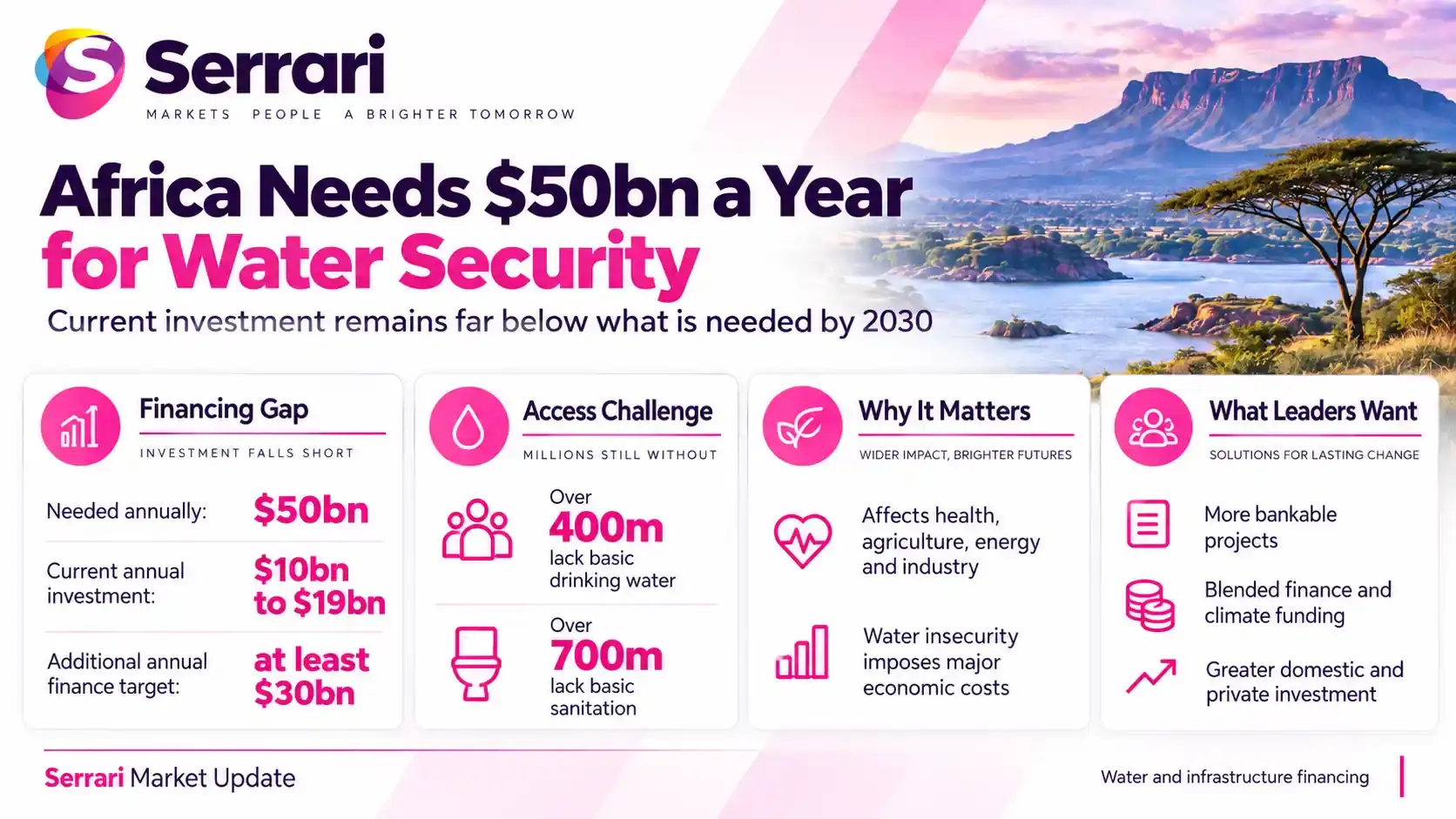
Africa needs approximately $50 billion in annual investment to achieve water security and sustainable sanitation by 2030, according to the African Union, highlighting a large gap between the continent’s infrastructure needs and current financing.
Annual water and sanitation investment is estimated at only $10 billion to $19 billion. That leaves governments and development partners needing to mobilise at least $30 billion in additional financing each year while improving project preparation, governance and access to private capital.
Key Overview
- Africa needs about $50 billion annually for water security and sustainable sanitation by 2030.
- Current annual investment is estimated at roughly $10 billion to $19 billion.
- At least $30 billion in additional financing needs to be mobilised each year.
- More than 400 million Africans still lack access to basic drinking water.
- More than 700 million people lack basic sanitation services.
- Poor water infrastructure and related climate impacts impose major economic costs across the continent.
- African leaders are pushing for more bankable projects, blended finance and greater domestic investment ahead of the 2026 UN Water Conference.
Africa Faces a Multi-Billion-Dollar Financing Gap
The scale of Africa’s water challenge is increasingly being framed as an investment problem rather than only a development shortfall.
The African Union Commission Chairperson Mahmoud Ali Youssouf said the continent requires approximately $50 billion every year to achieve water security and sustainable sanitation by 2030, calling for stronger resource mobilisation and investment in resilience.
Existing spending remains far below that level. Continental estimates put current annual investment at about $10 billion to $19 billion, leaving a substantial financing gap.
The Africa Water Investment Programme is targeting at least $30 billion in additional annual finance by 2030, with funding expected from domestic public resources, development institutions, climate finance and private capital.
Hundreds of Millions Still Lack Basic Services
The financing gap has direct consequences for households and businesses.
More than 400 million people lack basic drinking water across Africa, while more than 700 million lack basic sanitation, making universal access one of the continent’s largest infrastructure challenges.
Limited access contributes to health problems, lost working hours, weaker educational outcomes and reduced productivity. Water insecurity also affects agriculture, manufacturing, mining, energy production and urban development.
The economic cost is significant. Earlier continental assessments have estimated that Africa loses up to $200 billion annually because of insufficient water investment, climate impacts and inefficiencies.
Other estimates indicate that inadequate water infrastructure alone can cost Sub-Saharan Africa around 5% of GDP annually, reinforcing the case for treating water as productive economic infrastructure.
Context is everything. Stay ahead of shifting trends with today’s market updates, and uncover emerging opportunities using the Serrari Group Market Index and Marketplace. Then, take control of your own financial future by exploring our Money & Life Reset Transformation Blueprint ™ to build stronger habits, create better systems, and design a path toward lasting wealth.
Water Moves to the Centre of Africa’s Economic Agenda
The African Union has made water and sanitation its continental theme for 2026, linking reliable water systems to industrialisation, climate resilience, public health, food security and regional stability.
That approach represents a shift away from viewing water mainly as a public service. Policymakers increasingly describe reliable supply, sanitation and water-management infrastructure as essential inputs for economic growth.
Agriculture depends on irrigation and predictable water availability, while industrial facilities require reliable supplies for production. Electricity systems, including hydropower, also depend on effective water-resource management.
The wider goal is to make water investment part of national development planning rather than treating projects as isolated social programmes.
Focus Shifts Toward Bankable Projects
One of the largest obstacles is not only the availability of capital but the shortage of projects structured well enough to attract it.
African policymakers are calling for stronger project preparation and new approaches to bankability, including mechanisms that reduce risk and make infrastructure projects more attractive to commercial lenders and institutional investors.
Blended finance can combine public or concessional funding with private capital, helping absorb risks that might otherwise prevent investors from participating.
Governments are also being encouraged to improve water-sector governance, strengthen utilities, reduce losses from leaking infrastructure and develop predictable regulatory frameworks that support long-term investment.
Investment Push Builds Ahead of UN Water Conference
The financing effort is gaining urgency ahead of the 2026 UN Water Conference in Abu Dhabi, which is scheduled for December 8 to 10.
African leaders and development institutions are seeking to use the conference to convert policy commitments into investment-ready projects and financing partnerships.
The Africa Water Investment Programme says $10 billion to $12 billion has already been leveraged toward water and sanitation investment, but the scale required remains much larger.
Closing the gap will therefore require a combination of larger national budget allocations, concessional finance, climate funding and private investment.
The central challenge is now execution. Africa has identified the size of the financing need and established continental investment targets. Reaching water security by 2030 will depend on turning those targets into funded infrastructure, stronger utilities and reliable services for hundreds of millions of people.
Sources: African Union / Africa Water Investment Programme / World Bank / United Nations Economic Commission for Africa / United Nations / People Daily
Your financial future isn’t something you wait for—it’s something you build.
The real question is: when do you begin?
Move beyond simply staying informed.
Navigate the markets with clarity—track trends through the Serrari Group Market Index, uncover opportunities in the Serrari Marketplace, and build practical knowledge with our Curated Wealth Builder Platform.
Stay connected to what truly matters.
Get daily insights on macro trends and financial movements across Kenya, Africa, and global markets—delivered through the Serrari Newsletter.
Growth opens doors.
Advance your career through professional programs including ACCA, HESI A2, ATI TEAS 7 , HESI EXIT , NCLEX – RN and NCLEX – PN, Financial Literacy!🌟—designed to move you forward with confidence.
See where money is flowing—clearly and in real time.
Track Money Market Funds, Treasury Bills, Treasury Bonds, Green Bonds, and Fixed Deposits, alongside global and African indexes, key economic indicators, and the evolving Crypto and stablecoin landscape—all within Serrari’s Market Index.