The Bank of Uganda bond auction gives investors access to reopened government securities with high nominal coupons, but the key fixed-income lesson is that coupon and yield are different. A bond’s coupon is the fixed interest rate paid on its face value. The yield to maturity depends on the price investors pay at auction or in the secondary market. If a reopened bond is bought above face value, the investor’s yield can be lower than the coupon. If it is bought below face value, the yield can be higher. This is especially important for Uganda Treasury Bonds because the three securities have different maturities, tax treatment and duration risks.
Key Overview
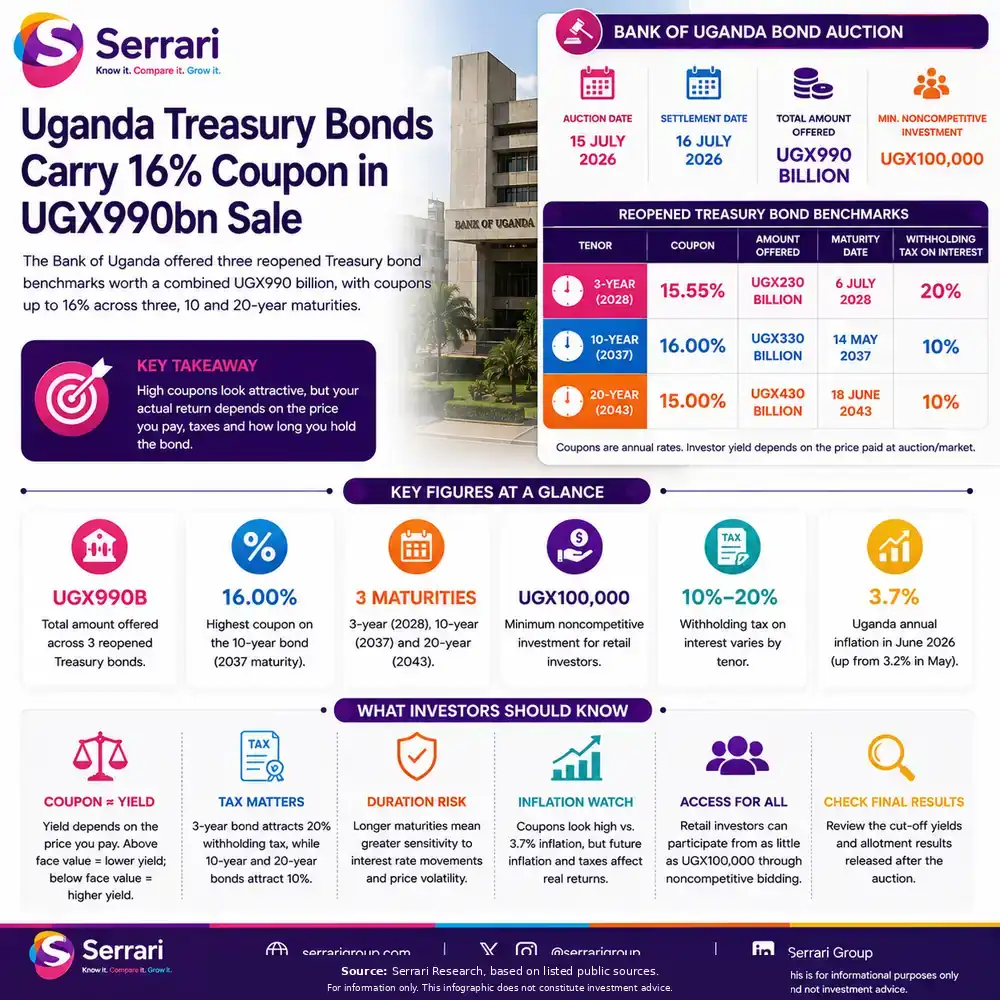
- Bank of Uganda offered three reopened Treasury bond benchmarks worth a combined UGX990 billion.
- The three-year reopening carried a 15.55% coupon and UGX230 billion amount offered.
- The 10-year reopening carried a 16.00% coupon and UGX330 billion amount offered.
- The 20-year reopening carried a 15.00% coupon and UGX430 billion amount offered.
- The auction closed on 15 July and settles on 16 July 2026.
- Uganda’s June inflation rose to 3.7% from 3.2% in May. (Kikubo Lane)
Uganda Treasury Bonds Carry 16% Coupon in UGX990bn Sale
Uganda Reopens Three Bond Benchmarks
The Bank of Uganda offered three reopened Treasury bonds worth a combined UGX990 billion in the 15 July auction. According to the auction notice reported by Kikubo Lane, the sale comprised UGX230 billion in the three-year benchmark, UGX330 billion in the 10-year benchmark and UGX430 billion in the 20-year benchmark. The securities settle on Thursday, 16 July. (Kikubo Lane)
The three-year reopening is tied to a 15.55% Treasury bond maturing on 6 July 2028. The 10-year security carries a 16.00% coupon and matures on 14 May 2037, while the 20-year security carries a 15.00% coupon and matures on 18 June 2043. These maturity dates matter because the benchmark labels do not equal the exact remaining time to maturity for reopened bonds. (Kikubo Lane)
Coupon Is Not the Same as Yield
The headline 16.00% coupon on the 10-year reopening is attractive, but it should not be read as the return every investor earns. The coupon is the fixed cash payment rate attached to the bond’s face value. Yield to maturity is the investor’s total annualised return if the bond is bought at a given price and held to maturity.
For example, if the 16% bond is bought above face value, the investor receives the 16% coupon but gradually absorbs a capital loss as the bond returns to par at maturity. If it is bought below face value, the investor earns the coupon and also benefits from capital appreciation toward par. Final accepted auction prices and yields were not publicly available at cut-off, so the coupon should not be presented as the final investor yield.
Tax Treatment Differs by Bond
Withholding tax is also different across the three securities. The three-year bond attracts 20% withholding tax on interest income, while the 10-year and 20-year securities carry a lower 10% withholding tax. That difference can change after-tax returns materially, especially for investors comparing shorter and longer securities. (Kikubo Lane)
For investors, the after-tax calculation matters more than the headline coupon. A longer bond may offer more favourable tax treatment, but it also exposes the investor to more duration risk and a longer holding period.
Retail Access Starts at UGX100,000
The auction terms also show why Uganda retail bonds matter. Noncompetitive investors can participate from UGX100,000, while competitive bidding requires much larger tickets. Kikubo Lane reported the minimum competitive bid at UGX200.1 million, with noncompetitive allocations accepted in full up to UGX200 million per tenor at the auction’s cut-off yield. (Kikubo Lane)
This structure allows smaller investors to access government securities without bidding on yield directly. It also allows banks, pension funds and larger institutions to compete on price and yield. The difference between noncompetitive and competitive bidding is important for retail education.
Context is everything. Stay ahead of shifting trends with today’s market updates, and uncover emerging opportunities using the Serrari Group Market Index and Marketplace. Then, take control of your own financial future by exploring our Money & Life Reset Transformation Blueprint ™ to build stronger habits, create better systems, and design a path toward lasting wealth.
Inflation Makes the Coupons Look High
Uganda’s inflation backdrop makes the coupons stand out. UBOS reported annual inflation of 3.7% in June 2026, up from 3.2% in May. Compared with that inflation print, coupons of 15.55%, 16.00% and 15.00% look high in nominal terms. (Uganda Bureau of Statistics)
But investors should not reduce the analysis to coupon minus inflation. Real returns depend on after-tax income, the auction price, future inflation, reinvestment of coupon payments and the investor’s holding period. A low current inflation print does not eliminate the risk that inflation rises over the life of a 10-year or 20-year bond.
Longer Bonds Carry More Price Risk
The 20-year bond has the longest maturity and therefore the largest duration risk. If market yields rise after settlement, the market price of a long bond can fall sharply. If yields fall, long bonds can gain more than shorter bonds. That makes the 20-year security potentially more volatile than the 2028 maturity, even though both are government securities.
This is the trade-off investors must understand. Longer maturities can help lock in coupons and may benefit from lower withholding tax, but they also create more exposure to interest-rate movements and secondary-market pricing.
Uganda’s Debt Strategy Explains the Supply
The sale also fits Uganda’s broader debt-management direction. The Ministry of Finance’s March 2026 debt bulletin says domestic debt rose as government continued issuing securities to finance budgetary requirements and refinance maturing obligations. It also says Treasury bonds accounted for the largest share of domestic debt issuance during the quarter, reflecting the government’s commitment to lengthening maturities and reducing refinancing risk.
That context matters. Long-dated bond issuance is not only about giving investors income products. It also helps the government manage refinancing pressure by spreading repayments across a longer period.
Secondary-Market Liquidity Still Matters
Investors who hold to maturity focus on coupon income and principal repayment. Investors who may need to exit before maturity must focus on secondary-market liquidity. Uganda Securities Exchange’s market-regulations page lists the Government Securities OTC Rules, which guide over-the-counter trading of government securities on the exchange. (use.or.ug)
That means there is a framework for secondary trading, but liquidity can still vary by bond, size and market conditions. Investors should not assume they can always sell immediately at face value.
Currency Risk for Foreign Investors
Foreign investors face an additional layer: Ugandan shilling risk. A high UGX coupon may still translate into a lower foreign-currency return if the shilling depreciates during the holding period. This matters most for investors measuring performance in dollars, euros, pounds or other hard currencies.
For domestic investors with shilling liabilities, the currency issue may be less central. For offshore investors, the bond’s yield must be assessed together with exchange-rate expectations and hedging costs.
What Investors Should Watch Next
Investors should watch the final auction results when published, especially cut-off prices, accepted yields and demand by tenor. A strong bid for the long end would show appetite for duration, while weaker demand would suggest investors require more compensation for long holding periods.
They should also watch inflation, the central-bank policy stance, fiscal financing needs and secondary-market trading levels. Coupon rates tell part of the story, but yield, price and liquidity will decide actual investor outcomes.
Conclusion
Uganda Treasury Bonds are offering high nominal coupons in the latest UGX990 billion reopening, led by a 16.00% coupon on the 2037 security. The three reopened benchmarks give investors a choice between shorter maturity, medium duration and long-term exposure.
The key investor lesson is that coupon is not yield. Actual returns depend on auction price, withholding tax, inflation, secondary-market liquidity and the investor’s holding period. The settlement gives Uganda’s fixed-income market another large domestic-debt transaction, but investors should analyse the securities as bonds—not simply as headline coupon numbers.
FAQs
1. What happened in the latest Uganda Treasury Bonds sale?
The Bank of Uganda offered three reopened government Treasury bonds worth a combined UGX990 billion. The auction closed on 15 July 2026 and settles on 16 July. The securities carry coupons of 15.55%, 16.00% and 15.00% across the three-year, 10-year and 20-year benchmark categories.
2. Does the 16% coupon mean investors earn 16%?
Not necessarily. The 16% figure is the coupon rate on the 10-year reopening. The investor’s actual yield to maturity depends on the price paid at auction or in the secondary market. Buying above face value reduces the yield, while buying below face value can increase it.
3. Why does withholding tax matter?
Withholding tax affects after-tax income. The three-year bond carries 20% withholding tax, while the 10-year and 20-year bonds carry 10%. Investors should compare after-tax returns rather than relying only on headline coupons.
4. Are longer Uganda government bonds riskier?
Longer bonds generally carry more duration risk. If market yields rise, long-bond prices can fall more sharply than short-bond prices. The 20-year bond may offer long-term income exposure, but it also has greater price sensitivity and liquidity risk if sold before maturity.
5. What should investors watch after settlement?
Investors should watch final auction results, accepted yields, secondary-market prices, inflation, fiscal financing needs and Ugandan shilling movements. Foreign investors should pay special attention to exchange-rate risk because a high shilling coupon does not guarantee a strong foreign-currency return.
Sources: Bank of Uganda, Kikubo Lane, Uganda Bureau of Statistics, Ministry of Finance Uganda, Uganda Securities Exchange
Growth opens doors.
Advance your career through professional programs including ACCA, HESI A2, ATI TEAS 7 , HESI EXIT , NCLEX – RN and NCLEX – PN, Financial Literacy!🌟—designed to move you forward with confidence.
See where money is flowing—clearly and in real time.
Track Money Market Funds, Treasury Bills, Treasury Bonds, Green Bonds, and Fixed Deposits, alongside global and African indexes, key economic indicators, and the evolving Crypto and stablecoin landscape—all within Serrari’s Market Index.