






The iShares U.S. Real Estate ETF (IYR) has fallen to its lowest level relative to the SPDR S&P 500 ETF Trust (SPY) on record. The IYR-to-SPY total-return ratio dropped to 0.122 on October 5, highlighting the widening performance gap between U.S. real estate stocks and the broader equity market.
Key Overview
- ETF: iShares U.S. Real Estate ETF (IYR)
- Benchmark: SPDR S&P 500 ETF Trust (SPY)
- IYR/SPY ratio: 0.122
- Previous comparison: About 0.46 in February 2007
- IYR dividend yield: 2.54%
- IYR market capitalisation: $4.06 billion
U.S. Real Estate Hits a Record Low
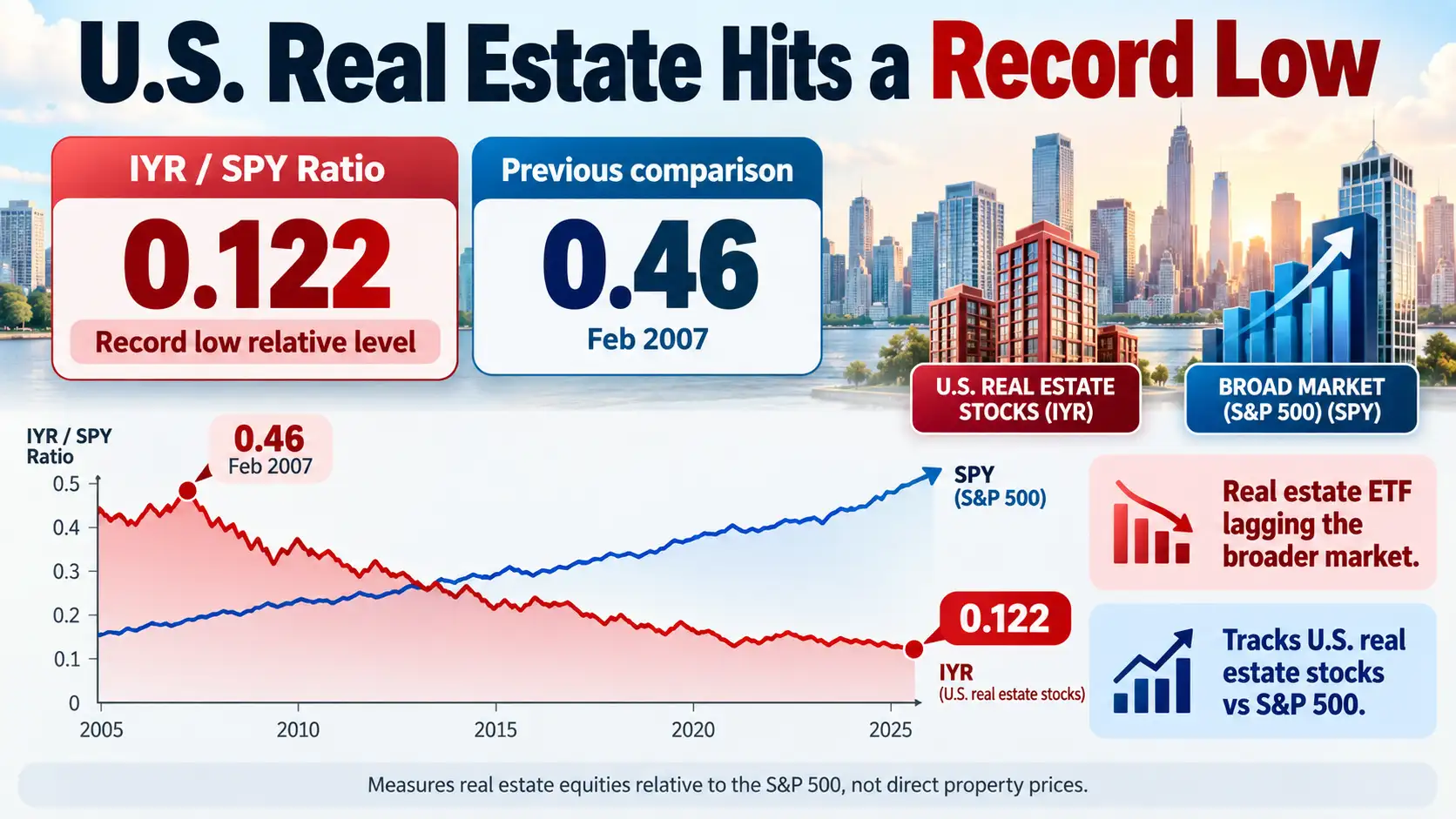
The iShares U.S. Real Estate ETF has reached its weakest level relative to the S&P 500 since the available data began around 2000. The ETF tracks U.S. real estate investment trusts and related companies, making its performance a useful indicator of how the sector is performing against the broader stock market.
The IYR/SPY ratio fell to 0.122 as of October 5, according to data highlighted by Creative Planning Chief Market Strategist Charlie Bilello.
The latest reading has erased the relative outperformance that U.S. real estate stocks accumulated during the early-to-mid 2000s housing boom. The ratio was around 0.46 in February 2007 before falling over the years.
Importantly, the record does not mean U.S. property prices themselves have fallen to an equivalent record low. Instead, it shows how significantly real estate equities have underperformed the broader S&P 500 over the long term.
Higher Rates Weigh on Real Estate
Higher borrowing costs have become a major challenge for the real estate sector. Rising interest rates increase financing expenses for property companies while also making income-producing assets such as REITs less attractive compared with other investments.
The current environment is particularly significant for investors who compare REIT dividends with yields available from government bonds. As Treasury yields rise, investors may demand higher returns from real estate securities to compensate for the additional risks associated with the sector.
Higher mortgage rates are also weighing on housing affordability and demand. Commercial real estate faces its own pressure from financing costs and refinancing requirements.
Investor Preferences Are Changing
The weakness in real estate stocks also reflects a broader shift in investor preferences. Higher Treasury yields can provide an alternative source of income, potentially reducing the appeal of real estate securities.
The divergence is particularly visible when comparing IYR with the S&P 500. While real estate stocks have struggled, the broader U.S. equity market has continued to pull further ahead, widening the relative performance gap.
This means the record-low ratio is less about a single-day collapse and more about a long period in which U.S. real estate equities have failed to keep pace with broader stocks.
Context is everything. Stay ahead of shifting trends with today’s market updates, and uncover emerging opportunities using the Serrari Group Market Index and Marketplace. Then, take control of your own financial future by exploring our Money & Life Reset Transformation Blueprint ™ to build stronger habits, create better systems, and design a path toward lasting wealth.
IYR Still Offers Dividend Income
Despite the weak relative performance, the iShares U.S. Real Estate ETF continues to offer dividend income. GuruFocus reported a dividend yield of 2.54% and a low payout ratio of 1.61.
The ETF also recorded a three-year dividend growth rate of 6.05%, according to GuruFocus. Its portfolio includes major real estate companies such as Welltower, Prologis, Equinix, Digital Realty Trust and Simon Property Group.
GuruFocus also reported that IYR had a market capitalization of $4.06 billion and was trading on the ARCA exchange.
Real Estate’s Long-Term Performance Gap
The historic IYR/SPY ratio highlights how dramatically the relative position of real estate equities has changed since the housing boom.
In February 2007, the ratio stood at approximately 0.46. The subsequent decline means that real estate stocks have progressively lost ground against the broader U.S. equity market.
The current reading therefore represents a long-term performance gap rather than simply a short-term market move. For investors, it raises questions about whether higher interest rates, changing capital flows and weaker property-market conditions will continue to weigh on the sector.
Outlook
The record-low relative performance of IYR shows the pressure facing U.S. real estate equities as borrowing costs remain elevated and investors have more alternatives for income.
The sector’s future performance will depend partly on the interest-rate environment, financing conditions, property demand and investor appetite for REITs and other real estate securities. While the relative weakness is significant, the IYR/SPY ratio measures performance against the broader stock market rather than the absolute health of the U.S. property market.
For now, the record reading underscores how far U.S. real estate equities have fallen behind the S&P 500 and how strongly the investment landscape has shifted since the housing-boom era.
FAQs
1. What happened to the iShares U.S. Real Estate ETF?
IYR fell to its lowest level relative to the S&P 500 on record.
2. What is the IYR/SPY ratio?
The IYR-to-SPY total-return ratio fell to 0.122 on October 5.
3. Why are real estate stocks under pressure?
Higher interest rates have increased borrowing costs, weakened housing demand and reduced the relative attractiveness of real estate income compared with other investments.
4. Does the record-low ratio mean U.S. property prices have collapsed?
No. The ratio measures the relative performance of real estate equities against the S&P 500, rather than directly measuring U.S. property prices.
Your financial future isn’t something you wait for—it’s something you build.
The real question is: when do you begin?
Move beyond simply staying informed.
Navigate the markets with clarity—track trends through the Serrari Group Market Index, uncover opportunities in the Serrari Marketplace, and build practical knowledge with our Curated Wealth Builder Platform.
Stay connected to what truly matters.
Get daily insights on macro trends and financial movements across Kenya, Africa, and global markets—delivered through the Serrari Newsletter.
Growth opens doors.
Advance your career through professional programs including ACCA, HESI A2, ATI TEAS 7 , HESI EXIT , NCLEX – RN and NCLEX – PN, Financial Literacy!🌟—designed to move you forward with confidence.
See where money is flowing—clearly and in real time.
Track Money Market Funds, Treasury Bills, Treasury Bonds, Green Bonds, and Fixed Deposits, alongside global and African indexes, key economic indicators, and the evolving Crypto and stablecoin landscape—all within Serrari’s Market Index.























Comments are closed.