In the USDC vs USDT comparison, the two largest dollar stablecoins are diverging. Tether’s USDT remains the largest by market value at roughly $184 billion, accounting for about 59% of the near-$315 billion market. Yet Circle’s USDC led real usage in June 2026, processing about $1.21 trillion, near 67% of adjusted transaction volume, against USDT’s $576 billion. The split matters under the new rules: Circle and Tether’s US-focused USAT are positioning for federal approval, while Tether’s offshore USDT needs a Treasury reciprocity determination to keep serving US users. For investors, USDC vs USDT is no longer only a question of size; it is a question of which coin fits the coming compliance perimeter for reserves, redemption and cross-border settlement — and which faces enforcement risk once the framework goes live.
Key Overview
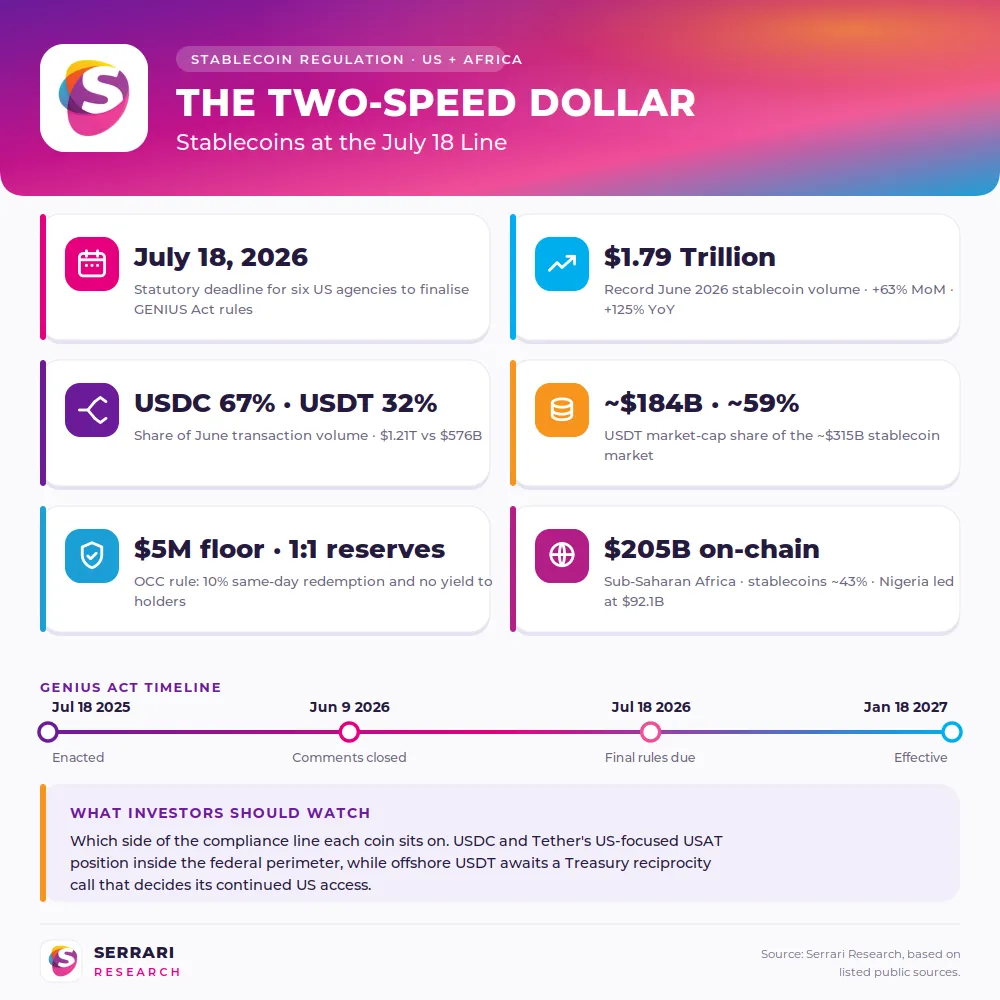
- The deadline: Six US agencies — the OCC, FDIC, NCUA, Treasury, FinCEN and OFAC — face a statutory deadline of July 18, 2026, to finalise GENIUS Act stablecoin rules. All major comment periods closed on June 9, 2026.
- A record month: Adjusted stablecoin transaction volume hit $1.79 trillion in June 2026 — up 63% on May and 125% year-on-year. Circle’s USDC led with about $1.21 trillion (67%), ahead of Tether’s USDT at $576 billion (32%).
- Market structure: The total stablecoin market sits near $315 billion, with USDT around $184 billion (~59%). The OCC’s proposal sets a $5 million capital floor, 1:1 reserves, a 10% same-day redemption tier, and a ban on paying yield.
- When it bites: The rules take effect the earlier of 120 days after finalisation or January 18, 2027. The deadline is statutory, but agencies can miss it with no automatic fallback.
- Africa’s stake: Sub-Saharan Africa received over $205 billion on-chain (Jul 2024–Jun 2025, +52%), with stablecoins near 43% of volume. Kenya’s Virtual Asset Service Providers Act took effect in November 2025.
- Investor implication: The rules reshape USDC vs USDT exposure, on-chain treasury management, and the cross-border corridors African businesses already depend on.
Stablecoin Regulation: GENIUS Act Deadline Nears July 18
The United States is days away from a defining moment for dollar-backed digital money. Six federal agencies are racing a statutory deadline of July 18 to publish final rules under the GENIUS Act — the law enacted on July 18, 2025 that created the country’s first federal framework for payment stablecoins. The rules will decide who can issue a dollar stablecoin, how issuers must back it, and whether they can pay holders anything at all. That decision lands in the same month stablecoins posted their busiest period on record, and it reaches well beyond US borders into the African corridors where these tokens already move real money.
A hard, if fragile, deadline
The GENIUS Act set a one-year clock. Congress passed a bipartisan federal stablecoin framework in mid-2025, and the implementing rules are due exactly a year later. With six federal agencies drafting final rules in parallel, the timeline is genuinely tight: the OCC, FDIC, NCUA, Treasury, FinCEN and OFAC each published proposals, and all major comment periods closed on June 9, leaving only weeks to reconcile them. Investors should treat July 18 as the statutory target rather than a guarantee. The deadline carries no automatic penalty if agencies slip, and the framework’s effective date is separately triggered as the earlier of January 2027 or 120 days after the primary regulators publish final rules.
What the rules actually require
The GENIUS Act reshapes the economics of issuance. The OCC’s proposal introduces a $5 million minimum capital floor for new issuers seeking federal approval, alongside a three-tier liquidity framework requiring 10% of tokens to be redeemable the same business day. Every compliant coin must hold reserves 1:1 in cash, insured deposits and short-dated US Treasuries. The single most debated provision is the contested ban on paying yield: issuers cannot pass interest to holders, which removes a feature some users had come to expect. Together these stablecoin reserves and capital rules favour large, well-capitalised issuers and squeeze mid-market operators who cannot absorb the compliance cost. The framework also creates a dual pathway: issuers can operate under federal oversight or under a state regime that Treasury certifies as substantially similar to the federal framework, a gateway condition that smaller issuers will lean on. Algorithmic stablecoins are effectively excluded, cementing a model built on high-quality liquid reserves rather than code-based pegs.
The USDC vs USDT split, and a record month
The regulatory clock is ticking during a boom. Adjusted stablecoin transaction volume reached a record $1.79 trillion in June 2026, up 63% on May and 125% year-on-year, even as broader crypto prices stayed weak. The composition is the story. Circle’s USDC handled about 67% of volume at roughly $1.21 trillion, while Tether’s USDT held near $184 billion in supply yet processed $576 billion in June flows. Tether still dominates by market capitalisation, but USDC now leads the payments and settlement use case the GENIUS Act is built around. Tether has responded by launching USAT, a US-focused coin issued through a federally chartered bank, positioning for the compliance perimeter while its offshore USDT awaits a reciprocity determination. The scale is broadening beyond a single month: the first half of 2026 saw $8.82 trillion in adjusted volume, and settlement has spread across networks, with Coinbase’s Base handling $565 billion in June, narrowly ahead of Ethereum’s $562 billion. That resilience through a soft market is the clearest sign yet that stablecoins now behave as payments infrastructure rather than a trading sideshow.
Context is everything. Stay ahead of shifting trends with today’s market updates, and uncover emerging opportunities using the Serrari Group Market Index and Marketplace. Then, take control of your own financial future by exploring our Money & Life Reset Transformation Blueprint ™ to build stronger habits, create better systems, and design a path toward lasting wealth.
Why Africa sits on the other side of the dollar rail
The GENIUS Act is a US law with a global footprint, because the dollar stablecoins it governs are the same ones African businesses and households already use. Sub-Saharan Africa received over $205 billion in on-chain value between July 2024 and June 2025 — a 52% jump — with stablecoins near 43% of regional volume. Adoption is driven by necessity: dollar access, inflation hedging and cheaper cross-border payments Africa struggles to deliver through traditional rails, where remittance fees still run near 8–9%. Nigeria’s $92.1 billion led the region, with Ethiopia, Kenya and Ghana rounding out the top five, and a currency-driven spike in early 2025 briefly pushed regional monthly volume toward $25 billion as households moved into dollar-linked tokens. BVNK’s research points to roughly 79% of crypto-active African users holding stablecoins. Regulators are formalising this: Kenya’s Virtual Asset Service Providers Act, effective November 2025, splits oversight between the Central Bank of Kenya and the Capital Markets Authority, mirroring a continent-wide shift from prohibition to supervision.
Conclusion
The near-term signals are concrete. Watch whether all six agencies publish by July 18 or let the clock run toward the January 2027 default. Watch the Treasury’s reciprocity call on Tether, which determines whether USDT keeps US access. Watch for bank issuers filing applications, since an approved large-bank coin would set the regulatory baseline. And watch the yield question, which could push balances toward tokenised money-market products instead. A further pressure point sits further out: from July 18, 2028, three years after enactment, digital-asset service providers are generally barred from offering non-compliant stablecoins to US users, so any token outside the permitted perimeter risks losing exchange access and liquidity over time. For African users and the businesses serving them, the key variable is whether US-regulated coins remain freely usable across borders — or whether compliance fragmentation raises the cost of the dollar rails the region has come to rely on.
FAQs
What is the GENIUS Act deadline, and will the agencies meet it? The GENIUS Act deadline is July 18, 2026 — one year after the law was enacted — by which six federal agencies must finalise the rules governing US payment stablecoins. All major comment periods closed on June 9, 2026, leaving a compressed window to reconcile several parallel proposals. The deadline is statutory, but it is not ironclad: agencies can miss it without an automatic penalty, and history shows US financial regulators sometimes overshoot such dates. Even if some rules slip, the broader framework still takes effect on the earlier of January 18, 2027 or 120 days after the primary regulators publish final rules, so the direction of travel is fixed even if the exact timing moves.
How does the GENIUS Act affect USDC vs USDT? The USDC vs USDT dynamic is central to how the rules will reshape the market. Circle’s USDC is already structured around US compliance and led transaction volume in June 2026 at roughly $1.21 trillion, or about 67% of the adjusted total. Tether’s USDT remains the largest by market capitalisation at about $184 billion but, as an offshore issuer, needs a Treasury reciprocity determination to keep serving US users under the new perimeter. Tether’s answer has been USAT, a US-focused coin issued through a federally chartered bank. For investors, the practical takeaway is that market-cap dominance and regulatory fit are no longer the same thing, and exposure decisions increasingly turn on which coin sits comfortably inside the framework.
What do the new rules mean for stablecoin reserves and yield? The rules tighten what backs a coin and what it can offer. Compliant issuers must hold stablecoin reserves 1:1 in cash, insured deposits and short-dated US Treasuries, with a proposed three-tier liquidity structure requiring 10% of tokens to be redeemable the same business day. New federally approved issuers face a $5 million minimum capital floor. Crucially, the framework prohibits issuers from paying interest or yield to holders, which removes an incentive some users valued and may redirect demand toward tokenised money-market funds and other yield-bearing instruments. The net effect is a safer, more bank-like reserve model that also concentrates the market around larger, better-capitalised players.
How does US stablecoin regulation affect Africa and Kenya? Because African stablecoin Africa adoption runs mostly on US dollar coins, Washington’s rules directly shape the tokens the continent uses for savings, trade and cross-border payments Africa cannot always move cheaply through banks. Sub-Saharan Africa received over $205 billion on-chain in the year to June 2025, with stablecoins making up close to 43% of that activity. Kenya has moved to supervise rather than ban the sector: the Kenya VASP Act, effective November 2025, divides oversight between the Central Bank of Kenya and the Capital Markets Authority. If US-regulated coins remain freely usable across borders, African businesses benefit from clearer, safer rails; if compliance fragments the market, the cost and availability of those dollar rails could tighten.
Sources: OCC, Sullivan & Cromwell LP, Freshfields, TechTimes, CoinDesk/ Visa, Chainalysis
Your financial future isn’t something you wait for—it’s something you build.
The real question is: when do you begin?
Move beyond simply staying informed.
Navigate the markets with clarity—track trends through the Serrari Group Market Index, uncover opportunities in the Serrari Marketplace, and build practical knowledge with our Curated Wealth Builder Platform.
Stay connected to what truly matters.
Get daily insights on macro trends and financial movements across Kenya, Africa, and global markets—delivered through the Serrari Newsletter.
Growth opens doors.
Advance your career through professional programs including ACCA, HESI A2, ATI TEAS 7 , HESI EXIT , NCLEX – RN and NCLEX – PN, Financial Literacy!🌟—designed to move you forward with confidence.
See where money is flowing—clearly and in real time.
Track Money Market Funds, Treasury Bills, Treasury Bonds, Green Bonds, and Fixed Deposits, alongside global and African indexes, key economic indicators, and the evolving Crypto and stablecoin landscape—all within Serrari’s Market Index.