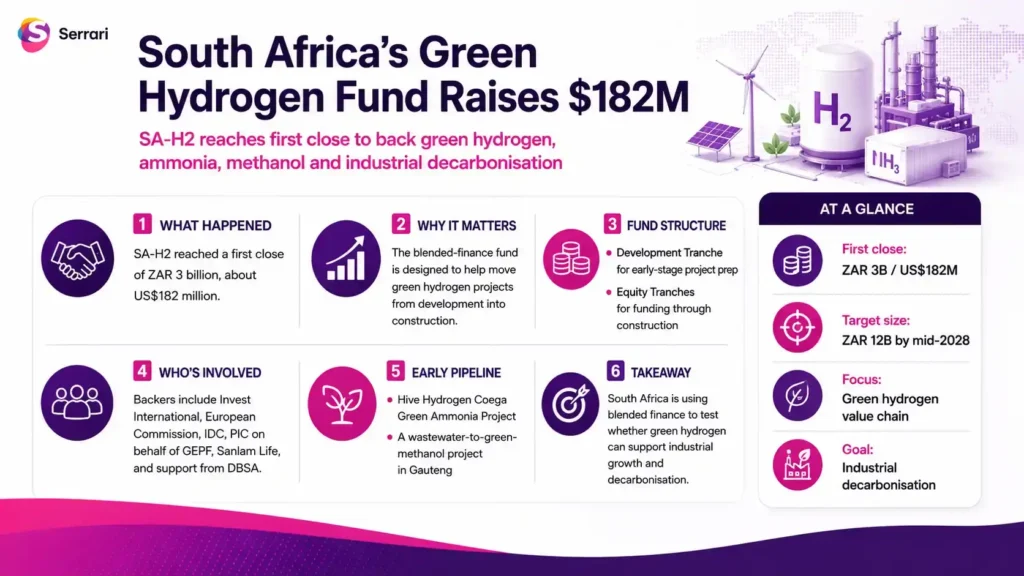
South Africa’s green hydrogen ambitions have gained a major financing boost after the SA-H2 Fund reached a ZAR 3 billion first close, equivalent to about $182 million at the exchange rate used for the announcement. Managed by Climate Fund Managers in partnership with Invest International, the blended-finance vehicle is designed to move green hydrogen, green ammonia, green methanol and industrial decarbonisation projects from development into construction. It is targeting a final fund size of ZAR 12 billion by mid-2028.
Key Overview
- SA-H2 has secured ZAR 3 billion, or roughly $182 million, at first close.
- The fund is targeting ZAR 12 billion in total commitments by mid-2028.
- Public and private investors include the European Commission, Invest International, PIC on behalf of GEPF, Sanlam Life and IDC, with support from DBSA.
- Development capital is intended to prepare projects for final investment decisions, while equity tranches can support construction.
- Early investments include a large-scale green ammonia project at Coega and a wastewater-to-green-methanol project in Gauteng.
Blended Finance Targets the Project Bankability Gap
Green hydrogen projects require large upfront investment in renewable power, electrolysers, water systems, storage, processing and transport infrastructure. That creates a financing challenge because projects can carry substantial development risk before construction starts or long-term buyers are secured.
SA-H2 is structured to address that gap through separate layers of capital. Its Development Tranche provides early-stage risk capital and technical assistance to prepare projects for a final investment decision, while blended Equity Tranches are intended to fund projects from financial close into construction.
The Development Tranche is backed by Invest International, the European Commission through Global Gateway and South Africa’s Industrial Development Corporation. Equity commitments come from the Public Investment Corporation on behalf of the Government Employees Pension Fund, Sanlam Life, Invest International and the European Commission, while the Development Bank of Southern Africa is supporting the fund.
This structure matters because institutional investors typically require projects to have clearer revenue models, technical preparation and risk allocation before committing large amounts of capital. By financing development work earlier, SA-H2 is attempting to create a larger pipeline of projects that can eventually meet those investment requirements.
Context is everything. Stay ahead of shifting trends with today’s market updates, and uncover emerging opportunities using the Serrari Group Market Index and Marketplace. Then, take control of your own financial future by exploring our Money & Life Reset Transformation Blueprint ™ to build stronger habits, create better systems, and design a path toward lasting wealth.
Coega and Gauteng Projects Anchor the Early Pipeline
The fund already has two projects demonstrating how that strategy could work. At Coega in the Eastern Cape, SA-H2 has committed up to $20 million in development funding to the Hive Hydrogen Coega Green Ammonia Project, with the right to participate in construction financing for up to $200 million.
The proposed facility is targeting annual production of about one million tonnes of green ammonia for export. Its planned infrastructure includes renewable generation, a large electrolyser, desalination, air separation, ammonia storage and export facilities, making it one of the most ambitious hydrogen-related industrial projects currently under development in South Africa.
In Gauteng, Climate Investor Three through SA-H2 has committed up to $4 million to develop a wastewater-to-green-methanol facility with Green eFuels Producers. The project is designed to process around 90,000 tonnes of municipal sewage sludge annually and produce an estimated 14,300 tonnes of green methanol.
Together, the projects show that the fund is not limited to hydrogen production itself. Its investment mandate extends into derivatives and industrial applications that could create commercial demand for renewable hydrogen while connecting energy transition investment with manufacturing and exports.
South Africa Links Hydrogen to Industrial Strategy
South Africa has been building a policy framework for hydrogen for several years. Its Hydrogen Society Roadmap identifies export markets and industrial decarbonisation as major objectives, alongside transport decarbonisation, greener power systems and domestic manufacturing of hydrogen-related technologies.
That industrial focus is important. Hydrogen is already used in South Africa’s chemicals and fuel-refining industries, but much of it has historically been produced from fossil fuels. Renewable hydrogen could eventually reduce emissions in sectors such as steel, chemicals, fertiliser and refining while creating new products for export markets.
The financing challenge, however, remains significant. Competitive electricity prices, water availability, infrastructure, technology costs and long-term offtake contracts will all influence whether projects can reach commercial scale. The first close provides capital, but it does not remove those underlying risks.
The Next Test Is Deployment
Reaching ZAR 3 billion gives SA-H2 enough capital to demonstrate whether its blended-finance model can convert development-stage hydrogen projects into operating industrial assets. The fund now aims to grow toward ZAR 12 billion by mid-2028, but the more important measure will be how many projects move through final investment decisions and construction.
For South Africa, success would mean more than producing green hydrogen. It would test whether climate finance can support new industrial capacity, local jobs, export infrastructure and lower-carbon production while attracting long-term institutional capital. The next phase will show whether the country’s hydrogen opportunity can move from ambitious project pipelines to commercially durable assets.
Sources: Africa Sustainability Matters / Climate Fund Managers / SA-H2 Fund Managers / South African Government
Your financial future isn’t something you wait for—it’s something you build.
The real question is: when do you begin?
Move beyond simply staying informed.
Navigate the markets with clarity—track trends through the Serrari Group Market Index, uncover opportunities in the Serrari Marketplace, and build practical knowledge with our Curated Wealth Builder Platform.
Stay connected to what truly matters.
Get daily insights on macro trends and financial movements across Kenya, Africa, and global markets—delivered through the Serrari Newsletter.
Growth opens doors.
Advance your career through professional programs including ACCA, HESI A2, ATI TEAS 7 , HESI EXIT , NCLEX – RN and NCLEX – PN, Financial Literacy!🌟—designed to move you forward with confidence.
See where money is flowing—clearly and in real time.
Track Money Market Funds, Treasury Bills, Treasury Bonds, Green Bonds, and Fixed Deposits, alongside global and African indexes, key economic indicators, and the evolving Crypto and stablecoin landscape—all within Serrari’s Market Index.