South Africa recorded R20.18 billion in renewable energy investment during the first quarter of the 2026/27 financial year, following the registration of 124 new generation facilities by the National Energy Regulator of South Africa (Nersa). Solar PV accounted for 122 of the facilities, while two were wind-powered. Together, the projects added 804MW of generation capacity, with wind projects accounting for 71% of the total installed capacity despite representing only two facilities.
Key Overview
- 124: New generation facilities registered by Nersa.
- R20.18 billion: Estimated total investment value.
- 804MW: Combined installed generation capacity.
- 122: Solar PV facilities registered.
- 2: Wind-powered facilities registered.
- 568MW: Capacity from the two wind facilities.
- R11.934 billion: Investment in Northern Cape projects.
- R25,099/kW: Average investment cost during the quarter.
South Africa Renewable Energy Investment Surges
South Africa’s renewable energy sector recorded significant investment activity during the first quarter of the 2026/27 financial year, with Nersa registering 124 generation facilities from April to June 2026.
The facilities represent an estimated R20.18 billion in investment and a combined 804MW of installed generation capacity, highlighting continued private-sector activity in the country’s clean energy market.
Solar photovoltaic (PV) projects dominated the number of registrations, accounting for 122 of the facilities. The remaining two facilities were wind-powered.
The figures point to continued growth in renewable energy projects as South Africa expands its generation capacity and attracts investment into alternative sources of electricity.
Solar PV Dominates New Generation Facilities
Although solar PV accounted for almost all the newly registered facilities, the wind projects made a significantly larger contribution to overall capacity.
The 122 solar PV facilities were joined by just two wind-powered facilities. Despite their small number, the wind projects collectively accounted for 568MW, equivalent to approximately 71% of the total 804MW capacity registered during the quarter.
This contrast highlights the different characteristics of South Africa’s renewable energy market. Solar projects can be developed across a large number of individual facilities, while larger wind developments can deliver substantial generation capacity through fewer projects.
The figures also show the scale of capital being directed toward clean energy investment across the country.
Northern Cape Leads Renewable Energy Investment
Regional differences were also evident in Nersa’s registrations.
The Western Cape, Gauteng and Limpopo recorded the highest numbers of newly registered generation facilities. However, the Northern Cape, Mpumalanga and Gauteng led in terms of total installed capacity and investment value.
The Northern Cape recorded the highest investment at approximately R11.934 billion, supporting projects with a combined capacity of 440MW.
The province’s position reflects the scale of renewable energy developments being registered there, with its projects accounting for more than half of the total capacity recorded across all 124 facilities.
The figures demonstrate how renewable energy investment in South Africa is distributed differently depending on whether the focus is the number of projects, generation capacity or capital committed.
Municipal and Eskom Networks Support New Projects
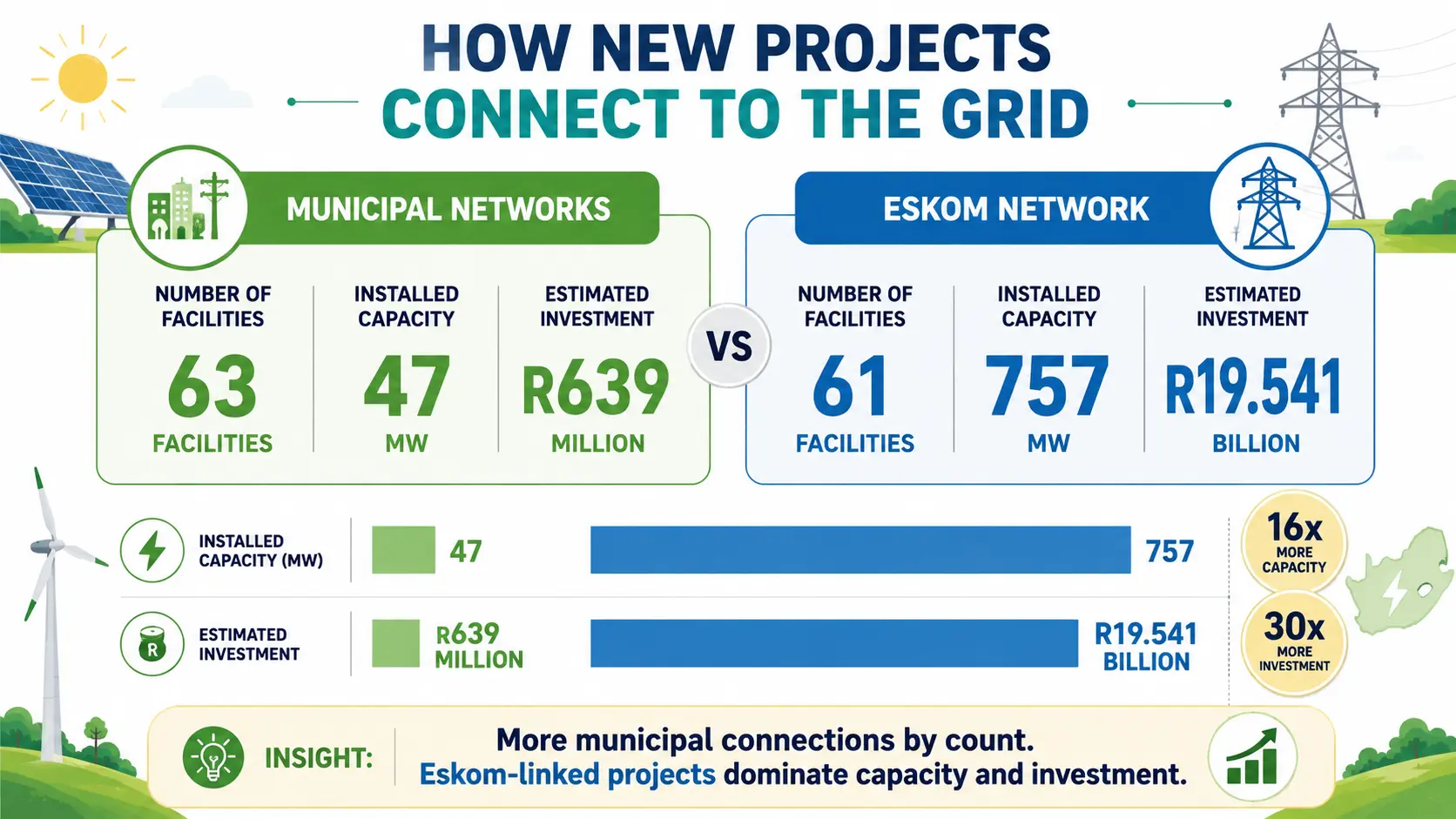
Nersa’s data also provides insight into how the new generation facilities are connecting to South Africa’s electricity system.
Of the 124 registered facilities, 63 are connected to municipal distribution networks. Together, these facilities have a combined capacity of 47MW and represent an estimated investment cost of R639 million.
The remaining 61 facilities are connected to Eskom’s national network. These projects have a much larger combined capacity of 757MW and represent approximately R19.541 billion in investment.
The difference between the two groups is significant. While more facilities are connected to municipal distribution networks, projects connected to the national network account for the overwhelming majority of both installed capacity and investment.
This indicates that larger-scale renewable energy generation projects are playing a major role in the investment figures recorded during the quarter.
Context is everything. Stay ahead of shifting trends with today’s market updates, and uncover emerging opportunities using the Serrari Group Market Index and Marketplace. Then, take control of your own financial future by exploring our Money & Life Reset Transformation Blueprint ™ to build stronger habits, create better systems, and design a path toward lasting wealth.
Wind Projects Deliver Most of the Capacity
The two registered wind facilities stand out because of their contribution to total capacity.
Together, they account for 568MW, or 71% of the 804MW registered during the quarter. This means the wind projects represent only a small fraction of the total number of facilities but contribute most of the generation capacity.
By comparison, solar PV accounted for 122 facilities, illustrating the larger number of smaller or distributed projects being developed in the solar segment.
The combination of solar and wind developments provides South Africa with additional clean electricity capacity, although the figures do not provide further details on the individual projects, expected generation or operational timelines.
Renewable Energy Investment Cost
Nersa reported that the average investment cost during the first quarter of the 2026/27 financial year was approximately R25,099 per kW.
Across the 804MW of registered capacity, the overall investment value reached R20.18 billion.
Investment costs can vary considerably between renewable energy projects depending on the technology, project size and infrastructure requirements. The data provided by Nersa therefore offers an overall indication of investment activity rather than a uniform cost for every facility.
The figures nevertheless underline the substantial capital requirements associated with expanding South Africa’s electricity generation capacity.
South Africa’s Growing Clean Energy Market
The registration of 124 facilities within a single quarter demonstrates continued momentum in South Africa’s renewable energy market.
Solar PV remains the dominant technology by number of facilities, while wind projects are making a major contribution to installed capacity. At the same time, the distribution of projects between municipal and Eskom networks highlights the different scales at which new generation is being developed.
The R20.18 billion investment recorded during the quarter also demonstrates the financial scale of the country’s ongoing energy transition.
For investors, developers and energy companies, continued additions of renewable generation capacity could create opportunities across project development, equipment supply, grid infrastructure and related services.
Outlook
South Africa’s latest Nersa figures point to strong investment activity in renewable energy, with 124 new facilities, 804MW of capacity and R20.18 billion in estimated investment registered during April–June 2026.
Solar PV continues to dominate the number of projects, while wind power accounts for most of the newly registered capacity. The Northern Cape remains a major investment location, recording R11.934 billion across projects totalling 440MW.
The next phase of development will depend on continued investment, grid connections and the ability to integrate new generation into South Africa’s electricity system. For the renewable energy market, the latest registrations provide evidence that significant capital continues to flow into new generation capacity.
FAQs
1. How much renewable energy investment did South Africa record?
Nersa registered generation facilities representing an estimated R20.18 billion in investment during the first quarter of the 2026/27 financial year.
2. How many renewable energy facilities were registered?
Nersa registered 124 generation facilities between April and June 2026. Of these, 122 were solar PV facilities and two were wind-powered.
3. How much generation capacity did the new facilities represent?
The 124 facilities had a combined installed capacity of 804MW. The two wind facilities accounted for 568MW, or about 71% of the total.
4. Which South African province recorded the highest investment?
The Northern Cape recorded the highest investment, at approximately R11.934 billion, for projects with a combined installed capacity of 440MW.
Sources: News24, Engineering News, Green Building Africa
Your financial future isn’t something you wait for—it’s something you build.
The real question is: when do you begin?
Move beyond simply staying informed.
Navigate the markets with clarity—track trends through the Serrari Group Market Index, uncover opportunities in the Serrari Marketplace, and build practical knowledge with our Curated Wealth Builder Platform.
Stay connected to what truly matters.
Get daily insights on macro trends and financial movements across Kenya, Africa, and global markets—delivered through the Serrari Newsletter.
Growth opens doors.
Advance your career through professional programs including ACCA, HESI A2, ATI TEAS 7 , HESI EXIT , NCLEX – RN and NCLEX – PN, Financial Literacy!🌟—designed to move you forward with confidence.
See where money is flowing—clearly and in real time.
Track Money Market Funds, Treasury Bills, Treasury Bonds, Green Bonds, and Fixed Deposits, alongside global and African indexes, key economic indicators, and the evolving Crypto and stablecoin landscape—all within Serrari’s Market Index.