South Africa’s National Treasury has introduced a new sustainable finance framework aimed at helping the country raise nearly R3.7 trillion needed to support climate mitigation and decarbonisation efforts over the next decade.
The framework establishes guidelines for issuing green, social, and sustainability-linked financing instruments, including bonds and loans, to fund projects with environmental and social benefits.
Officials say the initiative is designed to attract international and private-sector sustainable finance while supporting South Africa’s transition away from coal dependence and toward cleaner energy infrastructure.
Key Overview
- South Africa launched a sustainable finance framework
- The country aims to raise R3.7 trillion for climate mitigation projects
- The framework supports green, social, and sustainability bonds
- Eligible projects include hydrogen, hydropower, geothermal energy, and bioenergy
- South Africa plans to raise about R160 billion annually from climate-finance institutions by 2030
- S&P Global warned coal dependence may limit environmental benefits
- The framework supports South Africa’s Paris Agreement commitments
South Africa Launches Green Bond Framework
South Africa’s National Treasury has published a framework for sustainable finance instruments aimed at helping raise the R3.7 trillion needed to mitigate greenhouse gas emissions over the next decade.
The framework outlines guidelines for issuing green, social, and sustainability financing instruments, including loans and bonds, to support new and existing projects with environmental and social benefits.
Officials said the initiative is intended to align South Africa’s funding strategy with its broader sustainability and decarbonisation goals while attracting both domestic and international investors focused on climate-friendly development.
“This initiative aims to align the country’s funding strategy with its sustainability objectives, attracting sustainable finance to support South Africa’s decarbonisation commitments in a just and inclusive manner,” the Treasury said in the document.
The framework also establishes criteria that will guide financing decisions and determine which projects qualify under the program.
Renewable Energy and Infrastructure Projects Prioritized
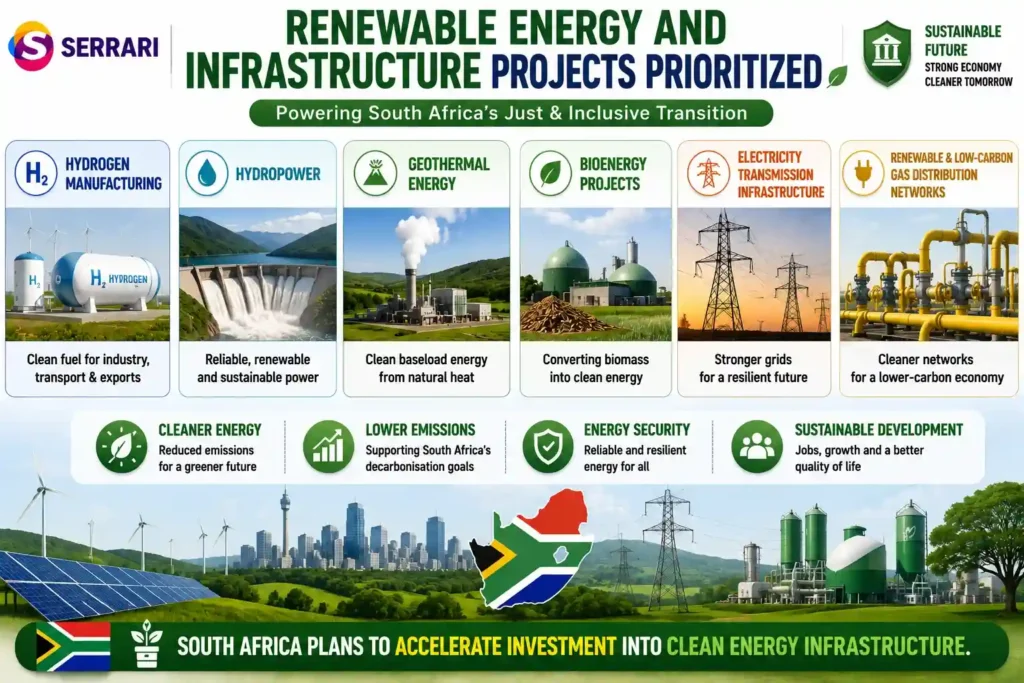
According to the Treasury, the framework will support a broad range of projects linked to clean energy, low-carbon infrastructure, and sustainable development.
Among projects that would be considered are :
- Hydrogen manufacturing
- Hydropower
- Geothermal electricity
- Bioenergy projects
- Electricity transmission infrastructure
- Renewable and low-carbon gas distribution networks
- Energy-efficient technologies for industries and households
Officials said the framework is intended to help accelerate investment into infrastructure needed to reduce emissions while strengthening energy security and supporting economic development.
South Africa has faced increasing pressure to diversify its energy system because of ongoing electricity shortages, aging coal infrastructure, and international climate commitments.
The country remains one of the world’s most coal-dependent economies, with coal accounting for the majority of electricity generation.
Climate Goals Require Massive Funding
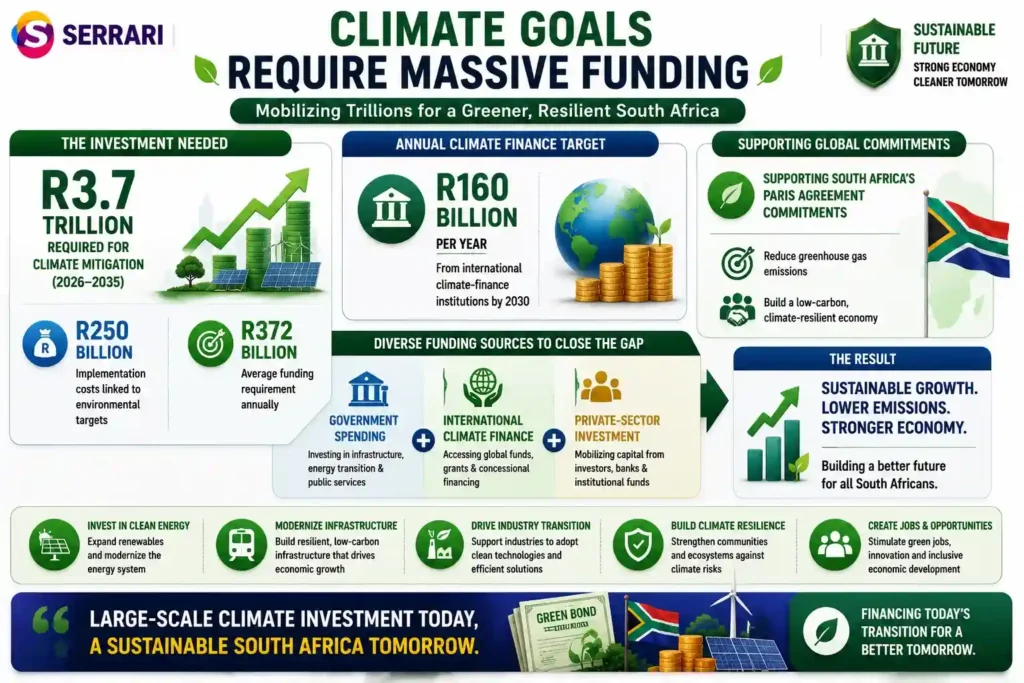
The Treasury said meeting South Africa’s environmental targets under international agreements, including the Paris Agreement, will require substantial long-term investment.
According to the framework, implementation costs linked to environmental targets are estimated at around R250 billion, while mitigation strategies between 2026 and 2035 could require approximately R3.47 trillion.
That represents an average funding requirement of roughly R372 billion annually over the next decade.
Officials said South Africa plans to raise around R160 billion per year from international climate-finance institutions by 2030, with the remaining funding expected to come from private-sector investment and government spending.
Analysts say attracting international green finance has become increasingly important for emerging markets facing large infrastructure financing gaps while attempting to transition toward cleaner energy systems.
Context is everything. Stay ahead of shifting trends with today’s market updates, and uncover emerging opportunities using the Serrari Group Market Index and Marketplace. Then, take control of your own financial future by exploring our Money & Life Reset Transformation Blueprint ™ to build stronger habits, create better systems, and design a path toward lasting wealth.
South Africa Faces Criticism Over Slow Climate Financing
South Africa has previously faced criticism for moving slowly in securing sustainable finance despite growing global investor appetite for climate-related investments.
The new framework comes more than five years after the government first indicated plans to develop sovereign green bond structures and broader sustainable finance mechanisms.
Analysts say the delay has limited South Africa’s ability to fully capitalize on international demand for ESG-linked investments and climate-focused infrastructure financing.
At the same time, the country continues planning major infrastructure spending while attempting to reduce reliance on coal and comply with global climate obligations.
The Treasury’s latest framework is expected to provide investors with clearer standards and greater transparency regarding how green financing proceeds will be allocated.
S&P Warns Coal Dependence Remains a Risk
While supporting the framework’s broader sustainability objectives, S&P Global Ratings warned that South Africa’s heavy reliance on coal could limit some of the program’s environmental benefits.
In an assessment published alongside the framework, S&P said achieving full climate-related outcomes may remain difficult while coal continues dominating the country’s electricity generation system.
Still, the ratings agency noted that the framework’s broader focus on healthcare, education, employment, and food security could help strengthen South Africa’s long-term development trajectory.
“The framework’s financing of projects linked to healthcare, education, employment, and food security will help tackle social challenges and strengthen South Africa’s development path,” S&P said.
However, the agency also noted that the framework’s broad scope creates uncertainty around the future environmental and climate impact of some projects.
Outlook
South Africa’s new green bond framework marks a major step in the country’s effort to mobilize large-scale climate finance and accelerate its transition toward a lower-carbon economy.
The initiative reflects growing recognition that substantial investment will be required to modernize energy infrastructure, reduce emissions, and meet international climate commitments while supporting economic development.
However, analysts say the success of the framework will depend heavily on South Africa’s ability to attract sustained investor confidence, accelerate project implementation, and gradually reduce its reliance on coal-fired electricity generation.
Your financial future isn’t something you wait for—it’s something you build.
The real question is: when do you begin?
Move beyond simply staying informed.
Navigate the markets with clarity—track trends through the Serrari Group Market Index, uncover opportunities in the Serrari Marketplace, and build practical knowledge with our Curated Wealth Builder Platform.
Stay connected to what truly matters.
Get daily insights on macro trends and financial movements across Kenya, Africa, and global markets—delivered through the Serrari Newsletter.
Growth opens doors.
Advance your career through professional programs including ACCA, HESI A2, ATI TEAS 7 , HESI EXIT , NCLEX – RN and NCLEX – PN, Financial Literacy!🌟—designed to move you forward with confidence.
See where money is flowing—clearly and in real time.
Track Money Market Funds, Treasury Bills, Treasury Bonds, Green Bonds, and Fixed Deposits, alongside global and African indexes, key economic indicators, and the evolving Crypto and stablecoin landscape—all within Serrari’s Market Index.
Sources: Fullview, Moneyweb, News24