Norway’s transition to electric mobility continued in July, with battery-electric vehicles accounting for 97.6% of all new passenger car registrations. The latest figures show that while the overall car market remained largely unchanged, demand for electric vehicles remained exceptionally strong. Toyota led monthly sales, Xpeng posted significant growth, and electric vehicles continued gaining market share across passenger cars, used vehicles, vans and trucks.
Key Overview
- Norway’s battery-electric vehicle (BEV) share reached 97.6% of new passenger car registrations in July.
- 9,609 new passenger cars were registered, up 0.5% year-on-year.
- Toyota became the best-selling brand, while Xpeng climbed to third place.
- Battery-electric vehicle registrations increased 1.3% year-to-date despite a decline in the overall market.
Battery-Electric Vehicles Reach 97.6% Market Share
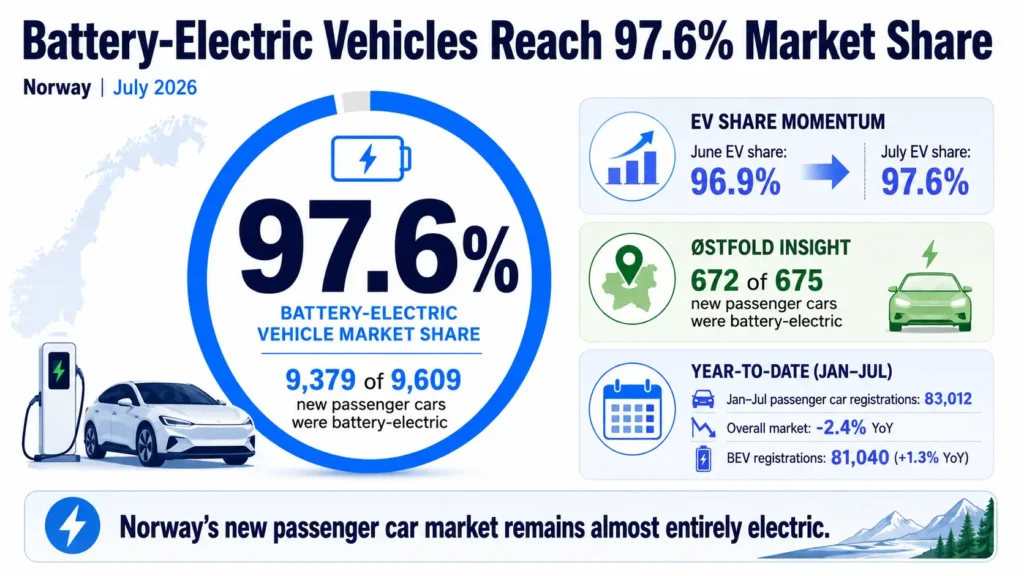
Norway registered 9,609 new passenger cars in July, representing a modest 0.5% increase compared with the same month last year. According to the Norwegian Road Traffic Information Council (OFV), 9,379 of those registrations were battery-electric vehicles, lifting the monthly EV share to 97.6 percent.
The result follows June’s record EV share of 96.9 percent, confirming that Norway’s new passenger vehicle market remains almost entirely electric.
Among Norway’s counties, Østfold recorded the country’s highest EV share, with 672 of 675 newly registered passenger cars powered by batteries.
Despite the continued strength of electric vehicles, the overall passenger car market has softened slightly this year. From January through July, Norway registered 83,012 new passenger cars, down 2.4% compared with the same period last year.
Battery-electric vehicles, however, continued expanding their presence, with registrations increasing 1.3% year-on-year to 81,040 units.
Toyota Leads Monthly Sales Rankings
Toyota emerged as Norway’s best-selling vehicle brand during July with 1,260 registrations.
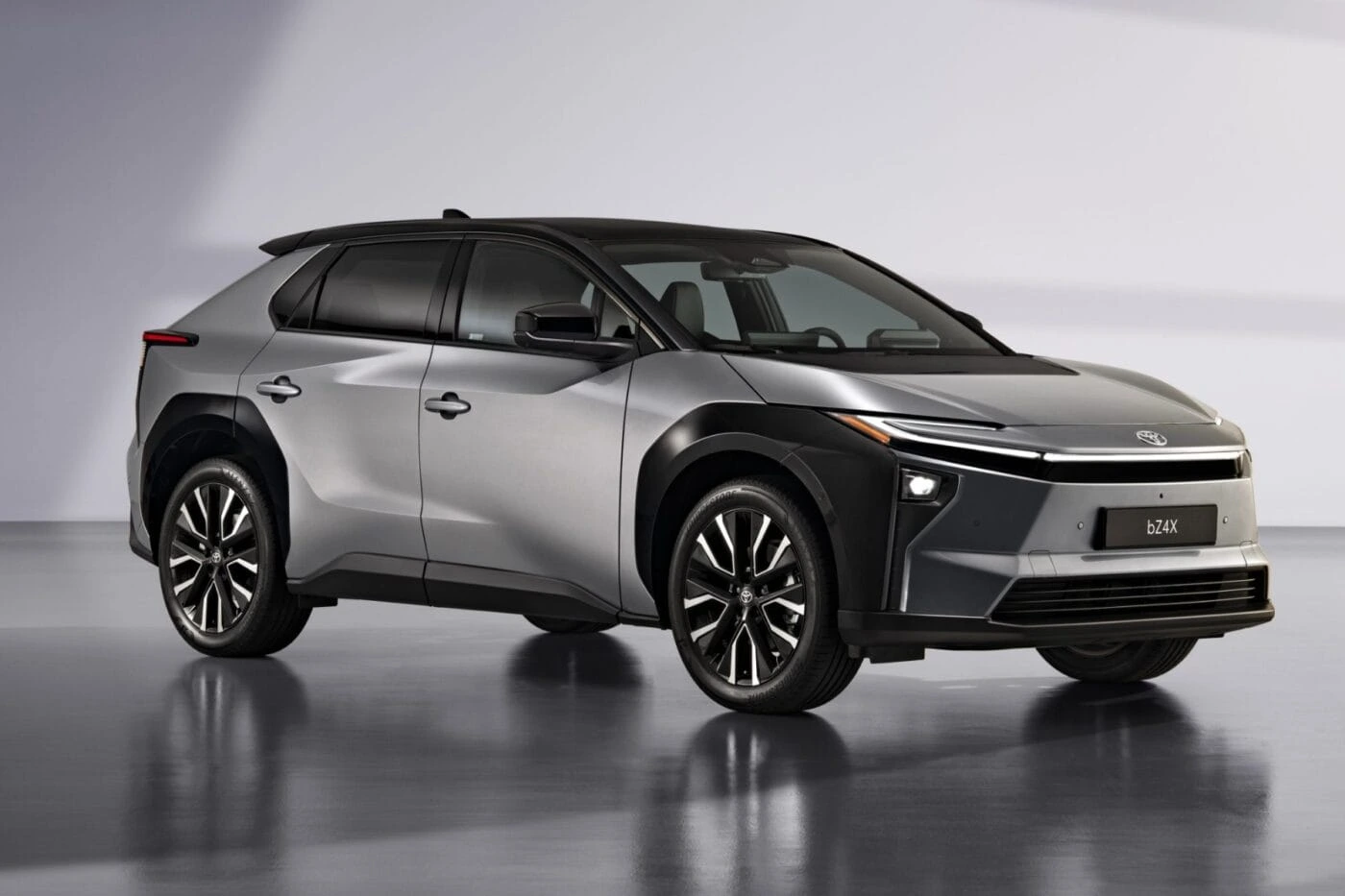
The performance was supported by strong demand for the Toyota bZ4X, which became Norway’s best-selling model for the month with 532 registrations. The Toyota Urban Cruiser ranked third among individual models with 437 units.
The Volkswagen ID.4 secured second place among individual models after recording 485 registrations.
Volkswagen ranked as the country’s second-best-selling brand during July, while Chinese electric vehicle manufacturer Xpeng climbed to third place after registering 843 vehicles, representing a 161% increase compared with the same month last year.
Commenting on the latest figures, OFV Chief Executive Officer Geir Inge Stokke said the competitive landscape continues to evolve despite relatively stable overall registration volumes.
“The July figures show how quickly the competitive landscape can change, even when the overall registration volume barely moves. Toyota has gone from tenth to first place in one year, and Xpeng from thirteenth to third place. Tesla is still the largest so far this year.”
Tesla Maintains Year-to-Date Lead
Although Tesla registered only 24 new vehicles during July, it remained Norway’s largest brand on a year-to-date basis.
Tesla recorded 14,413 registrations during the first seven months of the year, representing a 3.9% increase compared with the same period last year.
Toyota ranked second with 9,972 units, followed by Volkswagen with 8,149 units.
Context is everything. Stay ahead of shifting trends with today’s market updates, and uncover emerging opportunities using the Serrari Group Market Index and Marketplace. Then, take control of your own financial future by exploring our Money & Life Reset Transformation Blueprint ™ to build stronger habits, create better systems, and design a path toward lasting wealth.
Electric Vehicles Expand Across the Wider Market
Norway’s transition to electric mobility also continued beyond the new passenger vehicle segment.
According to OFV, ownership transfers of battery-electric passenger cars to private buyers increased 8% during July, while transfers of diesel and petrol vehicles declined by 5.7 per cent and 6.7 per cent, respectively.
Year-to-date, transfers of electric passenger cars have risen 43.2 per cent to 103,892, narrowly overtaking diesel vehicles in overall ownership transfer statistics.
The commercial vehicle market also continued shifting toward electrification.
Battery-electric vans accounted for 61.4% of new van registrations during July.
Meanwhile, battery-electric truck registrations increased by almost 70 compared with the first seven months of 2025, lifting their year-to-date market share to 23%.
Despite this progress, electric vehicles still represent only 10.6% of Norway’s total van fleet and 4.8% of its truck fleet.
Stokke said continued progress will depend on maintaining supportive policy conditions.
“The challenge now is to translate the growth in new registrations into a broader renewal of the vehicle fleet. This requires predictable taxes and support schemes, sufficient charging infrastructure and network capacity that allows companies to plan long-term. Without stable framework conditions, we risk that necessary investments will be postponed.”
Outlook
Norway continues to demonstrate one of the world’s most advanced electric vehicle markets, with battery-electric vehicles now accounting for almost all new passenger car registrations. While overall vehicle registrations have remained relatively stable, competition among manufacturers is intensifying as brands such as Toyota and Xpeng gain market share alongside established leaders. Electric vehicles are also expanding into the used car, van and truck markets, although fleet electrification still has considerable room for growth. Going forward, the pace of fleet renewal is expected to depend on stable policy support, continued investment in charging infrastructure and sufficient grid capacity to support the country’s ongoing transition
FAQs
1. What share of Norway’s new passenger car registrations were electric in July 2026?
Battery-electric vehicles accounted for 97.6% of new passenger car registrations in July.
2. Which brand sold the most electric vehicles in Norway during July?
Toyota was the best-selling brand with 1,260 registrations.
3. Which vehicle was Norway’s best-selling model in July?
The Toyota bZ4X was the top-selling model with 532 registrations.
4. Which manufacturer recorded the strongest growth?
Xpeng climbed to third among brands after registrations increased 161% year-on-year.
5. Is Tesla still Norway’s leading EV brand?
Yes. Despite lower July registrations, Tesla remained the largest brand year-to-date with 14,413 registrations.
Your financial future isn’t something you wait for—it’s something you build.
The real question is: when do you begin?
Move beyond simply staying informed.
Navigate the markets with clarity—track trends through the Serrari Group Market Index, uncover opportunities in the Serrari Marketplace, and build practical knowledge with our Curated Wealth Builder Platform.
Stay connected to what truly matters.
Get daily insights on macro trends and financial movements across Kenya, Africa, and global markets—delivered through the Serrari Newsletter.
Growth opens doors.
Advance your career through professional programs including ACCA, HESI A2, ATI TEAS 7 , HESI EXIT , NCLEX – RN and NCLEX – PN, Financial Literacy!🌟—designed to move you forward with confidence.
See where money is flowing—clearly and in real time.
Track Money Market Funds, Treasury Bills, Treasury Bonds, Green Bonds, and Fixed Deposits, alongside global and African indexes, key economic indicators, and the evolving Crypto and stablecoin landscape—all within Serrari’s Market Index.