
California regulators have approved significant changes to the state’s Cap-and-Invest carbon market program, including billions of dollars in additional free emissions allowances for oil refiners and industrial companies.
The California Air Resources Board (CARB) said the revisions are intended to reduce potential fuel price increases and protect consumers amid inflation and global energy market volatility.
Environmental groups and some economists, however, warned the changes could weaken emissions reduction efforts and make California’s climate targets harder to achieve.
Key Overview
- California approved changes to its Cap-and-Invest carbon market
- Regulators may provide up to $4 billion in additional free allowances
- The program aims to reduce pressure on fuel and consumer prices
- Environmental groups criticized the move as a giveaway to polluters
- California’s carbon market covers about 80% of state emissions
- Auction revenues could reportedly fall from $4 billion to $2 billion annually
- The revised program still preserves California’s broader climate goals
California Revises Carbon Market Rules
California regulators approved major revisions to the state’s Cap-and-Invest program, one of the most influential emissions trading systems in the United States.
The California Air Resources Board voted to revise the program by granting additional free emissions allowances to oil refiners and industrial companies to help them comply with greenhouse gas reduction requirements.
According to reports, the changes could provide up to $4 billion in additional free allowances through 2035.
Officials said the revised framework is designed to reduce pressure on consumers and avoid sharp increases in gasoline prices during a period of elevated energy costs and broader inflation concerns.
The decision comes as policymakers continue facing economic pressure linked to rising fuel prices following disruptions in global oil markets during the Middle East conflict.
Additional Free Allowances Approved
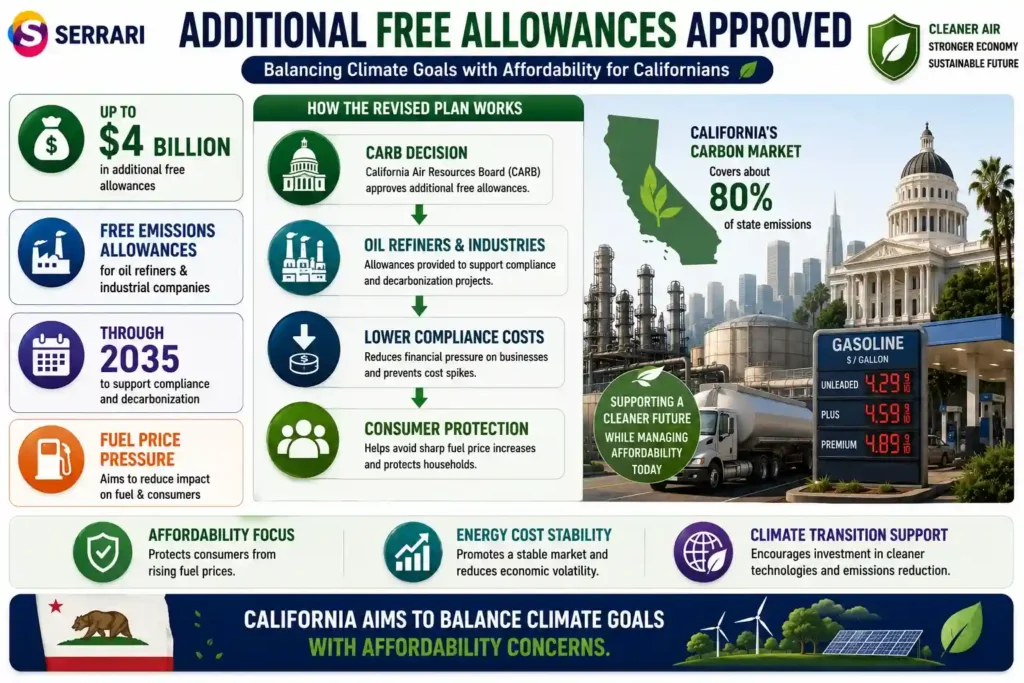
Under the revised plan, regulators will offset the removal of 118 million emissions allowances from the market by creating an equal number of free allowances through 2035.
The allowances will primarily be available to oil refiners and other industrial companies for decarbonization-related projects.
CARB also approved approximately $800 million in additional support measures aimed at preventing higher compliance costs from being passed on to consumers through fuel prices.
Regulatory staff said the approved changes are not expected to increase gasoline prices, though they are also unlikely to significantly reduce them.
The revised program reflects a balancing act between California’s climate goals and growing affordability concerns as energy prices remain volatile globally.
Environmental Groups Criticize the Decision
The changes immediately drew criticism from environmental groups, local officials, and some economists who warned the new allowances could weaken incentives for companies to reduce emissions.
Critics argued that expanding free allowances could lower carbon prices and reduce pressure on major polluters to accelerate decarbonization efforts.
Environmental organizations also warned that the revisions may make it more difficult for California to meet its climate targets, including reducing emissions to 40% below 1990 levels by 2030 and 85% below 1990 levels by 2045.
Katelyn Roedner Sutter, California senior director for the Environmental Defense Fund, described the decision as “deeply misguided.”
Bahram Fazeli, policy director at Communities for a Better Environment, accused regulators of prioritizing oil companies over communities and climate concerns.
Some progressive Democrats also criticized the move, describing it as a multibillion-dollar concession to fossil fuel companies.
Context is everything. Stay ahead of shifting trends with today’s market updates, and uncover emerging opportunities using the Serrari Group Market Index and Marketplace. Then, take control of your own financial future by exploring our Money & Life Reset Transformation Blueprint ™ to build stronger habits, create better systems, and design a path toward lasting wealth.
Carbon Market Revenues Could Decline
A report from California’s Legislative Analyst’s Office warned that the revisions could reduce certainty around meeting the state’s 2030 emissions targets.
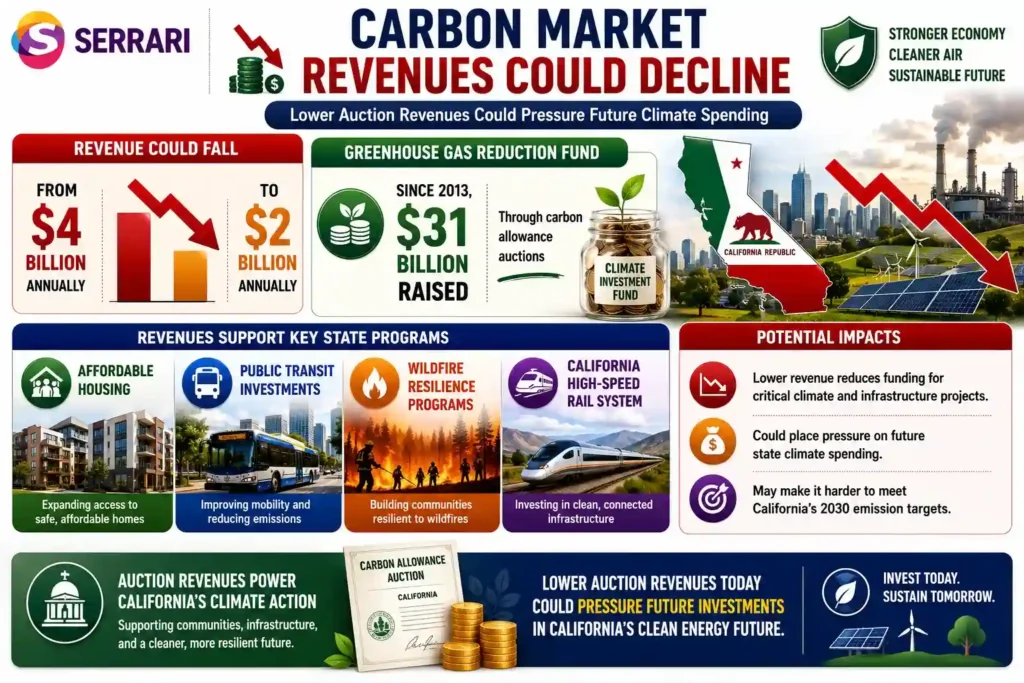
The office also estimated annual auction revenues could fall to approximately $2 billion from previous levels of around $4 billion annually.
Those revenues support a wide range of state initiatives including:
- Affordable housing projects
- Public transit investments
- Wildfire resilience programs
- California’s high-speed rail system
Since launching in 2013, California’s Greenhouse Gas Reduction Fund has reportedly collected more than $31 billion through carbon allowance auctions.
Analysts said reduced auction revenue could place pressure on future state climate spending and infrastructure programs.
CARB Defends Program Changes
CARB officials defended the revised rules, arguing the changes improve affordability without undermining California’s broader climate objectives.
The board also directed staff to conduct additional analysis before issuing the new allowances after some members raised concerns about possible impacts on emissions reductions and carbon market pricing.
Governor Gavin Newsom also supported the decision, describing the revised framework as part of California’s broader effort to balance economic stability with climate leadership.
“While Trump sows ongoing chaos and uncertainty, California is staying focused by protecting our economy, safeguarding public health, and doubling down on the clean energy future all Californians deserve,” Newsom said following the vote.
The changes also provide some relief to oil companies after industry groups warned earlier proposals could increase gasoline prices by more than $1 per gallon by 2030.
Outlook
California’s revised Cap-and-Invest rules highlight the growing tension between climate ambition, affordability concerns, and political pressure over energy prices.
While regulators argue the changes protect consumers and preserve the state’s broader climate strategy, critics fear the additional allowances could weaken emissions reduction efforts and slow decarbonization progress.
The outcome of the revised program will likely play a major role in determining whether California can maintain its reputation as a global climate leader while balancing economic and political realities tied to energy affordability.
Your financial future isn’t something you wait for—it’s something you build.
The real question is: when do you begin?
Move beyond simply staying informed.
Navigate the markets with clarity—track trends through the Serrari Group Market Index, uncover opportunities in the Serrari Marketplace, and build practical knowledge with our Curated Wealth Builder Platform.
Stay connected to what truly matters.
Get daily insights on macro trends and financial movements across Kenya, Africa, and global markets—delivered through the Serrari Newsletter.
Growth opens doors.
Advance your career through professional programs including ACCA, HESI A2, ATI TEAS 7 , HESI EXIT , NCLEX – RN and NCLEX – PN, Financial Literacy!🌟—designed to move you forward with confidence.
See where money is flowing—clearly and in real time.
Track Money Market Funds, Treasury Bills, Treasury Bonds, Green Bonds, and Fixed Deposits, alongside global and African indexes, key economic indicators, and the evolving Crypto and stablecoin landscape—all within Serrari’s Market Index.
Sources: Yahoo Finance, KQED, CalMatters, Politico