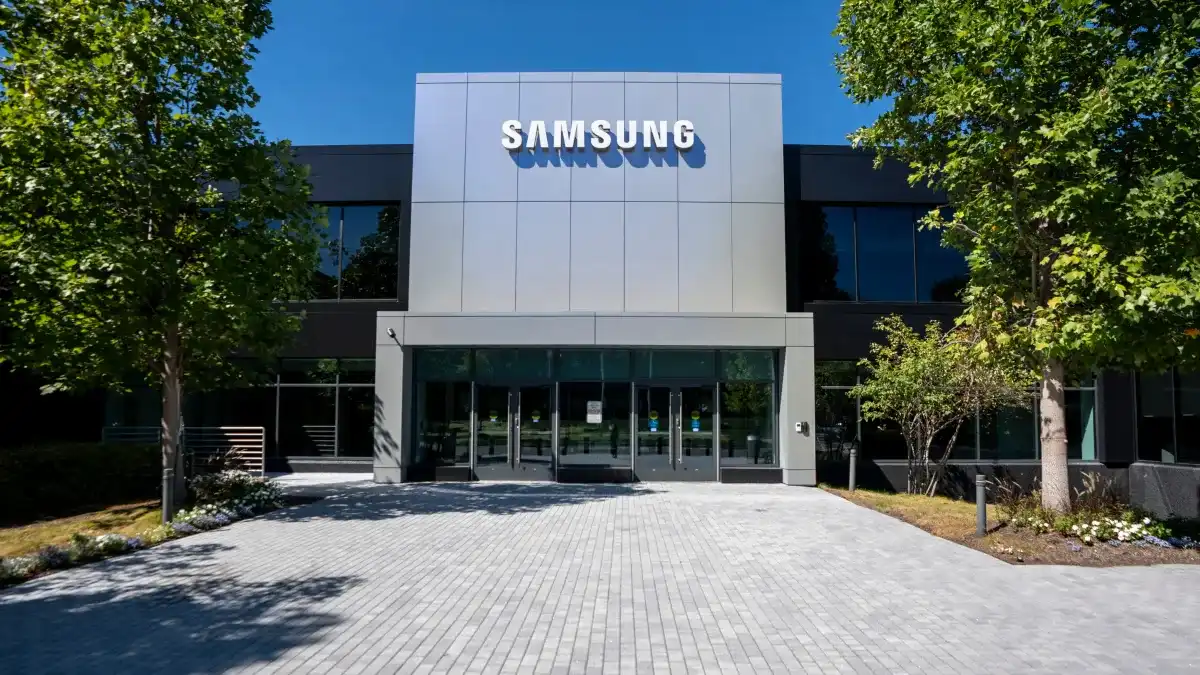
Samsung Electronics became the largest investor among the world’s top 10 semiconductor companies in 2025, after spending nearly 90 trillion won, or about $59.2 billion, on capital expenditure and research and development.
The spending underscores how aggressively the Korean technology giant is positioning itself for the AI semiconductor cycle, even after enduring a sharp industry downturn in 2023. While rivals are also expanding, Samsung’s investment scale shows that chipmakers are treating capacity, advanced memory and R&D as long-term strategic weapons rather than short-term cost centres.
Key Overview
Samsung invested 89.9 trillion won in 2025, based on industry data compiled by CEO Score.
The total included 52.2 trillion won in capital expenditure and 37.7 trillion won in R&D.
Samsung’s investment was ahead of TSMC, which ranked second with 69.4 trillion won in spending.
Samsung continued to invest heavily even in 2023, when operating profit fell 84.9 percent to 6.57 trillion won.
The company’s spending strategy is now tied closely to AI chips, high-bandwidth memory and next-generation semiconductor facilities.
Samsung Outspends Global Chip Rivals
Samsung Electronics spent almost 90 trillion won on capital expenditure and R&D in 2025, making it the biggest investor among the world’s top 10 semiconductor companies. The company’s spending was split between factory-related investment and technology development, with 52.2 trillion won allocated to capital expenditure and 37.7 trillion won to R&D, according to CEO Score data.
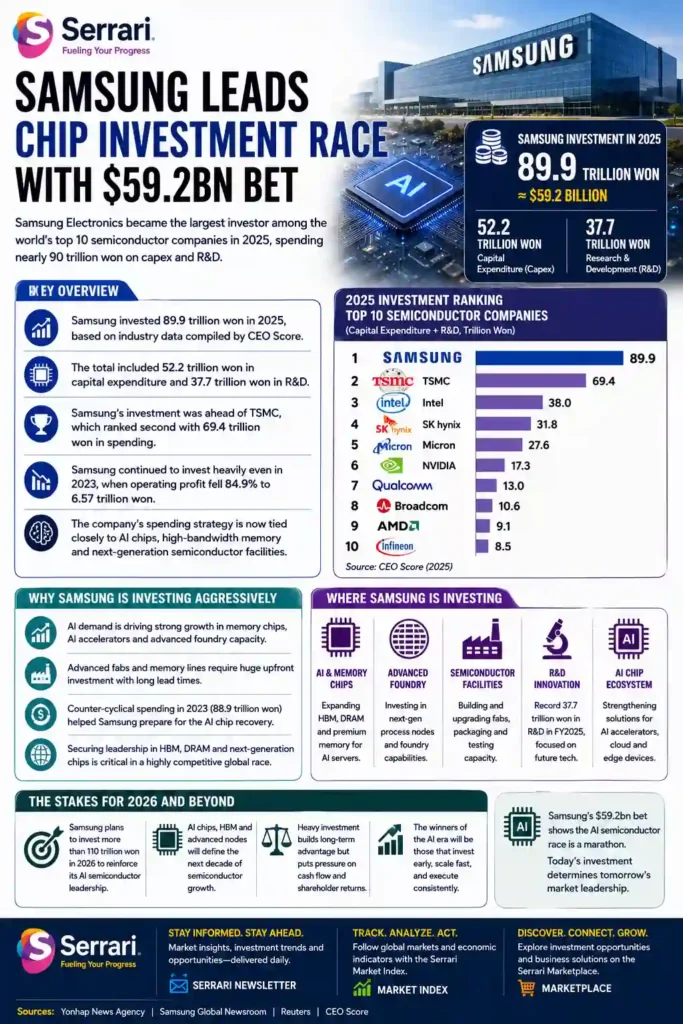
That level of investment placed Samsung well ahead of Taiwan’s TSMC, which spent 69.4 trillion won, according to the same ranking. The gap matters because both companies are central to the AI semiconductor supply chain, although they compete from different positions: Samsung as a memory, foundry and device giant, and TSMC as the leading pure-play contract chip manufacturer.
Samsung’s own reporting also confirms the scale of its technology push. In its FY2025 results, the company said R&D investment reached a full-year record of 37.7 trillion won, supported by stronger semiconductor earnings in the fourth quarter.
Context is everything. Stay ahead of shifting trends with today’s market updates, and uncover emerging opportunities using the Serrari Group Market Index and Marketplace. Then, take control of your own financial future by exploring our Money & Life Reset Transformation Blueprint ™ to build stronger habits, create better systems, and design a path toward lasting wealth.
Spending Through the Chip Downturn
Samsung’s 2025 investment lead did not come from a sudden shift. The company kept spending even when the chip market weakened sharply in 2023. Its annual operating profit fell to 6.57 trillion won that year, according to official results, as weaker semiconductor demand hit earnings.
Despite that pressure, Samsung invested 88.9 trillion won in 2023, more than 13 times its operating profit, according to CEO Score’s latest comparison. That counter-cyclical spending helped the company preserve long-term capacity and prepare for the AI-driven chip recovery that gained momentum in 2025 and 2026.
The strategy reflects the structure of the semiconductor industry, where companies often need to invest years before demand fully materialises. Advanced fabs, memory lines, packaging capacity and R&D programmes require heavy upfront spending, and companies that delay investment risk losing ground when the next cycle accelerates.
AI Chips Raise the Stakes for 2026
The pressure to spend is expected to remain intense. Samsung said in March that it planned to invest more than 110 trillion won in 2026 in research, development and facilities to strengthen its position in AI semiconductors. That plan, reported by Reuters, would mark another increase from Samsung’s already elevated 2025 spending level.
The focus is especially important in high-bandwidth memory, advanced DRAM, AI server chips and next-generation foundry processes. Samsung has been working to regain stronger momentum in premium memory used for AI accelerators, while also expanding investments in future semiconductor facilities.
However, the scale of spending also creates tension. CEO Score warned that the semiconductor sector requires continuous investment on an enormous scale, meaning large distributions of retained earnings or bonus payouts during boom periods could place pressure on companies. For Samsung, the central question is whether today’s heavy investment can translate into stronger market share and profitability as AI demand reshapes the global chip industry.
Sources used: Yonhap News Agency / Samsung Global Newsroom / Reuters
Your financial future isn’t something you wait for—it’s something you build.
The real question is: when do you begin?
Move beyond simply staying informed.
Navigate the markets with clarity—track trends through the Serrari Group Market Index, uncover opportunities in the Serrari Marketplace, and build practical knowledge with our Curated Wealth Builder Platform.
Stay connected to what truly matters.
Get daily insights on macro trends and financial movements across Kenya, Africa, and global markets—delivered through the Serrari Newsletter.
Growth opens doors.
Advance your career through professional programs including ACCA, HESI A2, ATI TEAS 7 , HESI EXIT , NCLEX – RN and NCLEX – PN, Financial Literacy!🌟—designed to move you forward with confidence.
See where money is flowing—clearly and in real time.
Track Money Market Funds, Treasury Bills, Treasury Bonds, Green Bonds, and Fixed Deposits, alongside global and African indexes, key economic indicators, and the evolving Crypto and stablecoin landscape—all within Serrari’s Market Index.