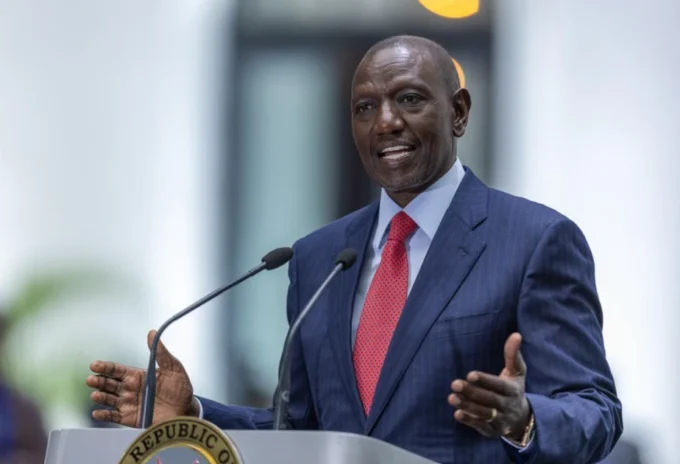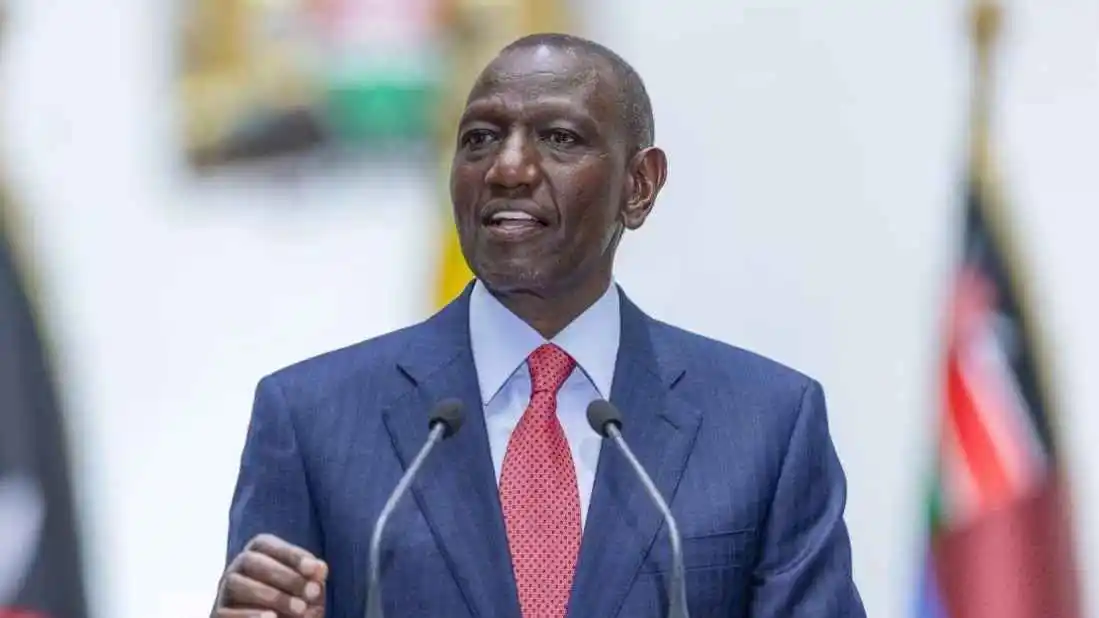
President William Ruto has urged Kenyan commercial banks to reduce lending costs, arguing that recent gains in macroeconomic stability should translate into more affordable credit for households, farmers and businesses. Speaking during the Central Bank of Kenya’s 60th anniversary events on September 17, he said the next phase of economic policy should focus on converting stability into investment, production and jobs through easier access to finance.
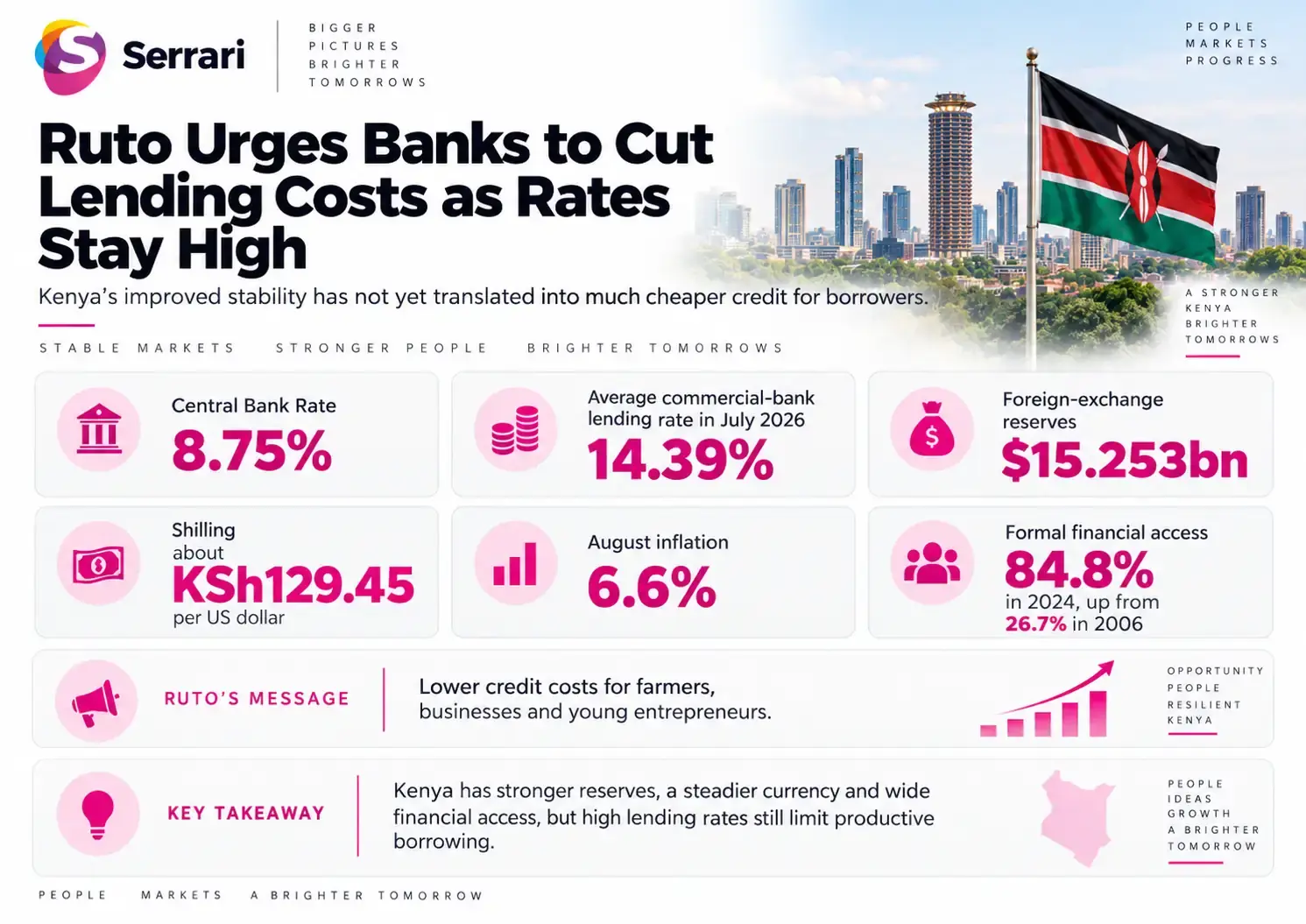
The call comes as the Central Bank Rate remains at 8.75% while the average commercial-bank lending rate stood at 14.39% in July 2026. That gap has kept borrowing costs elevated even as monetary policy has eased from earlier restrictive levels.
Key Overview
- The Central Bank Rate is currently 8.75%.
- Average commercial-bank lending rates were 14.39% in July 2026.
- Kenya’s foreign-exchange reserves stood at $15.253 billion on September 10.
- The shilling traded at about KSh129.45 per US dollar on September 10.
- Annual inflation was 6.6% in August 2026.
- Formal financial access increased from 26.7% in 2006 to 84.8% in 2024.
Ruto Presses Banks to Pass Through Lower Rates
Ruto argued that the benefits of monetary easing should increasingly reach borrowers rather than remain concentrated within the banking system. His remarks at the anniversary event focused on the cost of credit for productive sectors such as agriculture, manufacturing, technology, infrastructure and small business.
The pressure on banks reflects a broader policy question: how quickly changes in the policy rate are transmitted into the interest rates that households and firms actually pay. While the policy rate has been reduced over time, lending rates have adjusted more slowly.
Official data show that the average lending rate was 14.39% in July, compared with 14.81% in January. Deposit rates averaged 6.93% in July, while savings rates averaged 3.53%.
This means borrowers have seen some easing, but the cost of financing remains materially above the central bank’s policy rate.
Economic Stability Has Improved in Key Areas
Ruto linked his call for cheaper credit to stronger foreign-exchange buffers and a more stable currency. The September 11 monetary bulletin showed official foreign-exchange reserves at $15.253 billion as of September 10, equivalent to about 6.3 months of import cover.
The same bulletin showed the shilling trading at KSh129.45 to the US dollar on September 10, little changed from KSh129.48 a week earlier.
Inflation remains another important part of the credit outlook. Kenya’s August consumer-price data put annual inflation at 6.6%, with food prices rising 9.0% and transport costs up 15.7% year on year.
Those figures show that while exchange-rate and reserve conditions have strengthened, households are still facing meaningful price pressure, particularly in food and transport.
Financial Inclusion Has Expanded, but Credit Cost Matters
Kenya has made major progress in bringing more adults into the formal financial system. The 2024 FinAccess survey found that formal financial access reached 84.8% of adults, up from 26.7% in 2006.
Mobile money, agency banking, digital credit and other financial technologies have driven much of that expansion. However, access to an account or payment service does not necessarily mean access to affordable productive credit.
This distinction is central to Ruto’s argument. The policy focus is shifting from simply connecting people to financial services toward ensuring those services can support investment, enterprise growth and employment.
Context is everything. Stay ahead of shifting trends with today’s market updates, and uncover emerging opportunities using the Serrari Group Market Index and Marketplace. Then, take control of your own financial future by exploring our Money & Life Reset Transformation Blueprint ™ to build stronger habits, create better systems, and design a path toward lasting wealth.
Banks Face a Credit-Transmission Challenge
The central bank itself notes that lower policy rates are intended to encourage economic activity by reducing borrowing costs and increasing credit demand. The effectiveness of that process depends on how commercial banks price risk, funding costs, operating expenses and expected loan losses.
Banks therefore face competing pressures. Lower lending rates could support stronger credit growth and economic activity, but lenders must also account for borrower risk and maintain asset quality.
The government’s position is that stronger financial-sector conditions should increasingly support productive lending, while banks remain responsible for their own credit decisions and risk management.
Digital Finance Moves Into a New Phase
Ruto also used the anniversary events to highlight emerging financial technologies, including artificial intelligence, digital assets and new payment systems. The CBK anniversary programme included a dedicated conference on trusted artificial intelligence in central banking, regulation and financial supervision.
As Kenya adopts more digital financial tools, the challenge will be to balance innovation with consumer protection, cybersecurity and financial stability.
The debate over lending costs is therefore part of a wider transition. Kenya has already achieved high levels of financial access; the next test is whether financial institutions can convert that reach into affordable capital that supports farms, businesses, technology, exports and employment.
Sources
Central Bank of Kenya / Kenya National Bureau of Statistics / People Daily
Your financial future isn’t something you wait for—it’s something you build.
The real question is: when do you begin?
Move beyond simply staying informed.
Navigate the markets with clarity—track trends through the Serrari Group Market Index, uncover opportunities in the Serrari Marketplace, and build practical knowledge with our Curated Wealth Builder Platform.
Stay connected to what truly matters.
Get daily insights on macro trends and financial movements across Kenya, Africa, and global markets—delivered through the Serrari Newsletter.
Growth opens doors.
Advance your career through professional programs including ACCA, HESI A2, ATI TEAS 7 , HESI EXIT , NCLEX – RN and NCLEX – PN, Financial Literacy!🌟—designed to move you forward with confidence.
See where money is flowing—clearly and in real time.
Track Money Market Funds, Treasury Bills, Treasury Bonds, Green Bonds, and Fixed Deposits, alongside global and African indexes, key economic indicators, and the evolving Crypto and stablecoin landscape—all within Serrari’s Market Index.