
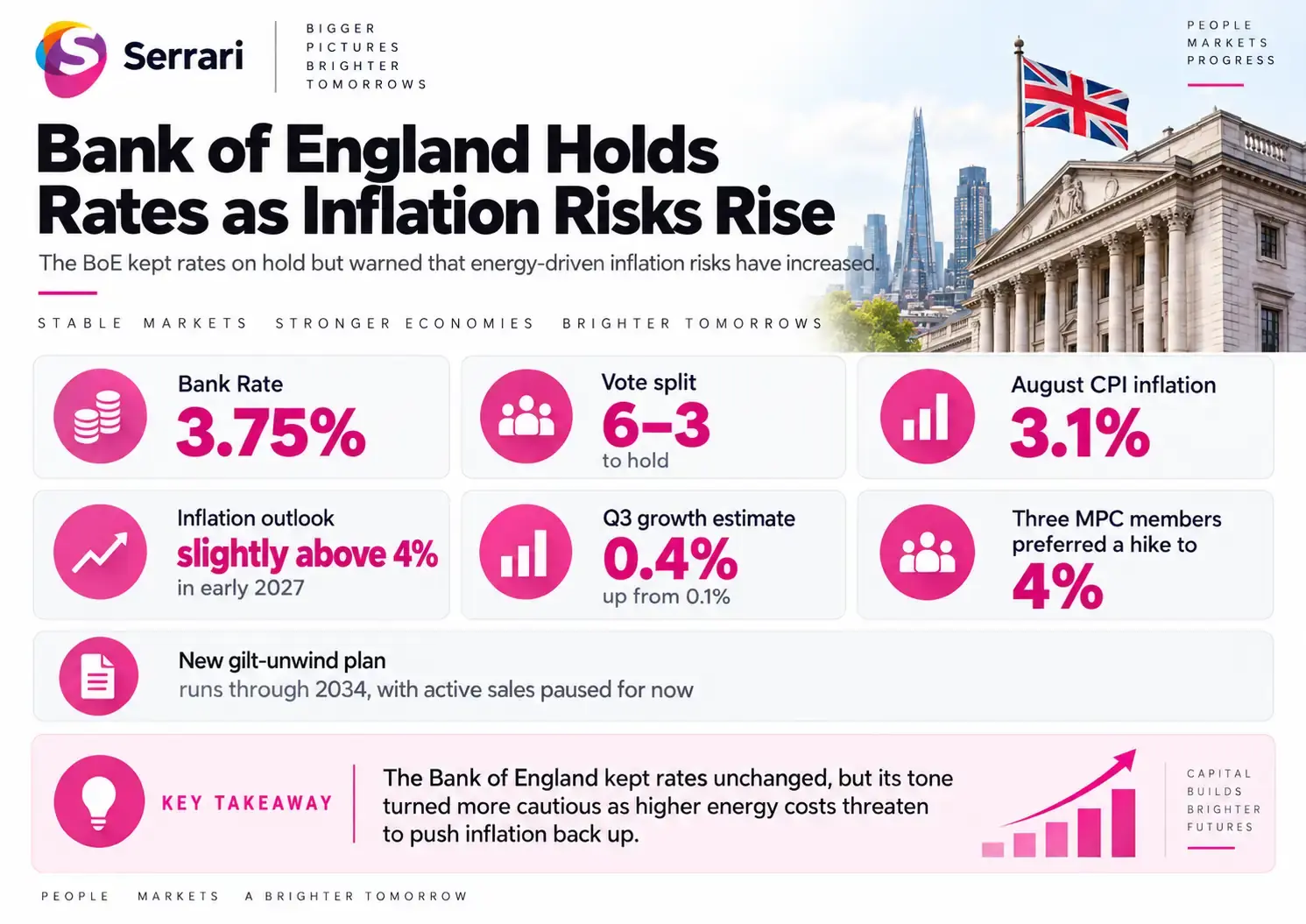
The Bank of England kept Bank Rate unchanged at 3.75% in September 2026 but signalled that persistent energy-price pressure could force tighter monetary policy if inflation becomes more entrenched. The September policy decision was approved by a 6–3 majority, with three Monetary Policy Committee members preferring an immediate quarter-point increase to 4%.
The Bank now expects consumer-price inflation to rise from 3.1% in August to around 3.75% in the fourth quarter of 2026 and slightly above 4% in early 2027. At the same time, it raised its estimate for third-quarter economic growth to 0.4%, showing that activity has held up better than previously expected.
Key Overview
- Bank Rate was held at 3.75% by a 6–3 vote.
- Three MPC members voted to increase the rate to 4%.
- UK CPI inflation was 3.1% in August 2026.
- Inflation is now expected to reach slightly above 4% in early 2027.
- Third-quarter GDP growth is estimated at 0.4%, up from an earlier 0.1% projection.
- The Bank has adopted a new multi-year plan to unwind monetary-policy gilt holdings by 2034.
Energy Shock Pushes Inflation Risks Higher
The Bank said the prolonged conflict in the Middle East has continued to lift global energy costs, increasing the risk that inflation remains above its 2% target for longer. Since the July Monetary Policy Report, Brent crude prices had risen by 36% and UK wholesale gas prices by 78%, according to the latest MPC assessment.
By September 14, Brent crude had reached about $106 a barrel while UK wholesale gas stood at 207 pence per therm. Those increases are already feeding directly into household energy and fuel costs, while the central bank warned that indirect effects through companies’ supply chains could become more visible over coming quarters.
The Bank now projects inflation at roughly 3.75% in the fourth quarter, compared with 3.2% in its July assessment, before moving slightly above 4% in the first quarter of 2027.
Rate Hike Risk Builds Despite September Hold
Governor Andrew Bailey and five other MPC members voted to keep rates unchanged, arguing that restrictive financial conditions and a soft labour market continue to limit domestic inflation pressure. However, the policy minutes make clear that the case for tighter policy could strengthen if high energy prices persist and begin influencing wages and broader price-setting.
Megan Greene, Catherine Mann and Chief Economist Huw Pill voted for an immediate increase to 4%. They argued that the duration of the energy shock, together with potential food-price pressures and other global cost increases, raised the likelihood of stronger second-round inflation effects.
Private-sector regular wage growth stood at about 2.9% in the three months to July, while unemployment was estimated at 4.9%. These figures still point to relatively soft labour-market conditions, which could help contain inflation even as headline prices rise.
Context is everything. Stay ahead of shifting trends with today’s market updates, and uncover emerging opportunities using the Serrari Group Market Index and Marketplace. Then, take control of your own financial future by exploring our Money & Life Reset Transformation Blueprint ™ to build stronger habits, create better systems, and design a path toward lasting wealth.
Economic Growth Proves More Resilient
The inflation warning comes alongside somewhat stronger economic activity. UK GDP expanded by 0.4% in the second quarter, slightly above the Bank’s previous expectation, while monthly output also increased by 0.4% in July.
Bank staff now estimate that the economy could grow by 0.4% in the third quarter, compared with the 0.1% projection published in July. However, higher borrowing costs and elevated energy prices remain headwinds for households and businesses.
Mortgage rates have also risen with broader financial conditions. The Bank noted that quoted two-year fixed mortgage rates were around 95 basis points higher than before the latest Middle East conflict began.
Bank Overhauls Its Gilt-Unwinding Strategy
Alongside the interest-rate decision, policymakers introduced a major change to quantitative tightening. The Bank held about £488 billion of government bonds in its Asset Purchase Facility as of September 16.
Under the new multi-year gilt plan, £120 billion of the longest-dated bonds will be retained to support banknote issuance, while the remaining £368 billion held for monetary-policy purposes is scheduled to be unwound by September 2034.
About £222 billion of those bonds will be allowed to mature naturally. Another £146 billion is intended to be sold at an annualised pace of £20 billion, producing an average annual reduction of about £46 billion when maturities are included.
The Bank has paused its APF gilt auctions while it reviews whether future sales could instead be made to the government through the Debt Management Office. Operational details are due by April 2027.
The September decision therefore leaves interest rates unchanged for now, but the Bank’s language has become more cautious. The direction of policy will depend heavily on whether higher energy costs fade or begin feeding more persistently into wages, consumer prices and inflation expectations.
Sources
Bank of England / Reuters
Your financial future isn’t something you wait for—it’s something you build.
The real question is: when do you begin?
Move beyond simply staying informed.
Navigate the markets with clarity—track trends through the Serrari Group Market Index, uncover opportunities in the Serrari Marketplace, and build practical knowledge with our Curated Wealth Builder Platform.
Stay connected to what truly matters.
Get daily insights on macro trends and financial movements across Kenya, Africa, and global markets—delivered through the Serrari Newsletter.
Growth opens doors.
Advance your career through professional programs including ACCA, HESI A2, ATI TEAS 7 , HESI EXIT , NCLEX – RN and NCLEX – PN, Financial Literacy!🌟—designed to move you forward with confidence.
See where money is flowing—clearly and in real time.
Track Money Market Funds, Treasury Bills, Treasury Bonds, Green Bonds, and Fixed Deposits, alongside global and African indexes, key economic indicators, and the evolving Crypto and stablecoin landscape—all within Serrari’s Market Index.