Oil and gas industry groups have urged the European Union to delay the implementation of its methane emissions regulation, warning that the rules could disrupt energy imports and potentially trigger supply shortages across the bloc.
Industry representatives say the regulation, which introduces strict reporting and verification requirements for methane emissions linked to fossil fuel imports, could make a large share of global oil and gas supplies non-compliant with EU standards when key provisions come into force in 2027.
The concerns have emerged at a time when global energy markets are already facing pressure from geopolitical tensions and supply uncertainties, raising fears that the policy could unintentionally tighten fuel availability in Europe.
Industry groups including FuelsEurope and the International Association of Oil and Gas Producers (IOGP) are calling on EU policymakers to pause the regulation temporarily while amendments and compliance frameworks are clarified.
According to industry representatives, the goal is not to abandon methane reduction efforts but to provide more time for producers and importers to adapt to the new reporting requirements.
Build the future you deserve. Get started with our top-tier Online courses: ACCA, HESI A2, ATI TEAS 7, HESI EXIT, NCLEX-RN, NCLEX-PN, and Financial Literacy. Let Serrari Ed guide your path to success. Enroll today.
EU Methane Regulation: A Major Climate Policy Initiative
The methane regulation forms part of the European Union’s broader climate strategy aimed at reducing greenhouse gas emissions across the energy sector.
Methane is considered one of the most potent greenhouse gases, with a warming potential significantly higher than carbon dioxide over shorter time periods. Although methane remains in the atmosphere for a shorter duration than CO₂, its immediate climate impact is much stronger.
Because of this, reducing methane emissions has become a major focus of global climate policy.
The EU regulation introduces a Monitoring, Reporting and Verification (MRV) system designed to track methane emissions across fossil fuel supply chains.
Under the rules, importers of crude oil, natural gas and coal must provide verified information about methane emissions associated with the production and transport of these fuels.
From that point onward, fossil fuel imports into the EU will need to demonstrate compliance with methane monitoring standards equivalent to those applied within Europe.
Compliance Requirements for Energy Imports
The regulation requires energy importers to demonstrate methane compliance through several mechanisms.
Companies must either provide direct emissions data from upstream producers or present contractual documentation verifying methane emissions throughout the supply chain.
These records must be supported by third-party verification processes that meet EU accreditation standards.
The rules apply to all fossil fuel imports linked to supply contracts signed or renewed after August 4, 2024, effectively ensuring that new energy agreements must include methane reporting provisions.
However, implementing these requirements has proven complex.
Industry studies suggest that only about 7 percent of global oil and gas production currently meets the methane reporting standards required by the EU.
This gap highlights the scale of adjustments that producers worldwide may need to undertake to maintain access to European energy markets.
Industry Warns of Potential Energy Supply Shock
Industry groups warn that strict enforcement of the methane regulation could have major consequences for Europe’s energy supply.
A study commissioned by FuelsEurope and IOGP and conducted by energy consultancy Wood Mackenzie suggests that a significant portion of current energy imports could struggle to meet the new rules.
According to the analysis, as much as:
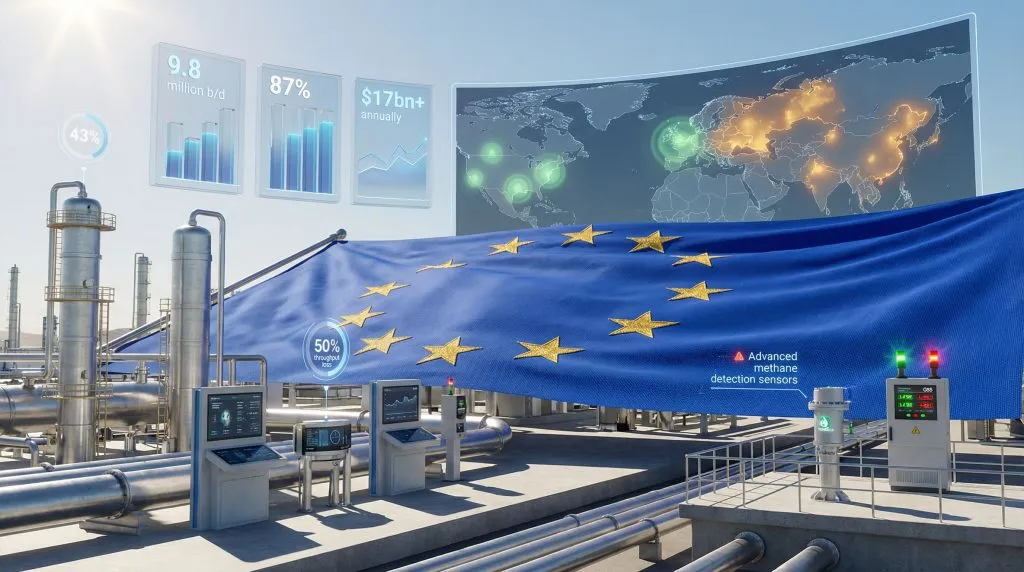
- 43 percent of EU natural gas imports
- 87 percent of EU crude oil imports
could be at risk of failing to comply with the regulation by 2027.
The study estimates that this could expose importers to substantial fines while discouraging producers from shipping fuel to European markets.
Industry representatives say the result could be a self-inflicted supply shock, similar to the disruptions experienced during the 2022 global energy crisis following Russia’s invasion of Ukraine.
Francois-Regis Mouton, Managing Director of IOGP Europe, said policymakers must carefully consider the economic implications.
“The EU cannot afford a self-made regulatory supply shock, especially in the current geopolitical context,” he said.
IOGP members include several of the world’s largest energy companies such as ExxonMobil, Chevron, BP and TotalEnergies.
Potential Impact on European Refineries
One of the most serious concerns raised by industry groups relates to the possible impact on Europe’s refining sector.
According to the Wood Mackenzie study, refinery throughput across the EU could fall by approximately 50 percent between 2027 and 2030 if sufficient volumes of compliant crude oil are not available.
This would represent a decline of roughly 4.6 million barrels per day of refining capacity.
Analysts say such a reduction would be equivalent to closing around 40 European refineries, a scenario that could significantly disrupt fuel supply chains and increase energy costs.
In addition, the study estimates that the regulation could increase Europe’s annual fuel import bill by more than $17 billion.
Natural gas prices could also rise significantly if supply constraints emerge, although analysts note that projected price increases would still remain below the extreme levels recorded during the 2022 energy crisis.
One decision can change your entire career. Take that step with our Online courses in ACCA, HESI A2, ATI TEAS 7, HESI EXIT, NCLEX-RN, NCLEX-PN, and Financial Literacy. Join Serrari Ed and start building your brighter future today
Geopolitical Pressures Add to Energy Market Concerns
The debate over methane regulation comes at a time when energy markets are already facing renewed geopolitical tensions.
Oil and gas prices have risen in recent weeks amid escalating conflict in the Middle East involving the United States, Israel and Iran.
The tensions have raised concerns about possible disruptions to oil shipments through key global trade routes.
European governments are particularly sensitive to energy supply risks following the region’s efforts to reduce dependence on Russian oil and gas imports since 2022.
Today, a large portion of Europe’s fossil fuel imports comes from Norway and the United States, making transatlantic energy trade an important component of the continent’s energy security.
The United States government has reportedly urged the EU to consider exempting U.S. oil and gas from the methane rules, although European officials have so far resisted rolling back the regulation.
Environmental Groups Challenge Industry Claims
While industry groups warn of supply disruptions, environmental organizations have challenged the findings of the Wood Mackenzie study.
Climate advocates argue that many energy companies have already committed to methane reduction initiatives and should be able to meet the EU’s requirements.
The Environmental Defense Fund (EDF) has conducted its own analysis suggesting that supplies meeting high methane-reporting standards could be sufficient to meet European demand.
EDF argues that companies participating in the Oil and Gas Methane Partnership (OGMP) 2.0 Level 5 standard already report methane emissions using robust methodologies that align closely with EU requirements.
According to the organization, gas supplies compliant with the OGMP framework could be more than double the volume needed to meet EU demand by 2027, particularly when including exports from Norway and the United States.
This suggests that while compliance may require adjustments, the regulation may not necessarily cause the severe supply disruptions predicted by industry groups.
Flexible Compliance Options Being Considered
European policymakers have acknowledged industry concerns but maintain that the methane regulation remains a central component of the EU’s climate policy.
The European Commission has emphasized that the regulation includes provisions designed to avoid compromising energy security.
For example, member states are required to ensure that penalties applied under the regulation do not “endanger security of supply.”
In addition, the Commission has indicated that companies may demonstrate compliance using contractual documentation and methane monitoring data, providing some flexibility in meeting reporting requirements.
However, one of the biggest challenges remains the lack of recognized equivalence agreements between the EU and exporting countries.
As of early 2026, no foreign jurisdiction has yet been formally recognized as having methane monitoring standards equivalent to those of the EU.
This lack of international alignment complicates compliance for global producers seeking to continue supplying European markets.
Outlook
The debate over the EU’s methane emissions regulation highlights the complex balance policymakers must strike between climate action and energy security.
Reducing methane emissions is widely regarded as one of the most effective short-term strategies for slowing global warming.
At the same time, Europe remains heavily dependent on imported fossil fuels during the ongoing transition toward cleaner energy systems.
Industry groups argue that without adjustments to the regulation’s implementation timeline, the policy could inadvertently create supply disruptions that drive up fuel prices and strain energy markets.
Environmental organizations, however, maintain that the regulation is both necessary and achievable, particularly as more companies adopt advanced methane monitoring technologies and reporting frameworks.
Over the coming months, European policymakers will likely face increasing pressure to clarify how the rules will be implemented and whether additional flexibility will be introduced.
The outcome of these discussions will play an important role in shaping not only Europe’s energy supply chain but also the global standards governing methane emissions in the oil and gas industry.
Ready to take your career to the next level? Join our Online courses: ACCA, HESI A2, ATI TEAS 7 , HESI EXIT , NCLEX – RN and NCLEX – PN, Financial Literacy!🌟 Dive into a world of opportunities and empower yourself for success. Explore more at Serrari Ed and start your exciting journey today! ✨
Track GDP, Inflation and Central Bank rates for top African markets with Serrari’s comparator tool.
See today’s Treasury bonds and Money market funds movement across financial service providers in Kenya, using Serrari’s comparator tools.
Photo Source: Google
By: Rosemary Wambui
Date : 12th March 2026