
Governor Uba Sani has signed the Kaduna State Climate Change Advisory Board Law, 2026, creating a formal framework for climate action and environmental sustainability across the state. The legislation is part of a broader reform package that also includes new electricity and agricultural laws. The new law is expected to strengthen climate action in Kaduna by supporting climate finance mobilization, integrating climate considerations into development planning, and enhancing the state’s capacity to address environmental and economic challenges linked to climate change.
Key Overview
- Governor Uba Sani signed the Kaduna State Climate Change Advisory Board Law, 2026
- Law establishes a framework for climate action and environmental sustainability
- Supports climate finance mobilization and development planning
- Part of a broader reform package covering energy and agriculture
- Aims to strengthen climate resilience and sustainable development
- Positions Kaduna as a model for subnational climate governance
Governor Uba Sani Signs Landmark Climate Law
Governor Uba Sani has signed into law the Kaduna State Climate Change Advisory Board Law, 2026, marking a significant step in strengthening climate governance and environmental sustainability in Kaduna State.
The legislation was signed alongside the Kaduna State Electricity Law, 2026, and the Kaduna State Agricultural Development Fund (KADFund) Law, 2025, which collectively aim to transform the state’s energy, agricultural and environmental sectors.
According to the Kaduna State Government, the laws provide a comprehensive framework for expanding economic opportunities, strengthening institutions and promoting sustainable development.
However, the Climate Change Advisory Board Law stands out as a major milestone in the state’s efforts to integrate climate considerations into long-term planning and development.
New Framework for Climate Action
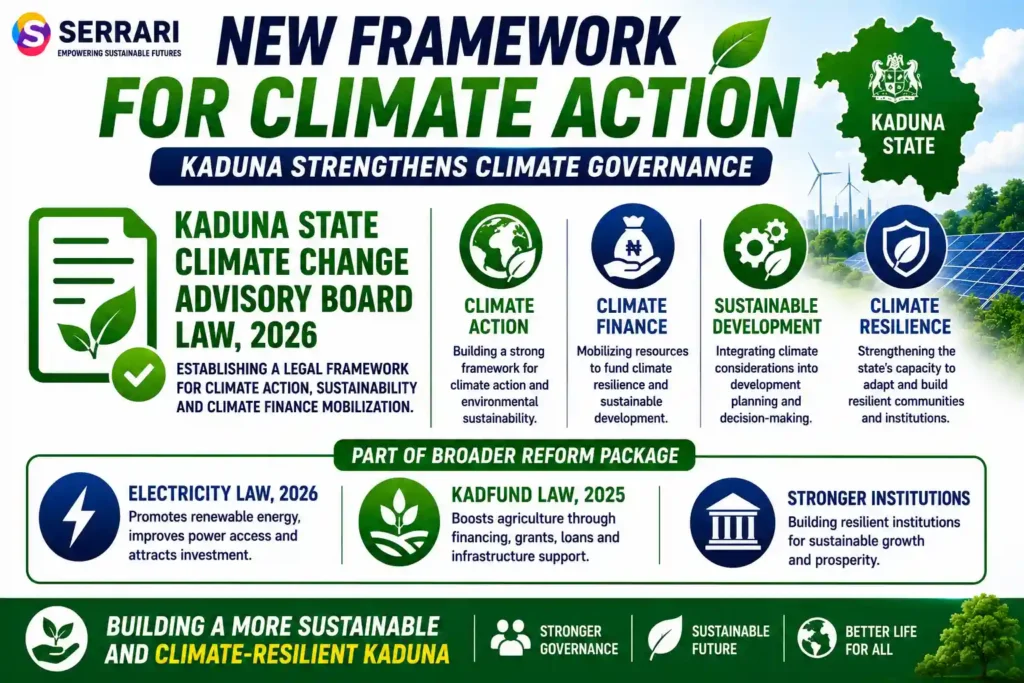
The Kaduna Climate Change Law establishes a state-level framework for climate action, environmental sustainability, climate finance mobilization and the integration of climate priorities into government planning.
Officials said the law is designed to ensure that climate-related considerations become part of decision-making processes across various sectors of the state economy.
Ahmed Maiyaki, Commissioner for Information and Culture, said the legislation reinforces Kaduna State’s commitment to sustainable development while creating the institutional structures needed to address emerging climate challenges.
The law is expected to provide guidance for environmental policies, support adaptation measures and help align development priorities with sustainability objectives.
Supporting Climate Finance and Sustainable Development
One of the most significant elements of the legislation is its focus on mobilizing resources for climate-related initiatives.
The new framework is expected to improve access to climate finance in Kaduna, helping the state attract funding for environmental programs, resilience projects and sustainable infrastructure development.
As climate finance becomes increasingly important for governments worldwide, Kaduna’s decision to establish a dedicated legal framework could improve its ability to access funding opportunities from national and international sources.
Officials believe this approach will help support long-term investments aimed at addressing climate risks while creating new economic opportunities.
Strengthening Climate Resilience
State officials said the legislation is also intended to strengthen climate resilience in Kaduna by creating mechanisms that help communities, institutions and businesses better respond to climate-related risks.
The law forms part of a broader strategy to build resilient institutions capable of supporting sustainable economic growth while protecting environmental resources.
Deputy Chief of Staff on Legal and Legislative Matters, Dr. Mustapha Musa, described the reform package as one of the most transformative governance reform packages introduced by the state government in recent years.
According to Musa, the reforms were designed to expand opportunities, strengthen institutions and drive sustainable development through effective policy frameworks.
Context is everything. Stay ahead of shifting trends with today’s market updates, and uncover emerging opportunities using the Serrari Group Market Index and Marketplace. Then, take control of your own financial future by exploring our Money & Life Reset Transformation Blueprint ™ to build stronger habits, create better systems, and design a path toward lasting wealth.
Part of Broader Governance Reforms
While climate governance remains a key focus, the newly signed legislation was introduced alongside reforms targeting the electricity and agriculture sectors.
The Kaduna State Electricity Law, 2026 establishes the Kaduna State Electricity Regulatory Commission, which will oversee electricity generation, transmission, distribution and supply within the state.
Officials said the law is expected to encourage renewable energy development, improve electricity access and attract private-sector investment.
Meanwhile, the KADFund Law, 2025 creates a dedicated financing mechanism for farmers, cooperatives and agribusinesses through grants, soft loans, technical assistance and infrastructure investments aimed at improving food security and agricultural productivity.
Together, the reforms reflect the administration’s broader vision of building resilient institutions that can support economic growth and improve living standards.
Kaduna Positions Itself as a Sustainability Leader
Government officials believe the new Kaduna climate policy framework will help position the state as a model for innovation, sustainable development and effective subnational governance in Nigeria.
Maiyaki said the legislation reflects Governor Uba Sani’s commitment to creating a prosperous, competitive and environmentally sustainable Kaduna State.
By embedding climate considerations into development planning, the government aims to ensure that future economic growth is aligned with sustainability goals.
The administration also views the law as an important step toward balancing environmental stewardship with economic development priorities.
Outlook
The signing of the Kaduna Climate Change Advisory Board Law, 2026 marks a significant development in Kaduna State’s environmental governance framework. By establishing formal structures for climate action, sustainability planning and climate finance mobilization, Governor Uba Sani has strengthened the state’s ability to address climate challenges while pursuing economic growth.
Combined with reforms in the energy and agricultural sectors, the new legislation signals Kaduna’s intention to build resilient institutions, attract investment and advance sustainable development for future generations.
Sources: Premium Times Nigeria, Channels Television, The Nation Newspaper, 21st CENTURY CHRONICLE, National Accord Newspaper
Your financial future isn’t something you wait for—it’s something you build.
The real question is: when do you begin?
Move beyond simply staying informed.
Navigate the markets with clarity—track trends through the Serrari Group Market Index, uncover opportunities in the Serrari Marketplace, and build practical knowledge with our Curated Wealth Builder Platform.
Stay connected to what truly matters.
Get daily insights on macro trends and financial movements across Kenya, Africa, and global markets—delivered through the Serrari Newsletter.
Growth opens doors.
Advance your career through professional programs including ACCA, HESI A2, ATI TEAS 7 , HESI EXIT , NCLEX – RN and NCLEX – PN, Financial Literacy!🌟—designed to move you forward with confidence.
See where money is flowing—clearly and in real time.
Track Money Market Funds, Treasury Bills, Treasury Bonds, Green Bonds, and Fixed Deposits, alongside global and African indexes, key economic indicators, and the evolving Crypto and stablecoin landscape—all within Serrari’s Market Index.
FAQS
1: What does the Kaduna Climate Change Advisory Board Law, 2026 do?
The law establishes a state-level framework for climate action, environmental sustainability, climate finance mobilization and the integration of climate considerations into development planning across Kaduna State.
2: Why did Governor Uba Sani sign the Kaduna Climate Change Law?
Governor Uba Sani signed the law to strengthen climate governance, improve environmental sustainability, enhance climate resilience and support sustainable economic development through stronger institutions and policies.
3: How will the Kaduna Climate Change Law support climate finance?
The law creates a framework that can help Kaduna State attract and mobilize climate finance for environmental projects, climate adaptation programs, resilience-building initiatives and sustainable infrastructure investments.
4: How does the Kaduna Climate Change Law benefit Kaduna State?
The legislation is expected to improve climate resilience, support sustainable development, attract investment, strengthen environmental stewardship and ensure climate considerations are incorporated into future development plans across the state.