The International Organization for Standardization (ISO) has launched ISO 32212, a new framework designed to help financial institutions develop and implement climate transition plans. The new iso net zero guidelines provide a common framework for banks, insurers, investors, asset managers and lenders to integrate net zero planning into financing decisions, risk management and governance. The standard aims to improve consistency, transparency and accountability while helping financial institutions support global decarbonization and climate resilience goals.
Key Overview
- ISO launched ISO 32212 for financial institutions
- Supports net zero transition planning across finance
- Applies to banks, insurers, investors and asset managers
- Covers governance, risk assessment and reporting
- Supports capital allocation toward decarbonization
- Designed to improve credibility of transition plans
- Could become a global benchmark for climate finance
ISO Introduces New Standard for Climate Transition Planning
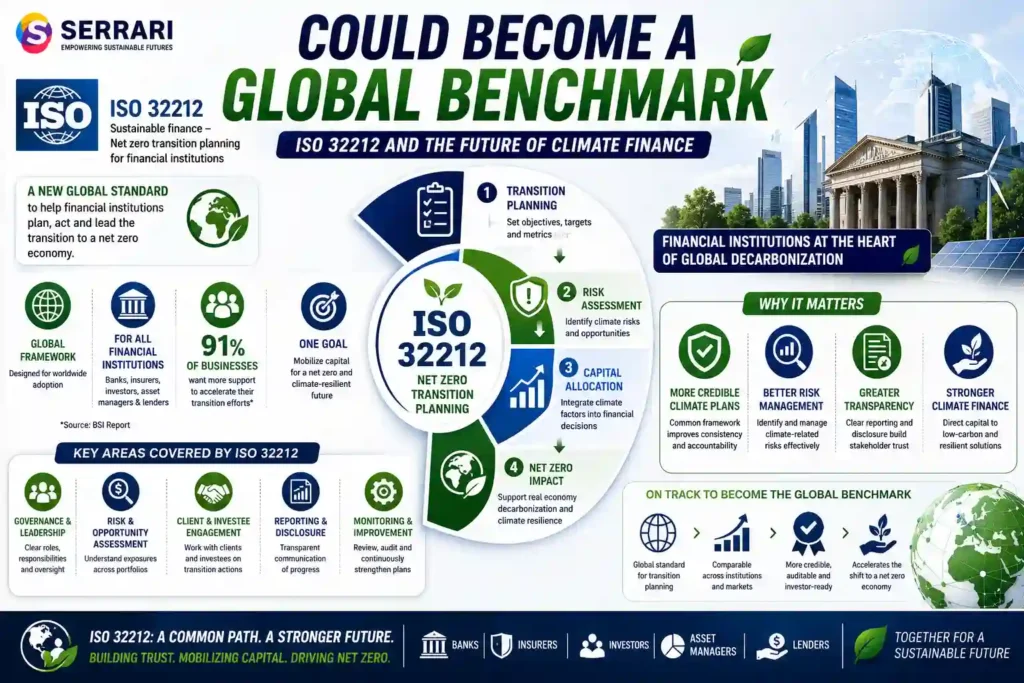
The International Organization for Standardization (ISO) has unveiled ISO 32212, “Sustainable finance — Net zero transition planning for financial institutions,” a new standard aimed at helping financial institutions develop, maintain and integrate climate transition plans into their activities.
According to ISO, the framework provides a common framework to transition planning across lending, insurance, asset management, investment and capital market activities. The organization said financial institutions play a crucial role in advancing the goals of the Paris Agreement because they influence how capital is allocated across the global economy.
“With connections to actors in all sectors of the real economy, financial institutions have an important role to play in advancing the goals of the Paris Agreement,” ISO said in the standard documentation.
By establishing transition planning objectives, targets and governance structures, financial institutions can help clients and investee companies manage climate-related risks while capturing opportunities associated with the shift to a net zero and climate-resilient economy.
Addressing Growing Demand for Clear Guidance
The launch of the new ISO net zero framework comes as transition planning becomes an increasingly important component of climate strategies across the financial sector.
Many banks, insurers and asset managers have announced net zero commitments in recent years. However, questions have remained over how institutions should set targets, measure progress and incorporate climate considerations into lending, investment and engagement decisions.
ISO 32212 seeks to address these challenges by providing structured guidance and requirements that can be applied consistently across financial institutions.
The framework encourages organizations to assess climate-related risks, opportunities and portfolio exposures while integrating transition objectives into broader business strategies and financial decision-making processes.
Key Requirements Under ISO 32212
The standard provides guidance on several critical areas of transition planning.
The net zero guidelines ISO framework covers the assessment of climate-related risks and opportunities, setting transition planning objectives and targets, developing accompanying metrics, and integrating climate considerations into financing and investment decisions.
It also includes recommendations on client and investee engagement, internal communication, external reporting, governance, leadership accountability, performance reviews, internal audits and continuous improvement processes.
ISO said the standard can be used by institutions at all stages of their transition journey, whether they are beginning to develop climate plans or strengthening existing frameworks.
Context is everything. Stay ahead of shifting trends with today’s market updates, and uncover emerging opportunities using the Serrari Group Market Index and Marketplace. Then, take control of your own financial future by exploring our Money & Life Reset Transformation Blueprint ™ to build stronger habits, create better systems, and design a path toward lasting wealth.
Supporting Capital for Decarbonization
A central objective of the standard is to help financial institutions mobilize capital toward decarbonization and climate adaptation activities.
According to ISO, transition planning can help institutions establish policies for lending, investment and insurance activities while supporting clients as they implement climate mitigation and adaptation strategies.
The publication of the net zero ISO framework reflects growing recognition that financial institutions have a significant role in accelerating the transition to a low-carbon economy through their financing decisions.
By identifying climate risks and opportunities early, organizations can strengthen resilience while supporting investment in clean energy, sustainable infrastructure and other low-carbon solutions.
Could Become a Global Benchmark
Experts believe ISO 32212 could become an important reference point for transition planning across the financial sector.
Daan van der Wekken, Head of Sustainability at BSI, ISO’s UK member body, said global frameworks for transition planning are becoming increasingly important as institutions assess credible transition strategies and direct capital toward them.
“The transition across the real economy depends on financial institutions being able to assess credible transition strategies and direct capital towards them,” he said.
The standard arrives as regulators in several jurisdictions, including the United Kingdom, are considering mandatory climate transition planning requirements for large businesses and financial institutions.
Recent research by BSI also found that 91% of businesses want additional support to accelerate their transition efforts, particularly through practical guidance, financial incentives and skills-based assistance.
Supporters argue that widespread adoption of the net zero ISO standard would make climate transition plans more comparable, credible and auditable across different institutions and markets.
Outlook
The launch of ISO 32212 marks a significant step in the evolution of sustainable finance and climate governance. By providing a structured framework for transition planning, the standard aims to help financial institutions move beyond broad climate commitments and embed net zero objectives into everyday decision-making.
As regulators, investors and stakeholders increasingly focus on credible transition plans, ISO 32212 could emerge as a global benchmark for how financial institutions assess climate risks, allocate capital and support the transition to a net zero economy.
Sources: ESG today, OneStop ESG,BSI Group
Your financial future isn’t something you wait for—it’s something you build.
The real question is: when do you begin?
Move beyond simply staying informed.
Navigate the markets with clarity—track trends through the Serrari Group Market Index, uncover opportunities in the Serrari Marketplace, and build practical knowledge with our Curated Wealth Builder Platform.
Stay connected to what truly matters.
Get daily insights on macro trends and financial movements across Kenya, Africa, and global markets—delivered through the Serrari Newsletter.
Growth opens doors.
Advance your career through professional programs including ACCA, HESI A2, ATI TEAS 7 , HESI EXIT , NCLEX – RN and NCLEX – PN, Financial Literacy!🌟—designed to move you forward with confidence.
See where money is flowing—clearly and in real time.
Track Money Market Funds, Treasury Bills, Treasury Bonds, Green Bonds, and Fixed Deposits, alongside global and African indexes, key economic indicators, and the evolving Crypto and stablecoin landscape—all within Serrari’s Market Index.
FAQ
1: What is ISO 32212 and why was it introduced?
ISO 32212 is a new international standard launched by the International Organization for Standardization (ISO) to help financial institutions develop, maintain and implement net zero transition plans. The framework provides guidance for integrating climate objectives into lending, investment, insurance, risk management and governance activities, helping institutions support the transition to a low-carbon economy.
2: Which organizations can use the new ISO net zero guidelines?
The ISO net zero guidelines are designed for a wide range of financial institutions, including banks, insurers, asset managers, asset owners, investors and lenders. The standard can be used by organizations at any stage of their net zero journey, from those developing their first transition plans to institutions seeking to strengthen existing climate strategies.
3: What areas does ISO 32212 cover?
ISO 32212 covers several key aspects of climate transition planning, including climate risk and opportunity assessment, transition targets and metrics, financing and investment decisions, stakeholder engagement, governance, reporting, performance reviews, internal audits and continuous improvement. The goal is to create more credible, transparent and measurable transition plans.
4: How can ISO 32212 help financial institutions achieve net zero goals?
The standard helps financial institutions establish structured transition plans that align climate objectives with business strategy and financial decision-making. By identifying climate-related risks and opportunities, institutions can better allocate capital toward decarbonization and climate adaptation projects while supporting clients and investee companies in their own net zero transitions.
5: Could ISO 32212 become a global standard for climate transition planning?
Yes. Many experts believe ISO 32212 has the potential to become a global benchmark for financial sector transition planning. If widely adopted by regulators, banks, insurers and investors, the standard could create a common framework that makes transition plans more comparable, credible and auditable across different jurisdictions and institution types.
6: How does ISO 32212 support the Paris Agreement?
ISO 32212 supports the goals of the Paris Agreement by helping financial institutions direct capital toward activities that reduce greenhouse gas emissions and strengthen climate resilience. Through improved transition planning, banks, insurers and investors can play a critical role in financing the global shift toward a net zero economy.