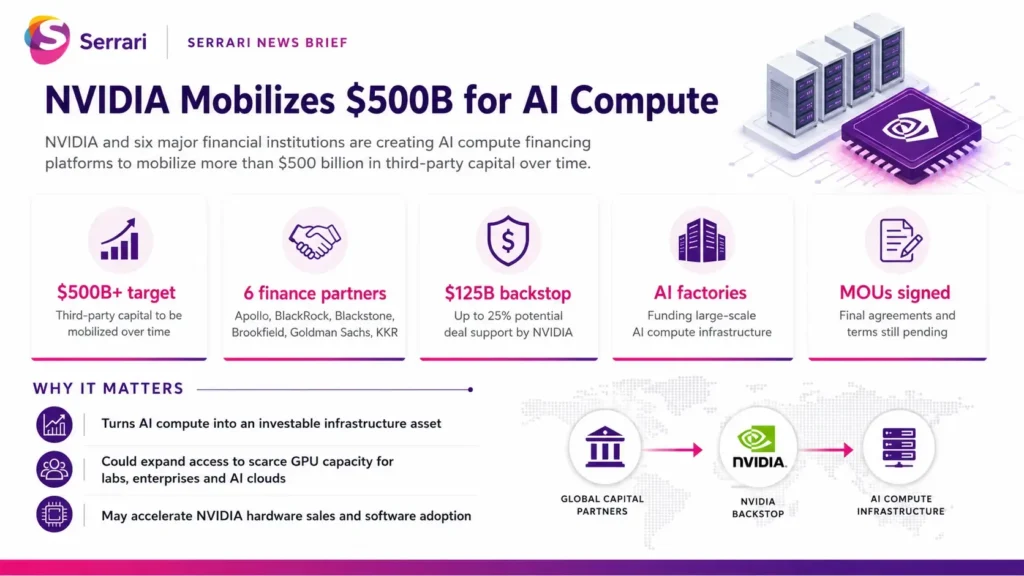
NVIDIA has signed memorandums of understanding with Apollo, BlackRock, Blackstone, Brookfield, Goldman Sachs and KKR to create independent compute-financing platforms designed to mobilize more than $500 billion in third-party capital over time.
The initiative seeks to make NVIDIA-powered AI infrastructure easier to finance for frontier AI labs, enterprises, governments and cloud providers while opening a new infrastructure-style investment opportunity for institutional capital.
Key Overview
- NVIDIA and six major financial institutions plan dedicated financing platforms for AI compute.
- The target is to mobilize more than $500 billion of third-party capital over time, rather than complete a single $500 billion fundraise immediately.
- Financing is intended to support NVIDIA customers seeking large-scale AI infrastructure and AI factories.
- Jensen Huang said NVIDIA has the option to backstop up to $125 billion, equivalent to 25% of potential transactions.
- Financial terms, individual partner commitments and a deployment timetable remain undisclosed, while the partnerships are still subject to final agreements.
Compute Becomes a Financeable Infrastructure Asset
The initiative represents a significant step in the financialization of AI compute. NVIDIA is positioning accelerated computing capacity not simply as technology spending but as productive infrastructure capable of supporting long-duration, usage-linked revenues.
Under the proposed structure, capital providers would independently underwrite infrastructure built around NVIDIA systems while customers gain access to financing at scale. The partners are expected to create dedicated pools of capital that could make funding available to NVIDIA customers at competitive rates.
That model could ease one of the biggest constraints facing AI developers: the enormous upfront cost associated with GPUs, networking equipment, power, cooling and data-centre capacity. Instead of developers and cloud operators carrying the entire capital requirement directly on their balance sheets, institutional investors could finance assets against expected demand for compute.
NVIDIA’s case is that its computing systems have characteristics that could make such financing viable, including broad adoption, transferability between customers and workloads, and continual improvement through its CUDA software ecosystem.
The financing effort also complements NVIDIA’s broader DSX AI factory architecture, which brings together computing, networking, storage, software, power, cooling and operational infrastructure into reference designs for large-scale AI facilities.
Context is everything. Stay ahead of shifting trends with today’s market updates, and uncover emerging opportunities using the Serrari Group Market Index and Marketplace. Then, take control of your own financial future by exploring our Money & Life Reset Transformation Blueprint ™ to build stronger habits, create better systems, and design a path toward lasting wealth.
Wall Street Capital Extends NVIDIA’s AI Ecosystem
The six partners bring different combinations of long-duration capital, infrastructure expertise, private credit and capital-markets distribution.
Apollo has described modern compute as an emerging mission-critical asset, while BlackRock is expanding an existing relationship with NVIDIA through its AI infrastructure activities. Brookfield and Blackstone already have substantial exposure to digital infrastructure, while Goldman Sachs and KKR contribute credit structuring, investment and capital-markets capabilities.
For NVIDIA, the strategic benefit extends beyond simply helping customers secure financing. Easier access to capital can support additional purchases of NVIDIA computing systems while potentially deepening adoption of CUDA and the company’s broader software stack.
The structure therefore creates a mechanism through which institutional capital can indirectly accelerate demand across NVIDIA’s ecosystem: financial institutions fund AI infrastructure, customers gain access to more computing capacity, and NVIDIA potentially sells more hardware and software into those projects.
The scale also reflects the extraordinary capital intensity of the current AI investment cycle. Combined spending by major technology companies is expected to surpass $730 billion in 2026 as companies continue expanding data centres and AI infrastructure.
Building a New Market for Compute-Backed Credit
The initiative could also push AI hardware deeper into credit markets. Goldman Sachs CEO David Solomon said the partnership creates an opportunity to develop a market for credit backed by NVIDIA compute, illustrating how GPUs and the infrastructure surrounding them are increasingly being treated as financeable economic assets.
That represents an evolution from conventional corporate technology financing. Investors would be underwriting assets whose economics depend heavily on utilization rates, customer demand, technological useful life and the revenue generated from AI workloads.
If standardized structures emerge around those economics, compute financing could increasingly resemble established infrastructure financing models used for telecommunications towers, aircraft, power projects and data centres.
However, GPU technology also evolves much faster than many traditional infrastructure assets, meaning investors will have to assess technological obsolescence, residual values, customer concentration and utilization risk alongside conventional credit considerations.
Execution Risks Remain
Despite the headline figure, the initiative remains at an early stage. NVIDIA and its partners have signed MOUs, but individual institutions have not publicly disclosed how much capital they will contribute or precisely how quickly the targeted $500 billion-plus could be deployed.
Independent reporting confirms that financial terms and deployment timing were not disclosed, meaning the headline target should not be interpreted as $500 billion of immediately committed capital.
Huang’s statement that NVIDIA could backstop as much as $125 billion is also significant. Such support could strengthen the economics of future financing structures and encourage third-party participation, but it would also make the extent of NVIDIA’s eventual exposure an important consideration for investors.
The companies have additionally stressed that the partnerships remain subject to final agreements, leaving their eventual structure dependent on negotiations and execution.
If implemented at scale, the platforms could accelerate the transformation of AI compute from a corporate technology expense into a recognizable infrastructure and credit asset class. More broadly, NVIDIA is attempting to connect booming demand for its computing systems directly with some of the world’s deepest pools of institutional capital — potentially creating a new financing layer for the global AI buildout.
Sources: NVIDIA Newsroom / Reuters / The Wall Street Journal / Goldman Sachs Asset Management
Your financial future isn’t something you wait for—it’s something you build.
The real question is: when do you begin?
Move beyond simply staying informed.
Navigate the markets with clarity—track trends through the Serrari Group Market Index, uncover opportunities in the Serrari Marketplace, and build practical knowledge with our Curated Wealth Builder Platform.
Stay connected to what truly matters.
Get daily insights on macro trends and financial movements across Kenya, Africa, and global markets—delivered through the Serrari Newsletter.
Growth opens doors.
Advance your career through professional programs including ACCA, HESI A2, ATI TEAS 7 , HESI EXIT , NCLEX – RN and NCLEX – PN, Financial Literacy!🌟—designed to move you forward with confidence.
See where money is flowing—clearly and in real time.
Track Money Market Funds, Treasury Bills, Treasury Bonds, Green Bonds, and Fixed Deposits, alongside global and African indexes, key economic indicators, and the evolving Crypto and stablecoin landscape—all within Serrari’s Market Index.