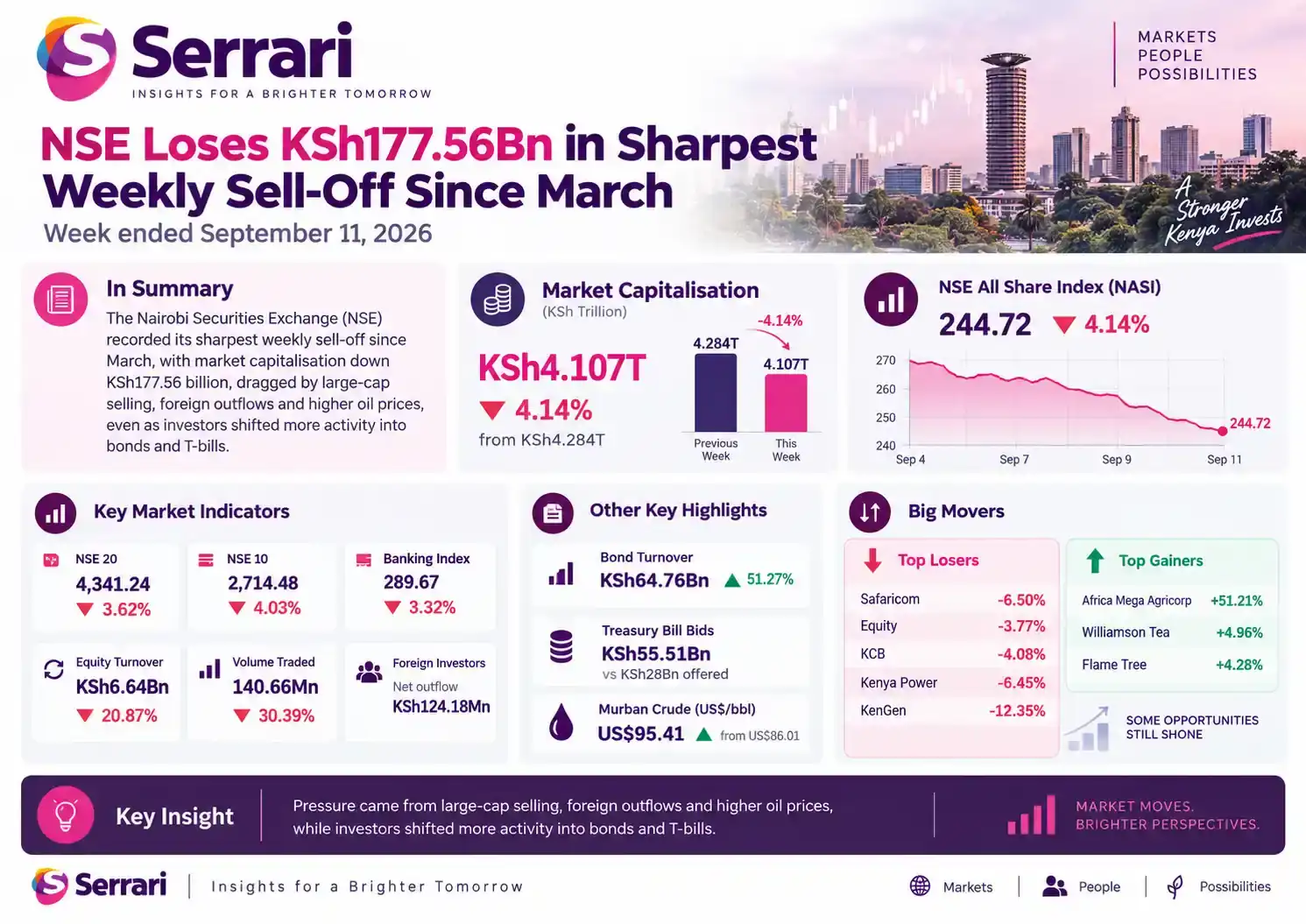
The Nairobi Securities Exchange (NSE) recorded its steepest weekly decline since March in the week ended September 11, with market capitalisation falling 4.14% to KSh4.107 trillion from KSh4.284 trillion. The KSh177.56 billion loss reversed much of the previous week’s advance as selling spread across telecommunications, banking and energy counters.
LIVENSE market summarySee NSE data →The correction came as global oil prices climbed sharply and foreign investors remained net sellers, although the pace of foreign outflows slowed. At the same time, activity strengthened in government securities, bonds and derivatives as investors shifted more capital toward fixed-income instruments.
Key Overview
- Market capitalisation fell 4.14% to KSh4.107 trillion, wiping out KSh177.56 billion in one week.
- The NASI dropped 4.14% to 244.72, while the NSE 20 declined 3.62% and the NSE 10 lost 4.03%.
- Safaricom, Equity Group, KCB, Kenya Power and KenGen were among the major counters that fell during the week.
- Foreign investors recorded a KSh124.18 million net outflow, substantially below the previous week’s KSh1.49 billion.
- Treasury bills attracted KSh55.51 billion in bids against KSh28 billion offered, equivalent to a 198.24% performance rate.
- Murban crude rose from US$86.01 to US$95.41 per barrel, increasing Kenya’s exposure to higher imported energy costs.
Large Caps Drive the Market Lower
The weekly decline was led by several of the exchange’s largest counters. Safaricom fell 6.50% to KSh35.20, Equity Group declined 3.77% to KSh102.00, KCB Group lost 4.08% to KSh94.00 and Diamond Trust Bank fell 3.76% to KSh185.25.
Energy stocks were also under pressure. Kenya Power declined 6.45% to KSh22.45, while KenGen dropped 12.35% to KSh11.00. The broader sell-off pushed NASI down 4.14% to 244.72, with the NSE 20 closing at 4,341.24 and the NSE 10 at 2,714.48.
The fall was smaller than the March market shock (Kenyan Wall Street), when KSh231.17 billion was erased during the week ended March 27. That earlier decline pushed market capitalisation down 6.66%, making the September move the steepest weekly setback since then.
Context is everything. Stay ahead of shifting trends with today’s market updates, and uncover emerging opportunities using the Serrari Group Market Index and Marketplace. Then, take control of your own financial future by exploring our Money & Life Reset Transformation Blueprint ™ to build stronger habits, create better systems, and design a path toward lasting wealth.
Turnover Falls as Banks Dominate Trading
Equity turnover declined 20.87% to KSh6.64 billion, while traded volume dropped 30.39% to 140.66 million shares. Banks accounted for 70.44% of weekly equity turnover, highlighting how strongly trading remained concentrated in financial stocks.
Equity Group generated KSh2.59 billion, or 39.07% of total turnover. Safaricom contributed 15.49%, followed by KCB at 9.60%, Diamond Trust Bank at 8.82% and EABL at 3.21%. Together, the five counters represented more than three-quarters of weekly turnover.
Not every counter declined. Africa Mega Agricorp surged 51.21% to KSh327.75 (MarketScreener), while Williamson Tea, Flame Tree, TPS Serena and East African Portland Cement also advanced. Uchumi, Standard Group, KenGen, Unga and Longhorn were among the week’s largest decliners.
Foreign Selling Eases as Fixed Income Activity Rises
Foreign investors remained net sellers for a third consecutive week, but net selling slowed to KSh124.18 million (TwStalker) from KSh1.49 billion in the previous week. Foreign purchases reached KSh1.86 billion against sales of KSh1.98 billion, while local investors accounted for 71.05% of turnover.
Capital also shifted toward fixed-income and derivatives markets. Bond turnover increased 51.27% to KSh64.76 billion, while derivatives contracts rose to 16,638.
LIVENSE market summarySee NSE data →Demand for government paper remained strong. Treasury bill bids totalled KSh55.51 billion (Central Bank of Kenya) against KSh28 billion offered. Accepted-bid rates eased to 8.7674% for the 91-day bill, 8.9296% for the 182-day bill and 9.0665% for the 364-day bill.
Oil Prices Add a New External Risk
Kenya’s shilling remained relatively stable at KSh129.45 to the US dollar on September 10, compared with KSh129.48 a week earlier. Foreign exchange reserves increased to US$15.253 billion from US$14.882 billion, lifting import cover to 6.3 months from 6.1 months.
The more immediate external pressure came from energy prices. Murban crude climbed 10.9% to US$95.41 per barrel from US$86.01. For a net fuel importer such as Kenya, sustained higher oil prices can raise the import bill, put pressure on transport and production costs and complicate the inflation outlook.
The combination of falling large-cap equities, continued foreign selling and rising oil prices leaves investors watching whether the September decline develops into a deeper correction or stabilises after the sharp weekly repricing.
Sources: The Kenyan Wallstreet / Central Bank of Kenya / MarketScreener / Business.co.ke / Faida Investment Bank
Your financial future isn’t something you wait for—it’s something you build.
The real question is: when do you begin?
Move beyond simply staying informed.
Navigate the markets with clarity—track trends through the Serrari Group Market Index, uncover opportunities in the Serrari Marketplace, and build practical knowledge with our Curated Wealth Builder Platform.
Stay connected to what truly matters.
Get daily insights on macro trends and financial movements across Kenya, Africa, and global markets—delivered through the Serrari Newsletter.
Growth opens doors.
Advance your career through professional programs including ACCA, HESI A2, ATI TEAS 7 , HESI EXIT , NCLEX – RN and NCLEX – PN, Financial Literacy!🌟—designed to move you forward with confidence.
See where money is flowing—clearly and in real time.
Track Money Market Funds, Treasury Bills, Treasury Bonds, Green Bonds, and Fixed Deposits, alongside global and African indexes, key economic indicators, and the evolving Crypto and stablecoin landscape—all within Serrari’s Market Index.