Nine countries have committed to supporting a new multilateral defence bank designed to expand access to lower-cost financing for military production and security-related projects.
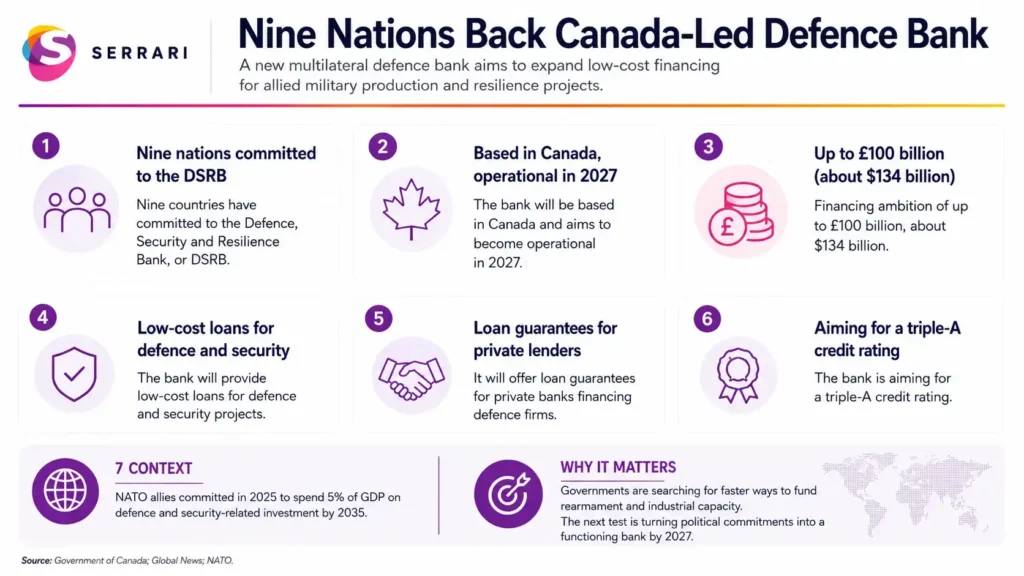
Canada, Albania, Belgium, Greece, Latvia, Luxembourg, Romania, Turkey and Ukraine have backed the proposed Defence, Security and Resilience Bank, known as the DSRB. The institution is expected to be headquartered in Canada and aims to become operational in 2027.
The new commitment gives the project enough political support to move closer to launch, although the absence of other major G7 economies may initially limit its financial reach.
Key Overview
- Nine countries have committed to supporting the DSRB.
- Canada will host the proposed multilateral bank.
- The institution aims to raise up to £100 billion, about $134 billion.
- The bank is targeting operational launch in 2027.
- It plans to provide low-cost loans and guarantees for private-bank financing.
- Membership remains open to additional countries.
- The bank is seeking a triple-A credit rating.
Nine Countries Give the Bank Political Momentum
The commitment was announced during the NATO summit in Ankara, where Canada confirmed that eight other countries had joined the initiative.
The supporting group includes Albania, Belgium, Greece, Latvia, Luxembourg, Romania, Turkey and Ukraine alongside Canada. Participating governments have been invited to complete domestic ratification processes before the planned launch.
The founding group does not yet include another G7 economy, but Canada has said the institution remains open to further members.
That matters because the bank’s eventual lending power will depend partly on the number and financial strength of participating governments.
Canada had been seeking about 10 national backers before the NATO summit, meaning the nine-country commitment fell slightly short of the initial target but still gives the project a workable base from which to expand.
Aiming for £100 Billion in Defence Financing
The proposed institution is designed to raise as much as £100 billion, equivalent to about $134 billion, to support defence and security investment.
The bank would seek a triple-A credit rating, allowing it to borrow at comparatively low cost and pass cheaper financing on to governments, defence companies and eligible projects.
The financing model is particularly aimed at countries and businesses that struggle to secure affordable capital despite rising demand for defence production.
Small and medium-sized companies are expected to be an important part of the bank’s target market because many defence suppliers face long procurement cycles, large upfront investment requirements and limited access to conventional financing.
Loan Guarantees Could Draw in Private Banks
The DSRB is not intended to rely only on direct lending.
It also plans to provide loan guarantees to commercial banks that finance defence companies and industrial expansion. That structure could encourage more private lenders to support projects that they might otherwise consider too risky.
The model is intended to help companies increase production of equipment, components and other strategic capabilities at a time when allied governments are demanding faster industrial expansion.
Several major financial institutions have already supported the broader initiative, including JPMorgan, Deutsche Bank, Commerzbank and ING, together with Canadian banks such as RBC, BMO, CIBC, National Bank of Canada, Scotiabank and TD Bank.
Their participation does not mean the institutions are founding government members, but it signals private-sector interest in a financial structure that could reduce lending risk.
Context is everything. Stay ahead of shifting trends with today’s market updates, and uncover emerging opportunities using the Serrari Group Market Index and Marketplace. Then, take control of your own financial future by exploring our Money & Life Reset Transformation Blueprint ™ to build stronger habits, create better systems, and design a path toward lasting wealth.
Pressure Builds to Expand Defence Production
The bank is emerging as NATO members and allied countries seek to increase military production following Russia’s full-scale invasion of Ukraine and wider concerns about long-term security competition.
A group of former NATO advisers, senior former military officials and bankers first proposed the institution in 2024.
Since then, governments have faced pressure to expand ammunition production, rebuild stockpiles and strengthen industrial capacity.
The urgency increased after NATO allies adopted a new spending commitment in 2025 to invest 5% of GDP annually in defence and security-related areas by 2035.
That commitment includes at least 3.5% of GDP for core defence requirements and up to 1.5% for related areas such as infrastructure, resilience and defence industry development.
Bigger European Powers Remain Cautious
The project still faces a major challenge in attracting larger European economies.
Britain and Germany had previously kept their distance from the initiative. However, Britain has since indicated that it is working more closely with Canada on the DSRB while also promoting its own separate multilateral defence financing mechanism.
The UK-backed initiative has attracted support from the Netherlands, Finland and Poland, creating the possibility that multiple international defence financing structures could operate alongside one another.
The competing funding initiatives show how quickly governments are experimenting with new ways to mobilise public and private capital for defence.
The 2027 Launch Now Becomes the Main Test
The DSRB has moved from concept toward a formal multilateral project, but significant work remains.
Participating countries must complete domestic approvals, agree governance structures and provide the capital needed to support the institution’s creditworthiness.
The bank must also demonstrate that it can achieve its intended triple-A rating and attract additional members.
For Canada, the nine-country commitment provides an early diplomatic success. For the wider defence industry, the bigger question is whether the proposed bank can reduce borrowing costs and unlock enough capital to meaningfully expand production.
The next test will be turning political commitments into a functioning financial institution by 2027.
Sources: Reuters / Government of Canada / NATO
Your financial future isn’t something you wait for—it’s something you build.
The real question is: when do you begin?
Move beyond simply staying informed.
Navigate the markets with clarity—track trends through the Serrari Group Market Index, uncover opportunities in the Serrari Marketplace, and build practical knowledge with our Curated Wealth Builder Platform.
Stay connected to what truly matters.
Get daily insights on macro trends and financial movements across Kenya, Africa, and global markets—delivered through the Serrari Newsletter.
Growth opens doors.
Advance your career through professional programs including ACCA, HESI A2, ATI TEAS 7 , HESI EXIT , NCLEX – RN and NCLEX – PN, Financial Literacy!🌟—designed to move you forward with confidence.
See where money is flowing—clearly and in real time.
Track Money Market Funds, Treasury Bills, Treasury Bonds, Green Bonds, and Fixed Deposits, alongside global and African indexes, key economic indicators, and the evolving Crypto and stablecoin landscape—all within Serrari’s Market Index.